Kieu Tran Creates Ceramic Self-Portraits of an Inner Life
Featured Artist Kieu Tran makes ceramic sculptures that are, at their core, self-portraits. "I'm not trying to represent how I look, but how it feels to exist in my body at a particular moment in time," she says.
Her elegant, sensuous, biomorphic pieces exist somewhere between the abstract and the figurative. In her work, Tran strives to give expression to emotion, to allow the aesthetic of the form to hint at the inspiration behind the piece on a wordless, instinctual, and emotional level.
As a first-generation Vietnamese American immigrant, she draws from her personal experience of immigration, identity, and belonging. But those emotions, once extracted, surpass the specificity of her history alone, and instead give form to the human soul, reminding us of our shared humanity.
Within this framework, clay emerges as her chosen medium—a material that, as the artist puts it, "allows a profound, wordless conversation akin to the soul." Built hollow through coil, pinch, and slab techniques, each piece bears the fingerprints of the hands that shaped it, deliberately infused with a specific emotional state, then sealed: a physical record of inner life given permanent form.
Delving into the depths of her subconscious, Kieu Tran hopes to inspire others to embark on a similar journey of self-discovery, fostering a realization of our shared universal connection.
Artwork Archive featured Kieu Tran back in 2022. Four years later, with a new baby, fragmented studio time, and a textile practice still taking shape, the question driving her work remains the same as it's always been: how does a physical object become a record of an internal state?
Here's where her practice stands now.
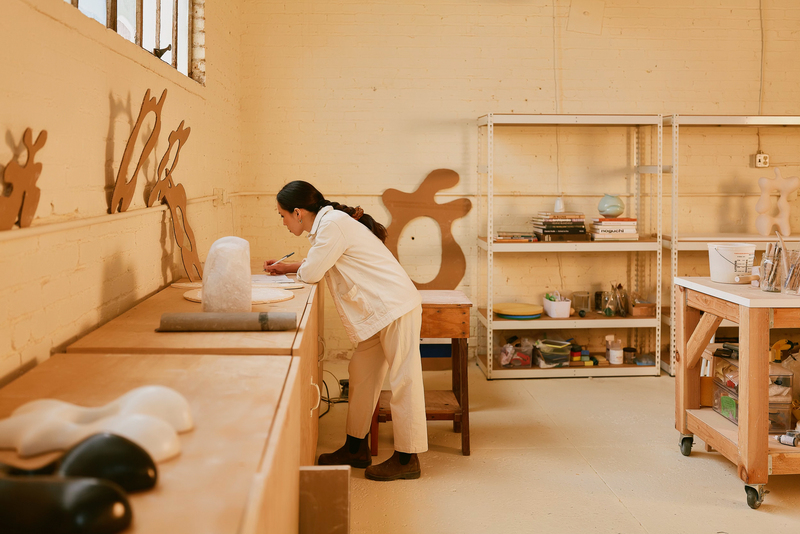
Kieu Tran at work in her studio, sketching alongside ceramic sculptures and wooden cut-out forms lining the walls. Photo courtesy of the artist
Building Ceramic Sculpture Through Intuition and Surrender
Before the clay, before the hollowing or the coiling or the pinching,Tran's process starts as a feeling somewhere in her body, unattached to any words. "I spend time sitting with that," she says. Through meditation, or simply by paying close attention, she locates where that unresolved state physically lives — chest, stomach, throat — until it becomes specific enough to carry into her work.
When she does begin a piece, there's no fixed form she's working toward. She builds slowly, intuitively, through repetition and touch, letting each figure emerge on its own. "The material holds memory," she notes, "so each gesture becomes a record of a specific moment or state."
Tran describes her process as anchored in meditation, surrender, and self-examination. But surrender, she admits, is the most difficult to access. "It's easy to default to control," the artist acknowledges, "to try to make something 'work' instead of allowing it to unfold. But that usually leads to pieces that feel resolved on the surface but not internally." When she catches herself there, she takes a beat. "Sometimes that means stepping away, and sometimes it means continuing without expectation of outcome. I've learned that consistency doesn't come from forcing a state, but from returning to the practice, even when it feels uncertain."
When surrender is accessible, Tran notices the work moves of its own weight, giving back things she hadn't consciously placed there. "It starts to reveal something back to me that I didn't consciously intend." It's here in the "middle space", when she's no longer trying to control the outcome, that she returns to most.
Finishing any given piece arrives the same way, as a recognition instead of a conscious decision. "There's a point where the piece begins to feel unfamiliar to me," she explains, "like it has its own internal logic, when the work has reached a kind of stillness. That's usually when I know I'm close."
Why She Calls Her Sculptures Self-Portraits
There's no face, no likeness, no autobiographical, identifiable detail rendered in clay. Yet, Kieu Tran calls her sculptures self-portraits.
"They're self-portraits not in a literal sense, but in how they hold internal states.
I'm not trying to represent how I look, but how it feels to exist in my body at a particular moment in time."
Each piece emerges from a specific emotional or psychological condition, often one built around contradiction. "The forms carry tension between opposing forces: expansion and contraction, softness and resistance, isolation and connection."
She builds each sculpture hollow, coil by coil, inflating the cavity with her emotions and thoughts before sealing it shut. What's inside stays inside. What the surface holds is the record of how it got there: every gesture, every repetition, every point where her hands met the clay in a particular emotional state. "Because the work is built through touch and repetition, it becomes a physical imprint of that state."
"They feel like records of being rather than images," Tran continues, "which is what makes them self-portraits to me." A portrait of a person at a particular moment, from the inside out.
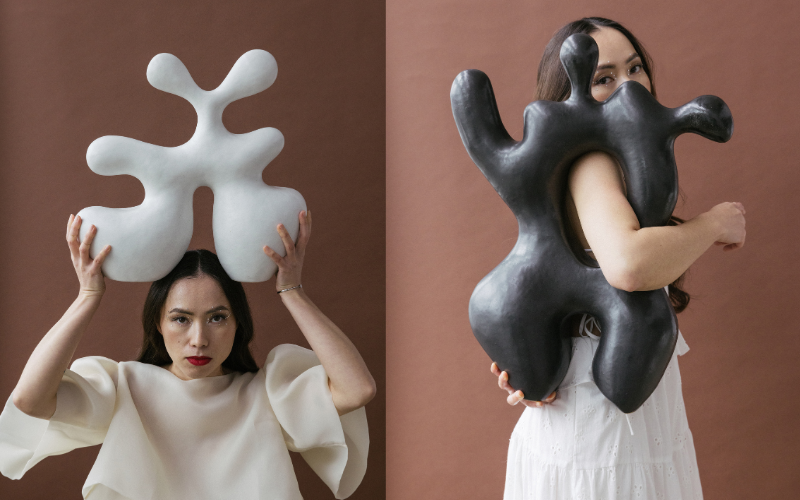
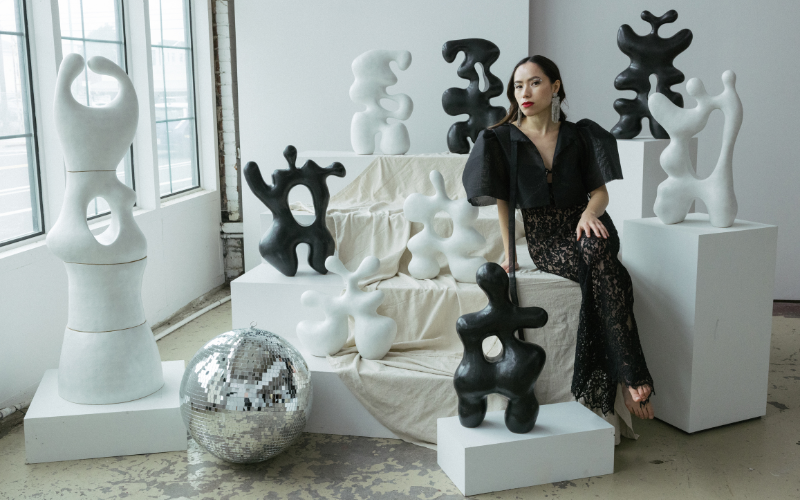
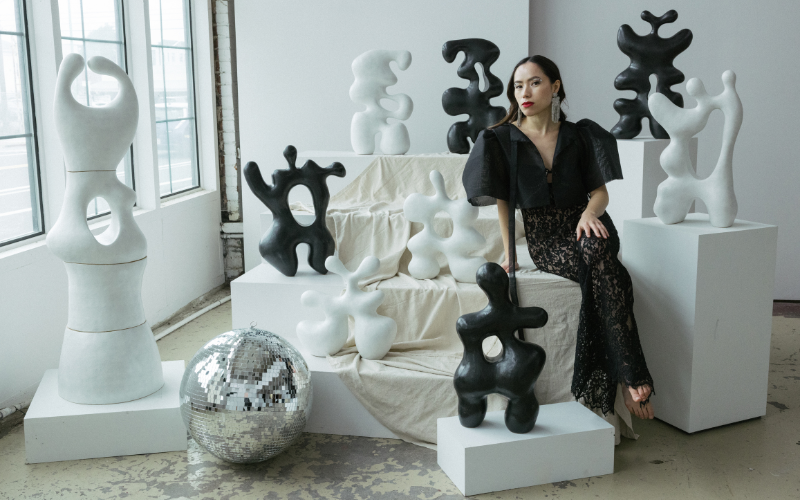
Kieu Tran posing with two of her organic-form ceramic sculptures in white and black. Photo courtesy of the artist
The Connection Between Clay, Memory, and Identity
As a first-generation Vietnamese-American, Tran draws from her own experience of immigration, identity, and belonging. The emotional territory her sculptures inhabit thought, expands beyond her story alone. The forms reach toward finding common ground: the texture of our inner lives, the shape of shared human experience.
Clay is what makes this possible—what she calls "a material that allows a profound, wordless conversation akin to the soul." The surface holds time in a way you can see. Where pressure was applied, where something was compressed, where something gave way: all of it visible. "That accumulation is what gives the work its emotional weight." Without it, a form might look like her work, but it wouldn't feel like it.
Recently, the artist has been moving into textile-based work. "Stitching and layering fiber carries its own rhythm of repetition and touch, holding time in a quieter way, but still maintaining a sense of intimacy." Still early in that process, the question she's sitting with is this: can fiber hold the same emotional density as clay? Can it carry, in her words, "the same weight of memory and internal states?"
"It feels like an extension of the same questions, just approached through a different language, and I’m curious to see where it leads."
💡Artwork Archive Tip: Tracking a Practice That Spans Multiple Mediums
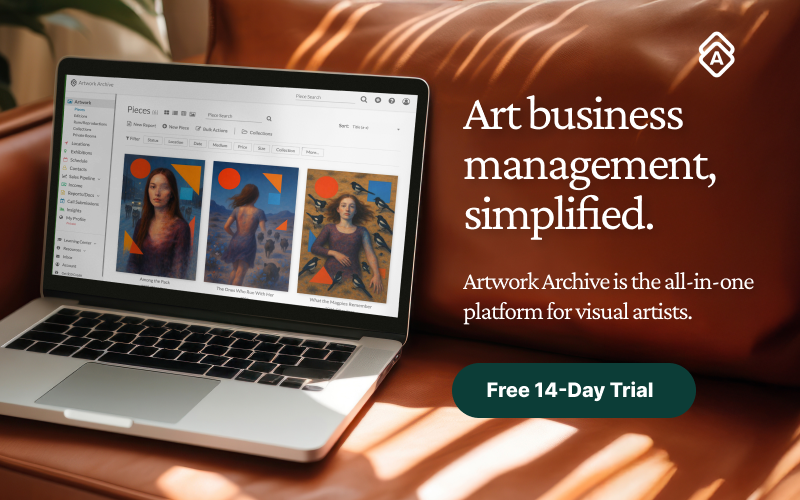
When your work spans ceramics, textiles, or any combination of materials, a single organized inventory keeps the whole practice visible — to you, to galleries, and to collectors.
Filter by medium to isolate a specific body of work, or use collections to group pieces across series, projects, or exhibitions.
See all the way you can sort & filter your work and create collections.
How Parenthood Changes an Artist’s Studio Practice
Since we last featured Kieu Tran in 2022, the most significant change in her practice has had nothing to do with clay. "Becoming a parent has fragmented my time and attention in a very real way," she reflects. "My practice no longer happens in long, uninterrupted stretches, but in shorter, more dispersed moments."
She's still working out what this means and learning what a sustainable rhythm looks like now. What she's found so far: "It's made the work feel more specific, but also more expansive."
That same renegotiation runs through how she thinks about the business side of being an artist. "Treat your practice as something serious before you feel ready to," she advises. Don't wait for external markers of success before building the structures that support the work. Don't wait to document carefully, to organize deliberately, to speak about what you make with clarity. "Taking your work seriously is what allows it to develop depth," she says. "Those structures aren't separate from the work — they shape how it evolves and how others encounter it."
The hardest lesson she's had to learn firsthand? Taxes. "It's one of those things that becomes unavoidable as your practice grows, but isn't often explained early on in a clear way." Tracking everything properly has been an ongoing process, and Artwork Archive, she notes, has helped make the financial side of practice feel a bit more manageable rather than something she has to brace for.
💡 Artwork Archive Tip: Keeping Income and Expenses in One Place Year-Round
The artists who find tax season least painful are the ones who log income and expenses throughout the year rather than reconstructing them in April. Artwork Archive's income and expense tracking feature lets you record sales, fees, and costs as they happen, so your financial picture stays current without requiring a separate system.
Start tracking your art business finances in Artwork Archive
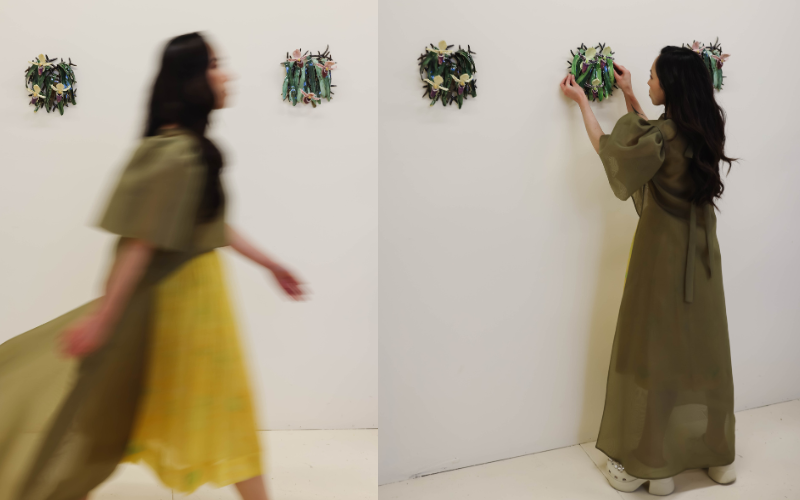
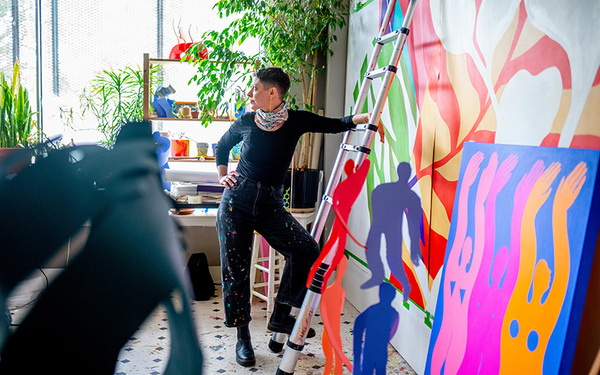
Kieu Tran installing her floral wall sculptures in a gallery space. Photo courtesy of the artist
Building a Complete Record of Your Art Practice
Kieu Tran came to Artwork Archive years ago. It matched how she already thinks about her work: as something that moves through the world, that lives in different contexts, that accumulates a history. Centralizing inventory, provenance, exhibition records, and location data in one place means she can track a work's full life and respond to opportunities, she notes, "without starting from scratch."
The feature she relies on most is detailed, work-specific record-keeping: installation images, exhibition history, current location. When a show is being prepared or an inquiry comes in, everything is in reach. The practical value is real. But what she points to as most meaningful is the view it creates over time. "It allows me to see the work as a whole," she points out, "how pieces relate across time and how the practice has evolved."
"It's become an essential part of maintaining continuity in my practice."
💡 Artwork Archive Tip: A Work's Record Doesn't End at the Sale
Where a piece has been shown, who has owned it, how it was installed — all that context is part of what gives a work its history and value. Artwork Archive lets you build a complete record for each piece: exhibition history, provenance, installation images, and current location, all in one place. The longer you keep it, the more it gives back.
What Emerging Artists Should Know About Building an Art Career
For artists at the beginning of their careers, Kieu Tran has three pieces of advice. First: "Stay close to what feels necessary for you to make." Second: "Invest early in clear, professional documentation."
And third: "Remember that artists don’t exist in isolation."
"The art world is an ecosystem, and it only functions through mutual support." Find a small group of artists, galleries, or institutions you genuinely believe in. Engage with them consistently and sincerely. "Contributing to that network with real care," she believes, "is part of sustaining both a practice and the world around it."
Kieu Tran's work begins in her body. It moves through her hands. It passes into the world. What has guided all of it is the belief that what is hardest to articulate is worth giving form to.
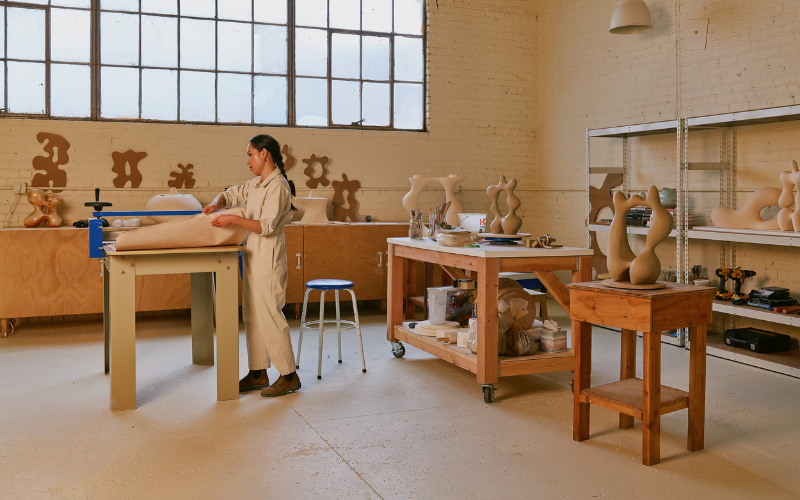
Kieu Tran working in her studio surrounded by ceramic sculptures and clay works in progress. Photo courtesy of the artist
No matter what season of your art career you're in, getting serious about your art career doesn’t need to feel overwhelming. A bit of structure now can mean more time and headspace for the work you actually want to be doing.
Artwork Archive helps artists build an online portfolio, stay on top of their inventory, and create things like tear sheets and invoices in just a few clicks. Start a free trial and see how it fits into your own process.