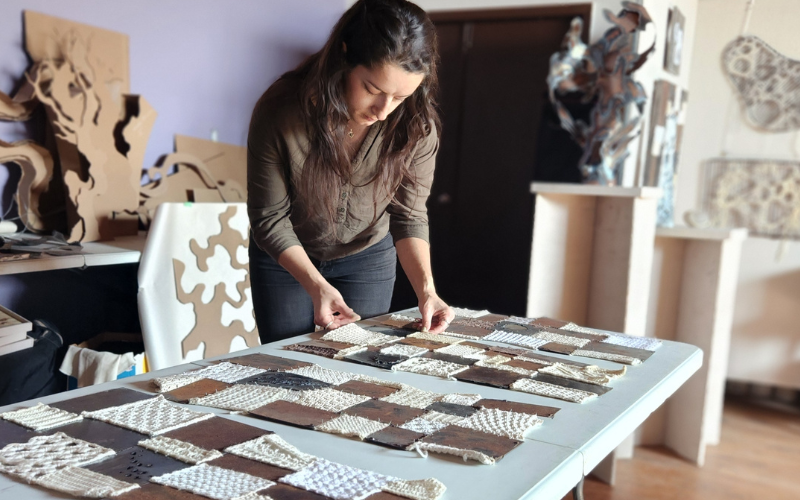
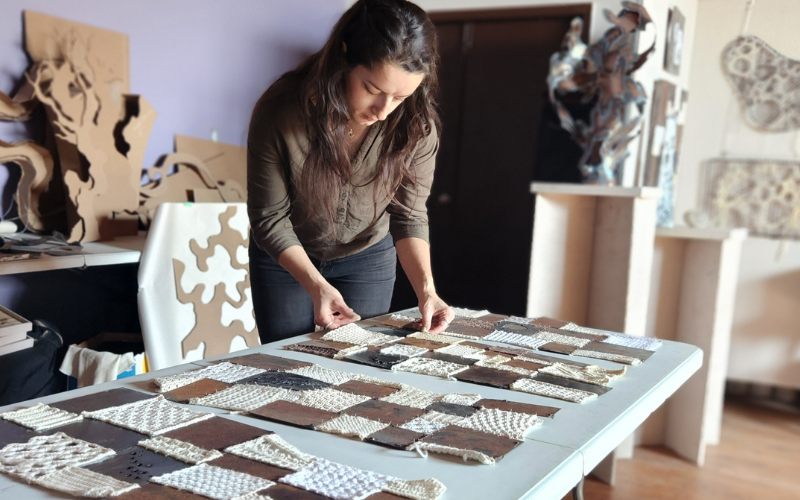
Amanda Langer arranges steel and fiber samples across her studio table. Photo courtesy of the artist.
Using Contrasting Materials to Create Contemporary Sculpture
Artwork Archive’s Featured Artist Amanda Langer works at the intersection of materials that seem, at first, incompatible.
Langer is a sculptor whose work lives at the collision point of two materials that, by all rights, have no business getting along. Steel makes scissors. Scissors cut yarn. And yet, in her hands, those opposites become collaborators, each one lending qualities to the other, each one becoming something it couldn't be alone.
Amanda’s work draws from the conflicts we see everywhere: between individuals and groups, between countries and cultures, and between human society and the environment we rely on.
Her pieces make these tensions visible, but they also show the infinite ways our differences can be integrated, negotiated, and brought into a shared form.
Artwork Archive had the chance to hear more about Amanda Langer's practice, the philosophy behind putting steel and yarn in conversation with each other, and how she keeps the business side of her career from falling through the cracks.
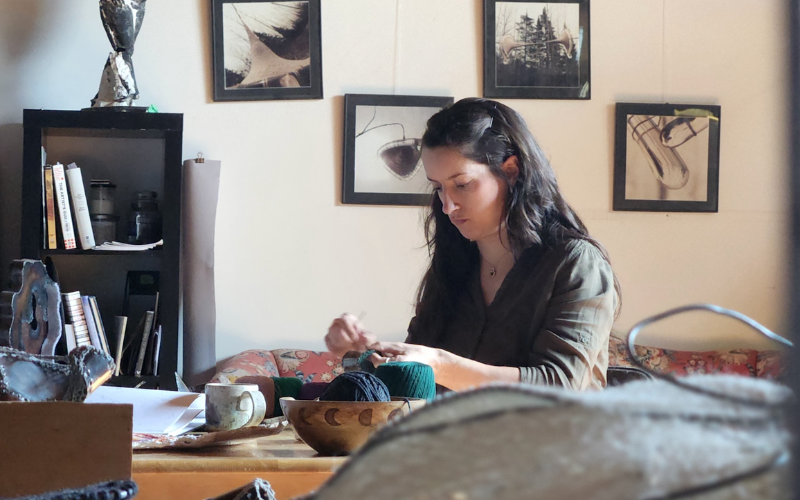
Amanda Langer crochets fiber in her studio, surrounded by reference photos on the walls. Photo courtesy of the artist
How a Bronze Casting Mistake Inspired a New Sculpture Practice
Every artist's story has a point of origin. For Amanda Langer, hers began with what others would see as a mistake: a bok choy leaf cast in bronze that refused to cooperate. When the vegetable didn't burn out completely, the casting was left riddled with holes and gaps. She needed to fill them, but couldn't mend them with bronze. So she reached for her crochet materials.
"I started with a swatch that I used as a patch," she recalls, "and then crocheted over and around the casting."
"That piece resonated strongly with myself and others." And she's been chasing that resonance ever since, drawn to what happens when two materials that don't share much common ground are asked to coexist.
Common ground between these two materials seems to be hard to find. Steel is the stuff of industry, weaponry, and tools. It makes scissors, and scissors cut yarn. Yarn and fiber, by contrast, are the stuff of nurturing: clothing and blankets, hot pads and trivets, washcloths and towels, the objects we reach for in moments of cold or discomfort or care. In daily life, these two materials rarely end up in the same conversation.
"Steel and fiber seem to me to be materials at odds," Langer notes. "They don't share much common ground in day-to-day life."
What drew her to them was precisely that distance, and the question of what might happen if it were bridged. With her creative process today, each new piece begins with a question: what relationship between steel and yarn hasn't she explored yet, and how can she embody it in physical form? She imagines the finished work first, a feeling, a general shape, an expression of form, and then works backward to figure out how to build it. The two materials get tested against each other until the ratios and gauge feel right. "It's an intuitive process," she says. "I often feel like I'm letting the materials tell me how they want to work together."
"I try to integrate them in ways that create a connection that allows each to be something it usually isn't," Langer explains. The steel allows the yarn to hold shape and structure. The yarn softens the steel, takes off its hard edges. Each gains what she calls a "mutual benefit," something they couldn't get at alone.
It's a principle that extends well beyond the studio. Growing up in this age of America, Langer acknowledges, has been a constant reminder of how much energy gets spent on conflict and domination, and how little goes toward collaboration and the pursuit of holistic good. Her sculptures, in their own way, make an argument for trying anyway.
From Farm Metal Shop to Finished Sculpture
Amanda Langer's practice is split between two locations, and, very true to the nature of her artwork, neither one can quite do what the other does.
Her studio in town handles most of the work: idea development, model-making, fiber work, assembling, and finishing. But her metal work belongs to somewhere else entirely: her family's farm, in the same shop where her father works on farm equipment. "It is really beautiful," she shares, to be making art in that same space. Outside the shop door, she's greeted by the sounds of cranes and geese, and at this time of year, spring peepers. She describes the farm as a confluence of nature, agriculture, and art.
"I feel the greatest sense of connection to the wholeness and interconnectedness of the world there. It's a wonderful place to start each piece of work."
The work that begins there starts, almost always, with intuition. Langer makes a lot of sketches and drawings, searching for the expression that matches the feeling she's after. Sometimes the rest of the process is intuitive, too. "I have been known to show up in the metal shop and just cut whatever shape comes to me, work it out from there, and decide what I'm doing afterward." Other days, the idea is clear enough that a specific procedure is required to execute it. Her practice has grown more concrete over time, her sense of what she's looking for more defined. But even as her work continues to develop, intuition will always remain part of her process.
What will also stay consistent is the feeling she gets the moment a piece is finished. When the steel form, built at the farm, finally meets the fiber work, developed in the studio. Two things made separately, in two different places, coming together for the first time. "It feels like magic," she reflects, "when I get to step back and see the thing I have trusted the vision of in my head for so long."
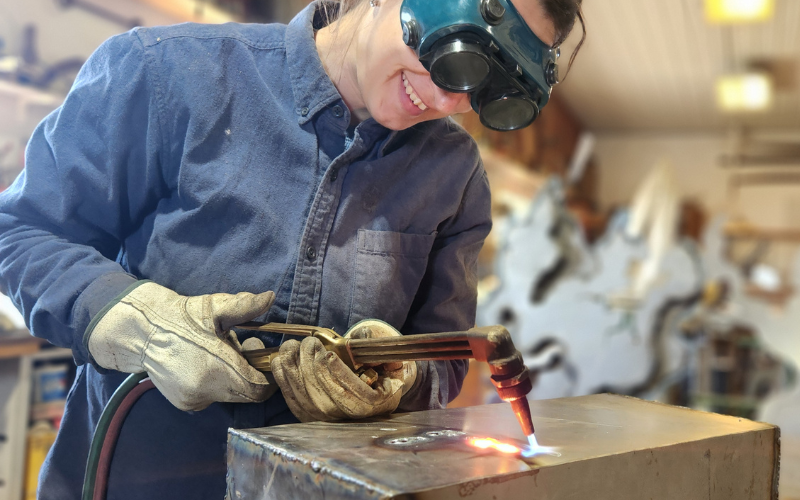
Amanda Langer works with a torch on a steel form in her family's farm shop. Photo courtesy of the artist.
Building an Art Career by Staying Open to Opportunity
One conviction has shaped the way Amanda Langer moves through her art career: the fact that potential can come from any direction, at any time, as long as you put yourself out there.
"You never know where the next great thing for you is going to come from," she points out. Which means: meet people. Stay open. Don't write off an evening that feels like a waste of time. She's watched this prove true enough times. Events that felt like total flops in the moment became opportunities months or years later. "Even in the midst of the disappointing experience, I was still meeting people, communicating about my work, and making connections."
"Anything can be an opportunity."
The harder-won lesson, the artist admits, has been the financial side of being an artist. Tracking everything, actually understanding her numbers, "it doesn't come naturally for me, but it's critical." For a while, she tried working around it. "I've tried accounting by vibes only," she says, with a candor that will ring true for many, "and it didn't work out great for me."
But she kept at it, because she recognized something important: you can't get measurably better at something without a baseline to measure against. "I need to know what's actually going on."
"You can't measure progress without a baseline":
And that baseline starts with, as Amanda Langer has discovered, really knowing your numbers. Artwork Archive's Income & Expense tracking gives you a running picture of your sales, costs, and overall financial activity, making it a lot easier to see the full picture and track how your practice is growing over time.
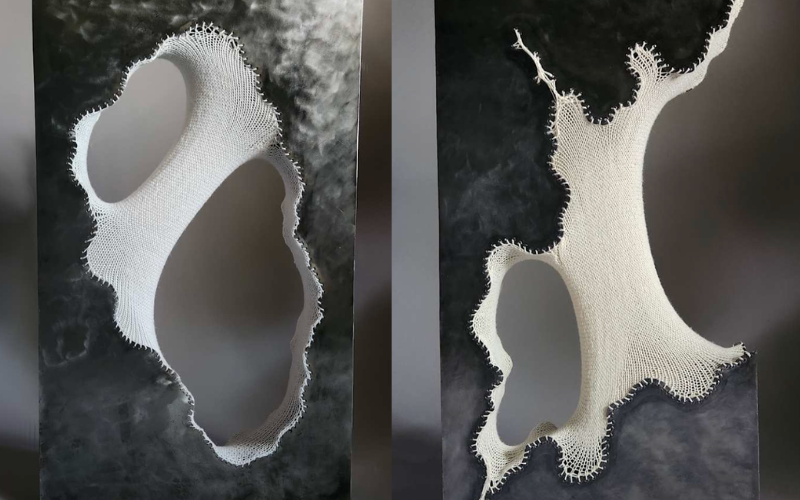
Amanda Langer, Revelation of the Softness Within, & Careful Corrosion, 2025
Building an Art Inventory System for a Growing Art Practice
The more opportunities Langer got, the more information she needed to have ready. Exhibition applications required piece dimensions, descriptions, provenance, where each work had been shown and when. The volume crept up, but her tracking didn't.
"I realized how much information I needed to have on hand about all of my art," she recalls, "and I also realized how little of that information I was remembering to track myself." Finding Artwork Archive came with a huge sense of relief.
"Artwork Archive felt like a gift of guidance and convenience when I came upon it," she tells us. "I instantly understood the benefit of having all these details put in one place, that I can always access, and that's organized and easy to move through."
Her most-used feature is the Pieces page: the gallery-style inventory view that lets her sort, filter, and scan her work. "I refer to that for almost everything I apply for," she explains. "I appreciate how easy it is to sort work and how visually clear it is, so I can find the information I need quickly and accurately." Pulling together an application used to mean hunting materials across folders and half-remembered notes. Now it means opening one page.
The Exhibition feature solved a problem she had mostly been ignoring. "This is one of those things I forget to track: which pieces were shown where. This feature makes it super easy to keep track of exhibitions and shows and to know for sure where my artwork is being displayed."
For a practice spread across two locations, with a body of work that keeps growing, having one place that holds all of it has given Amanda Langer the confidence that nothing is falling through the cracks.
Why Your Exhibition Record Matters Beyond the Opening Night:
Every show your work appears in adds to the story of your practice. Keeping that history logged consistently, with which pieces were shown and where, means you have something concrete to reference when pricing work, writing grant applications, or talking to galleries about your career trajectory.
Exhibitions on Artwork Archive make that record easy to build and easy to find.
Explore how to build your own Exhibition Records here.
The Advice She'd Give Her Younger Self
Three things, Amanda Langer says, have proven true across every stage of her career.
The first: "Anyone who succeeds at anything has only found that success because they didn't give up the pursuit of it."
The second: "Very little comes your way without first taking steps toward it. That means trying things—a lot of things. Applying—a lot. Showing up—a lot."
And then, the one that might matter most: "You're here, because you love what you do. Stay in love and keep it fun. Otherwise, what's the point?"
It's a reminder that the weight of building a career and the joy of doing the work are not separate things. That your practice will sustain you if your practice still delights you. That even in a career built around hard metal and careful engineering, the whole thing still has to feel like magic.
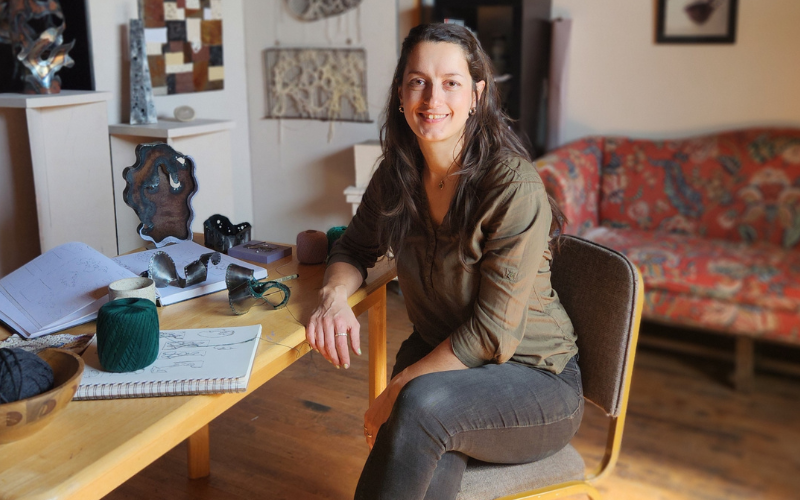
Amanda Langer in her studio, with sketchbooks, yarn, and steel and fiber sculptures surrounding her workspace. Photo courtesy of the artist.
No matter what season of your art career you're in, getting your business side in order doesn’t need to feel overwhelming. A bit of structure now can mean more time and headspace for the work you actually want to be doing.
Artwork Archive helps artists build an online portfolio, stay on top of their inventory, and create things like tear sheets and invoices in just a few clicks. Start a free trial and see how it fits into your own process.