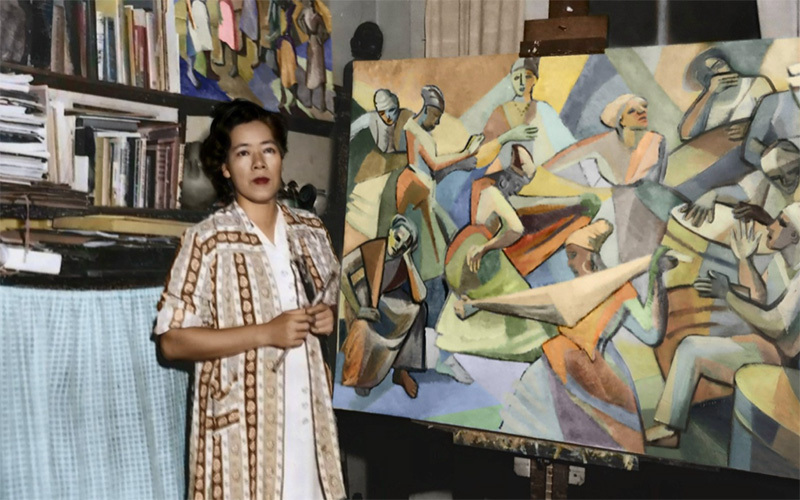
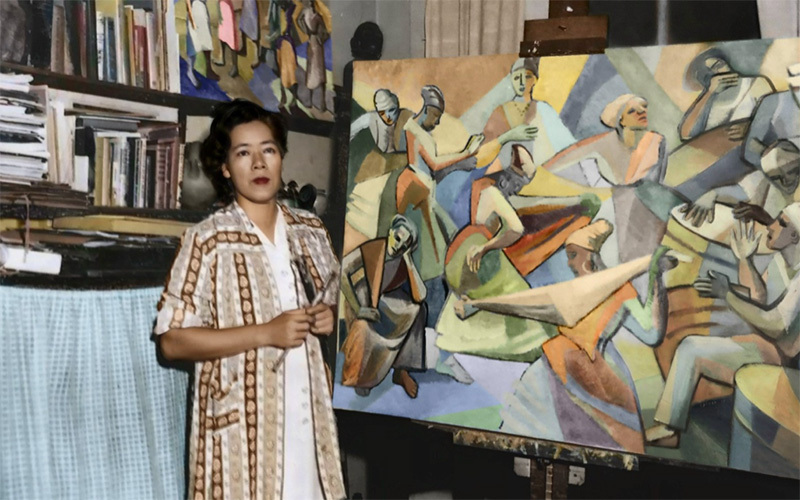
 The artist Sybil Atteck in her studio with her artwork "Bélé," 1956. (Image courtesy of Keith Atteck. Image restoration by Solstice Restorations.)
Learn how Sybil Atteck's nephew is using Artwork Archive to revive and preserve the artworks of this prolific painter, ceramicist, and sculptor.
Sybil Atteck was one of the most important Caribbean artists of the twentieth century.
A prolific painter, ceramicist, and sculptor over a career spanning forty years, she was the first British West Indian artist to exhibit at the Royal Academy in London, and the first artist from her country—Trinidad and Tobago—to have a solo exhibition of her work shown internationally. She was a key figure in the creation of the Trinidad Art Society, serving as its president for many years. Through her teaching and her artworks, she inspired thousands of artists during her life, both in Trinidad and throughout the world.
But less than fifty years after her death, her artistic legacy was at risk.
Her own archives had been dissipated through moves and deterioration. The people who knew her work well during her life were aging or passing away themselves. Institutions had incomplete records of her work. There was no central place holding all the details of her vibrant artistic life, and as time went on, more and more was fading away.
That’s when her nephew, Keith Atteck, decided to step in.
Over a little less than a decade, Keith has managed to dramatically fill out the picture of Sybil’s life and work by tracking down and recording as much information as he could about this remarkable artist.
He’s created an active archive of Sybil’s work, locating artworks in galleries and collector’s homes, and adding high-quality images to replace the grainy newspaper clippings he inherited. He has opened up this archive to researchers and curators who have been astonished at Sybil's vital art. And his work has brought newfound attention to an artist whose work was at risk of being lost to time.
Want to find out how Keith Atteck has single-handedly revitalized interest in Sybil Atteck’s work? Read on to see how he created a living archive of his aunt's entire artistic life, making it easy for him to collaborate with anyone interested in her art. Plus, learn how he discovered the tool that has made all his work possible.
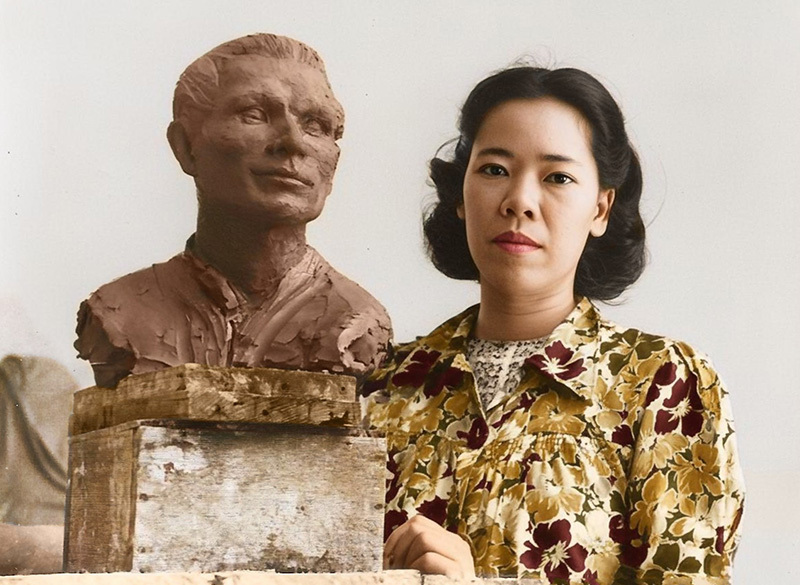 Sybil Atteck beside a sculpture of Dr. A. H. McShine included in the Art Society's 1944 November Exhibition. (Image courtesy of Keith Atteck. Image restoration by Solstice Restorations).
Sybil Atteck: A Powerful Artistic Voice In a Time of Change
When Sybil Atteck was born on the island of Trinidad in 1911, it was a colonial possession of the British Empire. Her lifetime of creativity spanned more than six decades, two world wars and the decolonization process that turned Trinidad and Tobago into an independent nation.
These were tumultuous times, and it was certainly not easy for her to cut her path to a successful career.
“Sybil faced many obstacles in her lifetime,” her nephew Keith Atteck told Artwork Archive. “The first was that there was no life as an artist for a young woman of her era.”
But Sybil was exceptional in many ways: she began painting when she was very young, and by the time she was in high school she had already began her formal artistic training. When she was in her twenties she travelled to London to study art, and continuing studies took her to Peru, the United States, and beyond.
Her early paintings were fluent, traditional portraits and landscapes, but already she was taking what she was learning in her art classes and filtering them through her unique position as a Trinidadian woman artist. In her thirties, her work took on simpler, more expressive forms, reflecting her encounters with Indigenist art in Latin America. Informed by the work of the German painter Max Beckmann, her teacher at Washington University, she also began to adapt Expressionist techniques to capture the vibrancy of Caribbean street festivals or the motion of martial artists sparring.
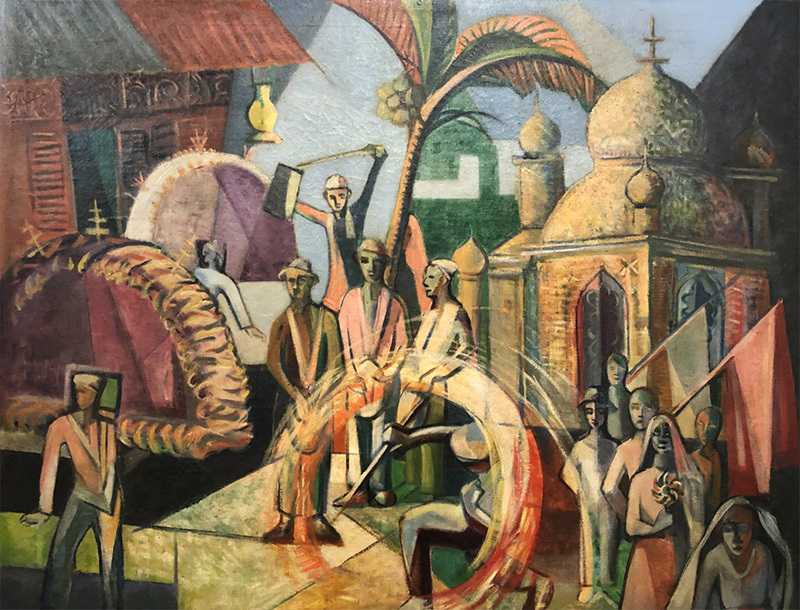 Sybil Atteck, Indian Festival - Hosay - Hosein Festival, 1959, Oil On Canvas, 44 x 53 in. (Image courtesy of Keith Atteck.)
She represented her friends, the people, the cultural traditions, and the distinctive landscapes of her country in watercolor, oil, and acrylic paintings, and in clay copper and bronze sculptures.
Throughout all these evolutions in her work, there was a core of love for her surroundings and the artistic community of Trinidad and Tobago. She taught at five high schools, educating thousands of the nation’s young women artists, and she led the Trinidad Art Society through the hectic independence period.
“The challenge for all artists in her region and her time was to develop as artists and stay true to their personal growth and artistic styles, without political and social pressures drawing them away from their own true artistic soul,” Keith reflects. “Sybil did not deviate or did not allow the political fervor to change her artistic trajectory or practice. She helped to steady the artistic community and guide it through her strong presence.”
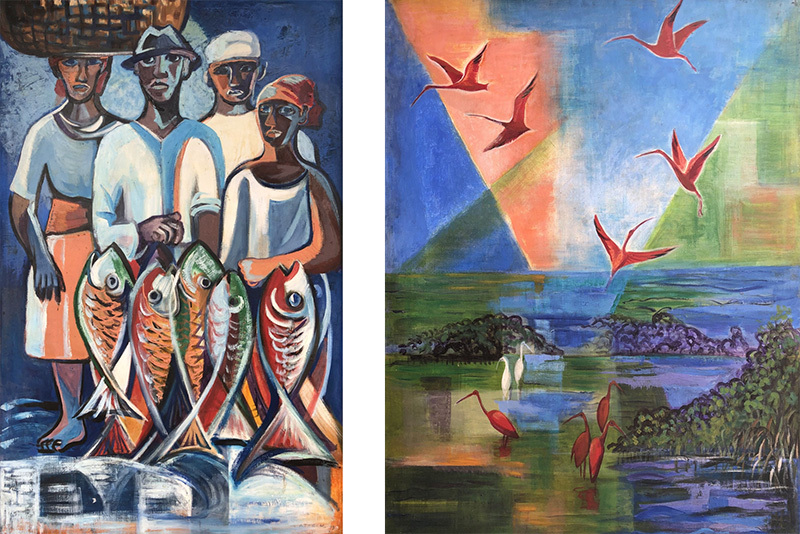 Sybil Atteck, Fishermen - Pescadores, 1969, Acrylic On Canvas, 49 x 38 in, and Scarlet Ibis - Ibis Escarlate, 1969, Acrylic On Canvas, 48 x 36 in. (Images courtesy of Keith Atteck.)
How Sybil Atteck’s Artistic Legacy Was Almost Lost
When she passed away in 1975, Sybil’s reputation seemed to need no protecting. She was known as “the mother of the visual arts of Trinidad and Tobago”—her artworks had even been featured on the nation’s stamps several times.
But an artist’s legacy, if it is not tended to and maintained, can quickly fall from public view. And when that happens, it becomes harder and harder for audiences in the future to put together the pieces of what gets lost to time.
Keith had grown up thinking of Sybil as his glamorous artist aunt. His family lived close to her house, and he remembers how she would encourage him to paint: “But I was too young and mostly interested in cricket and playing outside.”
It wasn’t until years after her death that Keith started to wonder how Sybil’s work could be preserved for future generations. Keith’s parents had become the de facto archivists of his aunt’s work. They had kept her archive in their home, and whenever a gallery or collector wanted to know something about Sybil, they asked Keith’s mother.
But in 2018, with his mother in her 80s, Keith realized that it was time for his generation to take up the mantle of preserving Sybil’s legacy: “I asked myself how I could do the same once she passed.”
He began by peppering his mother with questions, finding out as much as he could about Sybil and her work: “I took the information and stories and then, through my research, found the evidence to prove her assertions and memories and in many cases, I found all the evidence to confirm everything she told me and so much more.”
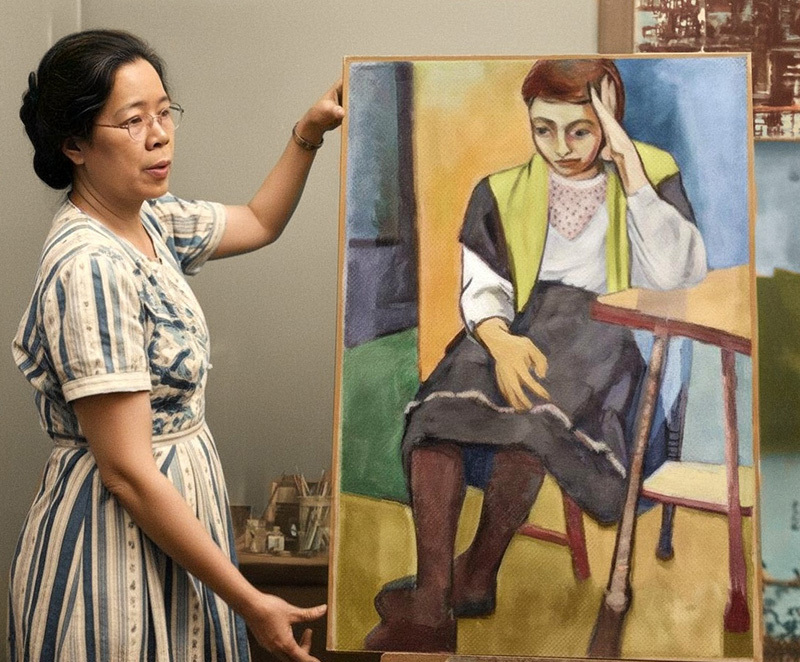 Sybil Atteck with artwork selected for the Gulf Caribbean Exhibition, 1965. (Image courtesy of Keith Atteck. Image restoration by Solstice Restorations.)
How Keith Created a Living Archive of His Aunt’s Artworks
As he began collecting the details of Sybil Atteck’s prodigious creative life, Keith needed a way to track all that he was finding out.
“I came to realize that using spreadsheets, Word documents, and PowerPoints was not going to be effective,” he recalls. “A relational database built specifically for art with all of the fields and functionality for provenance, documentation, and sharing was what I needed.”
He stumbled upon Artwork Archive, which he immediately started using to store artwork information, upload images, and build out the picture of Sybil’s oeuvre.
“I am so fortunate that I selected Artwork Archive, as it has met my needs and provided me so much more than I originally thought of,” he told us.
He's stored over 750 artworks produced by his aunt in Artwork Archive, and right now, he’s using the Public Profile to post images of the artworks that he’s seeking more information about. “The challenge for me is that most of her artworks are in private collections hidden from the world,” he explains. “I know that there are literally hundreds of artworks that I only have an old photograph of newspaper images.”
He uses Artwork Archive to share images with collectors around the world, and slowly but surely he is fleshing out the entire archive of Sybil’s work. When he has a promising lead, he asks the owners to send him what they know about the piece’s provenance, along with high-quality photos: “In some cases, I have traveled to Trinidad and England myself to photograph artworks there.”
And he says for the past five years, he’s been able to take the old photographs, slides, newspaper articles, and archival sketches and successfully confirm that they're existing pieces in the world with high quality photography, at a pace of one artwork each month, an admirable rate for any researcher.
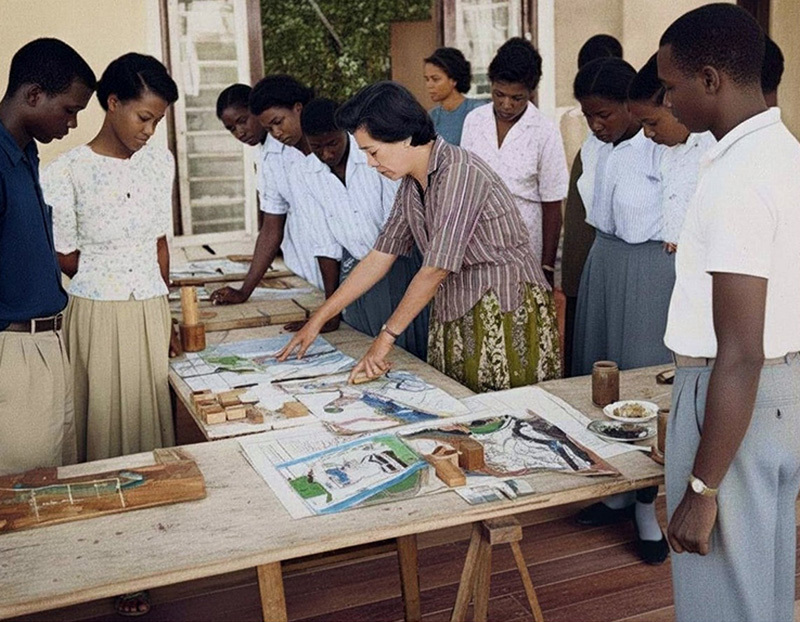 Sybil Atteck teaching art in Barbados, 1963. (Image courtesy of Keith Atteck. Image restoration by Solstice Restorations.)
How Artwork Archive Makes Keith’s Archiving Work Possible
The page that Keith has set up on Artwork Archive has become the main resource for anyone interested in Sybil Atteck’s work. He uses the site’s News section to provide in-depth updates on major events that feature Sybil and her art, upcoming exhibitions, related articles, and new research that his work has facilitated.
He has been able to use Artwork Archive’s Private Rooms to share selections of Sybil’s work, as he’s done for a PhD student in the UK, a curator at an art gallery in the Netherlands, and an art historian author who featured one of Sybil’s artworks on the cover of her book.
“I can impress other researchers by being able to find information and artworks in an instant,” he says, of Artwork Archive's easy-to-use tools. “I can respond to researchers with ease to set up a Private Room.”
You don't have to reinvent the wheel:
Artwork Archive has already created the perfect platform for collectors, archivists, and artists looking to take control of their art inventory. With built-in tools that make it easy to build provenance, track locations, and share your collections, it's the choice for art professionals who are serious about making their collection admin simple.
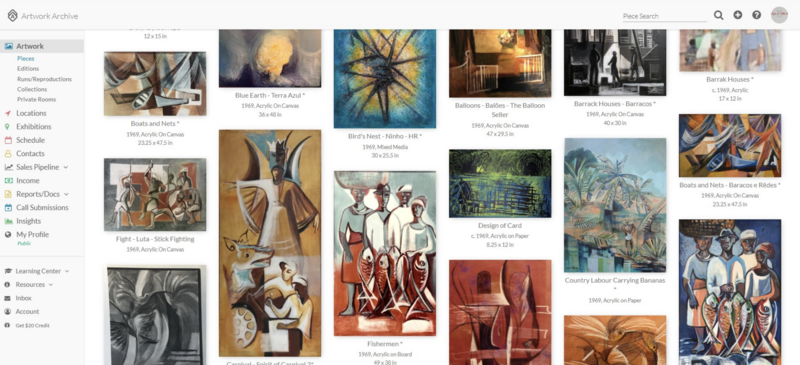 A peek inside the archive that Keith Atteck has built from the work that his aunt, Sybil Atteck, made during her prodigious career.
On one occasion his site saved one of Sybil’s works, literally: one painting was destined for the landfill until a man in the UK reached out to Keith via the Artwork Archive site to learn more about the piece. Keith was able to confirm, through the records he has collected, that the piece is authentic: “I have records of when that artwork went to England.”
He’s using Artwork Archive’s Collections feature to group artworks to help identify specific periods in Sybil’s artistic evolution. He uses Locations to track where the pieces live in the world. He runs Reports often to track his progress. And the Public Profile is central to all his efforts: “I need a presence on the web to allow people to contact me directly so that they feel that their privacy is protected.”
All told, using Artwork Archive has been vital to the work he has been doing since 2018: “I have found that Artwork Archive has supported my project immensely and I could not have accomplished what I have without it.”
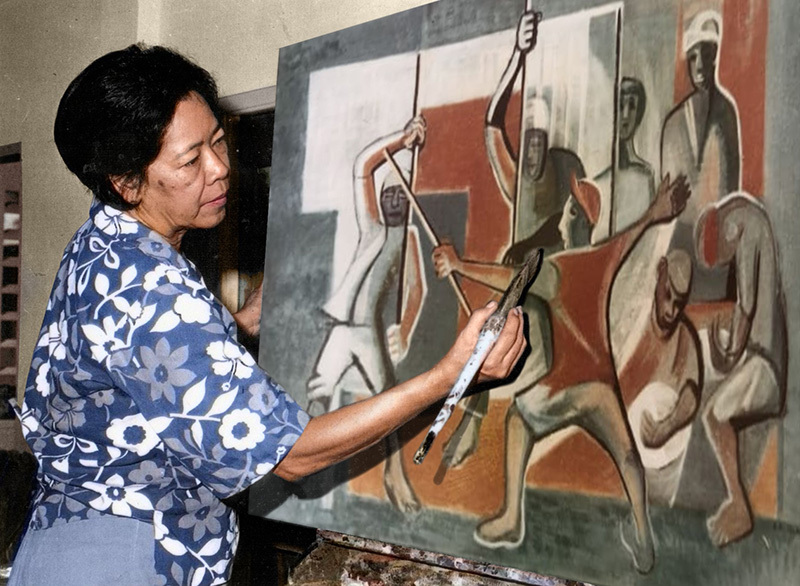 Sybil demonstrating painting in her studio, 1959. (Image courtesy of Keith Atteck. Image restoration by Solstice Restorations.)
Take Action to Protect Your Art Archive Now, It Only Gets More Difficult
If there’s one lesson Keith has learned as he’s gathered the different threads of Sybil’s life, it’s that artists need to keep good records of their careers.
“In my case, Sybil Atteck is a significant figure in the art world and even so her legacy was lost,” he warns. “It has taken my decade-long effort to bring her back into the light.”
It’s heartbreaking to Keith to think about what is already beyond saving: “I will still never find everything. Many artworks may never be found or are destroyed.”
So if you’re an artist who wants to keep better track of your art career, or you’re a family member tending to the legacy of an artist relative, the sooner you start, the easier your job will be.
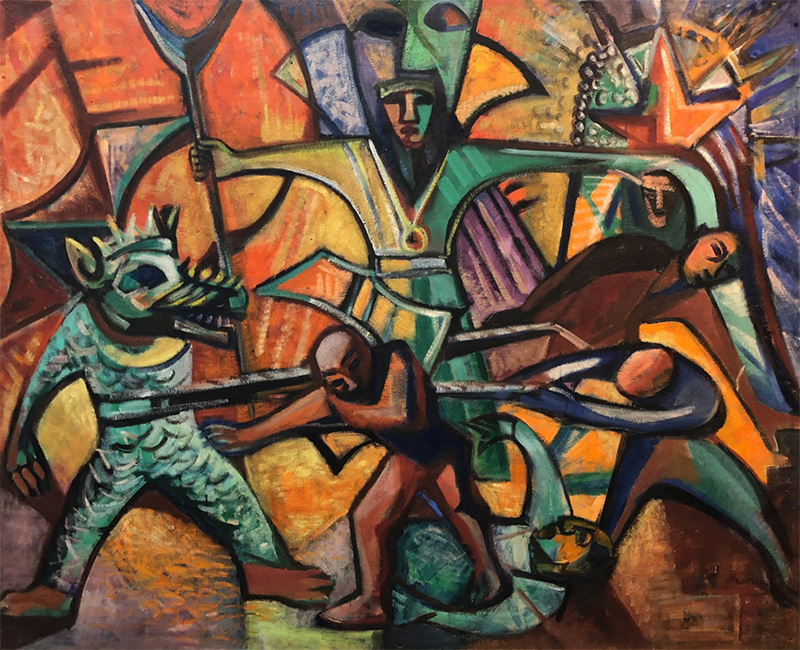 Sybil Atteck, Spirit of Carnival 1, 1962, Oil On Board, 48 x 66 in. (Image courtesy of Keith Atteck.)
“Artists have no idea how influential their art or life story will become,” Keith says. “The story of their lives and the life of an artwork can be as important as the artwork and sometimes add great value to the narrative around the artwork. How can one understand this without the context of the artists life?”
It’s much easier to keep good records as you go through your art career than it is to try to reconstitute them after the fact. There might be exhibitions you’ve already forgotten about, or you don’t remember which pieces were shown in what year. That’s vital information that can take researchers years to try to recover.
For Keith, all the work he has put into his aunt's archive has been worth it. Despite the time and energy he's committed to the project, he takes great satisfaction in keeping Sybil's incredible artistic legacy alive. And he’s thrilled to be able to share her work with all the people who reach out to him. Just a couple years ago, the art publisher Phaidon got in touch to learn more about Sybil’s work, which lead to her work being featured in their coffee table book Great Women Painters. “The inclusion of Sybil in that book has provided me a boost of interest in my aunt’s story and artworks.”
And if readers have a question about Sybil’s career, or want to know more about her artworks, he has a closing message: “They can message me directly from my Public Profile on Artwork Archive.”
Want to see how easy it is to start building your living legacy? No matter where you are in your art journey, Artwork Archive can help you track your artworks, exhibitions, sales, and more, all in one place. A bit of structure now can mean more time and headspace for the work you actually want to be doing.
Artwork Archive helps artists build an online portfolio, stay on top of their inventory, and create things like tear sheets and invoices in just a few clicks. Start a free trial and see how it fits into your own process.