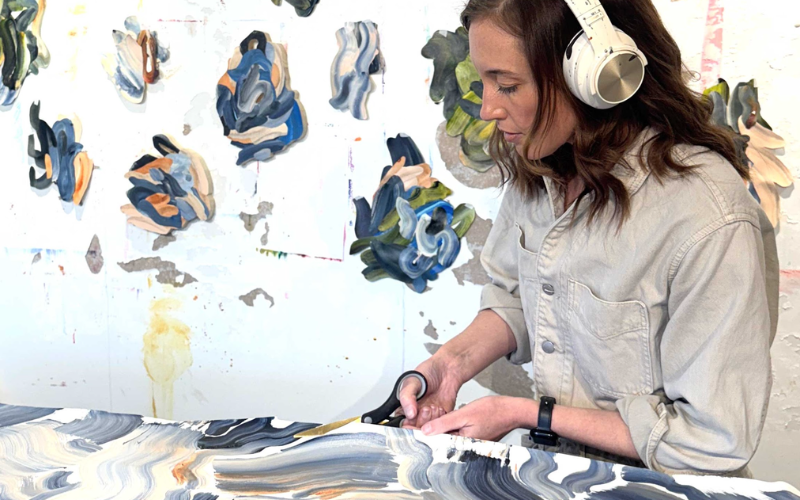
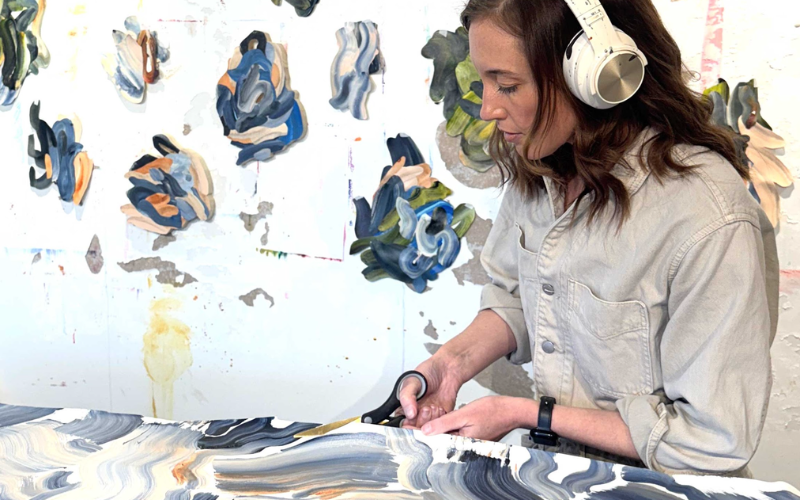
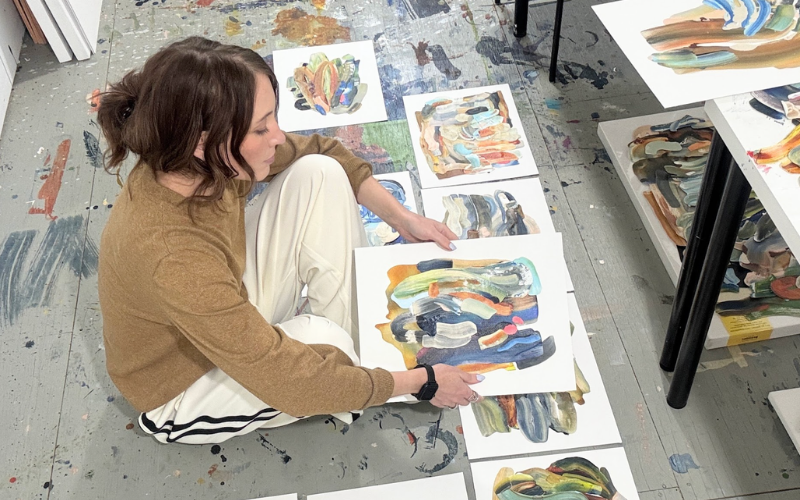
Ellen Sherman at work in her studio, cutting into a new stained canvas while finished pieces line the wall behind her. Photo courtesy of the artist
“So much of my work begins with a simple, ‘what happens when I add this to that?’”
From across the room, her work reads as a single painting, the kind of surface that looks like it was composed in a single sitting. Move closer, though, and the illusion gives way. A hairline edge catches your eye, then another, and another, and pretty soon you're nose-to-canvas, tracing the seams where one fragment ends and another begins. Dozens of individually cut pieces reveal themselves, each one carrying its own history.
Featured Artist Ellen Sherman drives a practice built on the relationship between fragment and whole. She cuts apart old paintings and reassembles individual pieces into a new collective form, centering everything on the exploration of materials and the meeting of moments planned and unplanned.
After earning her BFA in Studio Art from Michigan State University, Sherman spent a decade in Miami before settling in Ann Arbor, where she maintains a studio and small gallery space. Her work has been shown across the US and internationally, and continues to evolve through an active practice rooted in process, material, and the ongoing question of how disparate parts become a whole.
We sat down with Ellen Sherman to talk through how she got here, what she's chasing next, and the hard-won lessons that have shaped how she runs her studio.
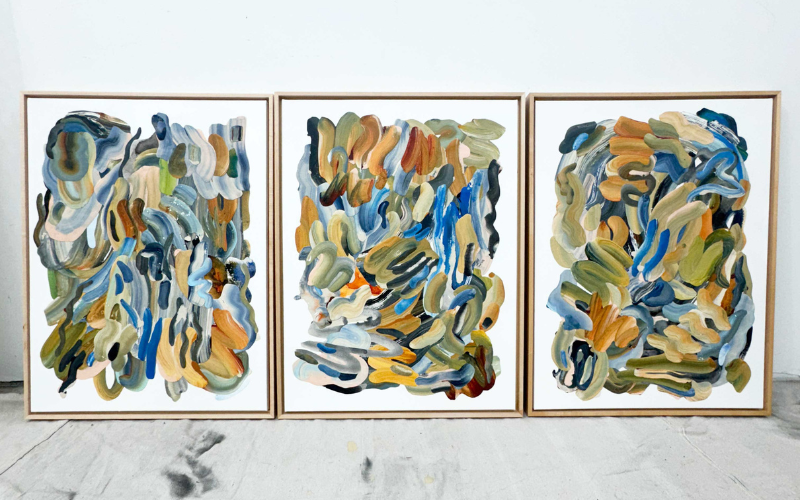
Ellen Sherman, Murmurations, 24 x 18 x 1.25 in
The Soak-Stain Technique Behind Ellen Sherman’s Abstract Paintings
Picture thinned paint pooling on raw canvas, slowly bleeding outward, the fibers drinking it in until the pigment becomes part of the fabric. This technique, called soak-staining, was pioneered by Helen Frankenthaler in the 1950s, and is the method that now anchors so much of Sherman's practice.
She first encountered Frankenthaler's work while earning her BFA, and something about it clicked with what she was already trying to do. Living on the bay in Miami at the time, water filled her paintings as subject, mood, and metaphor, so the leap to a process built around water wasn't a far one to make. Frankenthaler had used oils, but Sherman adapted the method for acrylics, and it stuck. Gravity and absorption became collaborators in the studio, with pigment moving on its own and water deciding where edges would form and how deeply they'd bleed.
"I was searching for ways to add a bit of chaos to the control of my work."
Every pour opened up something new, and Ellen found herself less interested in mastering soak-staining than in following where it led. "It gave me that little bit I couldn't plan for, that would ignite additional questions and avenues of study," she describes. One accidental edge would point her toward the next thing worth investigating, and the practice kept generating itself from there.
Inside Ellen Sherman’s Cut-and-Collage Process
Once the stained canvases and papers have dried, Ellen Sherman pulls out the scissors. She cuts each one apart in search of pieces that might lead somewhere new, or might answer whatever question is rattling around her studio that week. The fragments then get laid out like puzzle pieces across her workspace. "I add and remove until I feel the conversation I'm having with the piece start to draw to a close," she notes. "Once I feel like there's nothing more for it to say, I adhere the individual pieces to the surface and call it a day."
Her favorite part of the whole sequence is what she calls "the inbetween," that stretch of time when the pieces are free floating and can become anything, when the composition remains unfixed and a shape that lands one way today might land an entirely different way tomorrow. The work is at its most generous in this state, and at its most demanding, asking her to hold every possibility open while still moving toward resolution.
"It's playful, but requires a serious critical eye at the same time," she adds.
There's no telling how long a piece will take, and Sherman has stopped trying to guess. Some resolve in a matter of days with the cuts settling into place almost without resistance. Other times the back-and-forth stretches across weeks or even months, with a single piece sitting out in the studio long enough to outlast a whole season of other ideas.
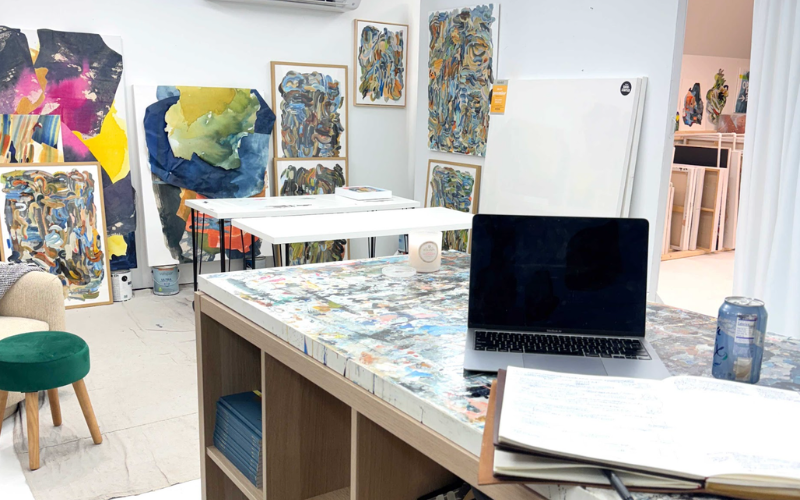
A look inside Ellen Sherman's Ann Arbor studio and workspace. Photo courtesy of the artist
How She Reworks Her Past Pieces Into New Art
Many of the pieces leaving Ellen Sherman's studio today contain canvases she stained years ago, sometimes a full decade ago, which means the artist who originally poured that pigment isn't the same artist now picking up the scissors.
"The timeline of my work is a meeting of past-present-future selves," she reflects. "I'm not the same artist that moved a pool of pigment across a canvas 10 years ago. I have new interpretations, new questions I ask of my materials, entirely different pathways of thought. So present me gets to have a little conversation with past me as I cut and layer the work."
Past and present aren't the only ones in conversation, though. Her future self drops in too, peeking over the shoulder of whoever is currently working: "Future me will poke her head in every now and then too, saying 'you're going to cut this piece up again.'"
Nothing Ellen Sherman makes is truly ever finished, and nothing is past the possibility of being remade. The work she finishes today is just material for the version of herself who comes along later, with new questions and new tools and a new reason to pick up the scissors all over again. And the practice she's built is essentially a long-running collaboration between everyone she's ever been and everyone she's still becoming.
Taking Her Abstract Work Into Three Dimensions
The cut work, until now, has lived on the flat plane. That's where, for years, the conversations between past and present selves have unfolded. Now, though, a new question is starting to take up real space in her studio: what happens when those conversations lift off the surface altogether?
"I'm very interested in what happens when it is taken off the flat surface and exists in a way I can experience it from multiple angles," Sherman offers.
The pull toward three dimensional work is what the flat surface can't give her: the shadows that would gather underneath overlapping pieces, the undulations a hand could feel as easily as an eye could see, the way light would catch and release the work depending on where someone happened to be standing in relation to it— "they're all calling for exploration," she says.
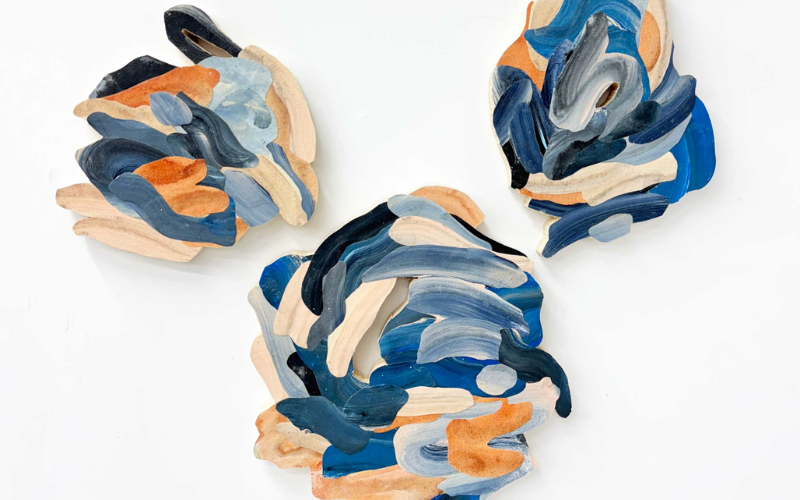
Ellen Sherman, Cocoon, (3, 4, 5)
Why Artists Shouldn’t Wait for Inspiration to Create
Most artists assume the order of operations goes inspiration first, then work. Sherman would tell you it's almost always the other way around. The inspiration you're waiting for, in her experience, almost never shows up before you do. "Stop waiting for inspiration and show up for your practice regardless of it."
"Treating inspiration as a prerequisite to working is a good recipe for not getting anything done," she cautions. "Professionals in every other field don't wait to feel 'moved' before they begin. Artists shouldn't either."
There's a caveat, though, as she acknowledges that rest and recovery belong in any sustainable practice. "Self-care is so important," she insists. And it matters more than the productivity discourse tends to allow. "There's a difference between intentional rest and avoidance," which is a distinction every working artist eventually has to make for themselves.
The conviction comes straight from her own studio hours. "I've found that inspiration follows work far more often than it precedes it," she reflects. "The act of showing up even without a 'momentum' forward is what usually generates my next idea."
The Lost Painting That Changed How This Artist Tracks Her Work
Every artist has a story they wish they didn't, the hard-learned lesson that reorganized how they run their practice from that point forward. For Ellen Sherman, it's the painting she lost track of.
Years ago, she sent a piece off to a three-month exhibition and promptly forgot about it, the way busy artists sometimes do when one show closes and the next opens. When a call came in with someone who wanted to buy it, she realized she genuinely had no idea where the piece was. "It was unprofessional, and honestly rather embarrassing and completely avoidable," she admits.
She hasn't let it happen again. Nothing leaves the studio anymore without a full paper trail: where it's going, how long it'll be gone, who's holding it on the other end. For a while, all that info was kept in a spreadsheet. But when her inventory grew, so did the rows and columns, and things slipped through the cracks faster than she could keep up with.
"I am not by nature an organized person, so without rather strict supervision things descended into chaos quickly."
What she needed instead were what she calls "guardrails," a system with enough structure to hold her practice together and enough flexibility to absorb the variety of inputs her work required. Artwork Archive was the clear answer, robust enough to track every attribute she could think to log, but intuitive enough to evolve with her ever-changing practice.
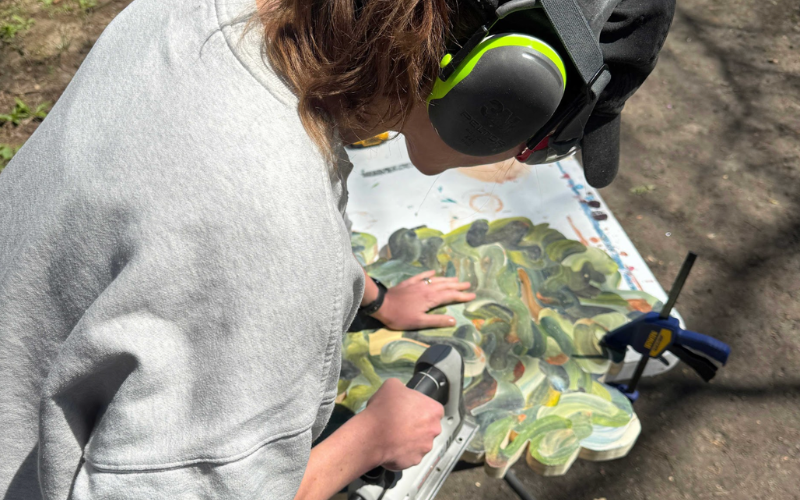
Sherman at work cutting pieces outside the studio. Photo courtesy of the artist
The Two Artwork Archive Features She Uses Most
Two Artwork Archive features have settled into permanent spots in Sherman's day-to-day.
Private Rooms come first, and she uses them for just about everything, sharing curated selections of her work with prospective collectors, galleries, or anyone she wants to give a sneak peek to. The link plugs straight into what she already has on the platform, which means she doesn't have to rebuild a page on her website every time someone wants a tailored view of her work.
Artwork Labels handle her open studio nights, which she hosts regularly, rotating different selections of work on the walls. Instead of designing each label from scratch like she used to, she uses Artwork Archive to print exactly what she needs on demand and moves on to the parts of the night she actually wants to spend her energy on. "I can spend the time choosing the pieces I want instead," she offers.
💡 Artwork Archive Tip: Build Fresh Tear Sheets for Every Open Studio:
If you rotate the work on your walls between events the way Ellen Sherman does, Tear Sheets can rotate with them. Artwork Archive lets you generate new sheets for any selection of pieces in a few minutes, so each open studio night has its own set of takeaways ready to go.
Print a stack for the night, hand them out as conversations happen, and follow up later with the visitors who took one home.
Why Artists Should Start an Art Inventory From Day One
If Ellen Sherman could talk to the artist she was at the beginning of her career, she'd give her one piece of advice and make her promise to follow it: "Start your inventory system now. Yesterday."
"Before you have a body of work, before you have a gallery relationship, develop a documentation system and apply it consistently to every piece you make," she adds.
A piece without a photo, dimensions, or title is a piece that can't be submitted, proposed, or sold, and the professional architecture of a sustainable practice rests on the records that prove the work exists in the first place.
"Work that isn't documented is work that doesn't get seen."
Build the habit early, and the archive grows alongside the work itself, one record at a time, accumulating into the kind of foundation that makes future opportunities easier to go after. Wait, and you'll do what Sherman did: scramble to reconstruct an entire career's worth of records after the chaos has already settled in.
Ellen Sherman still cuts apart canvases her younger self once painted, still listens for the conversation between past and present and future selves, and still treats every finished piece as a potential beginning. The only difference is that now, when she sends a piece into the world, she knows exactly where it is, exactly when it's coming back, and exactly which version of herself is going to pick it up next.
💡 Artwork Archive Tip: Start With One Piece, Then the Next:
The biggest barrier to building an archive is usually the thought of catching up on everything at once. Start with your most recent piece, log it, and work backwards from there. Pick one day a week to tackle five or ten older works at a time, and treat it as a recurring appointment rather than a project. Then, going forward, don't count a new piece as finished until it's logged in your inventory. By the time you need the records, the habit's already built and your archive's already there.
Put Better Systems Behind Your Creative Practice
No matter what season of your art career you're in, getting serious about your art career doesn’t need to feel overwhelming. A bit of structure now can mean more time and headspace for the work you actually want to be doing.
Artwork Archive helps artists build an online portfolio, stay on top of their inventory, and create things like tear sheets and invoices in just a few clicks. Start a free trial and see how it fits into your own process.