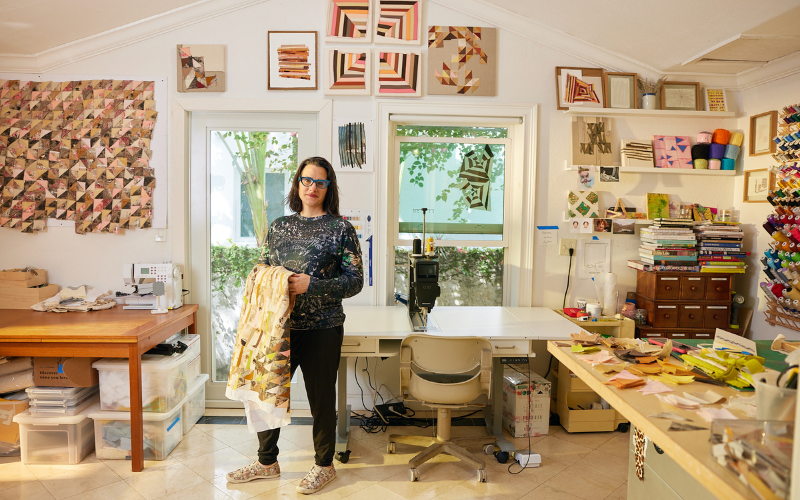
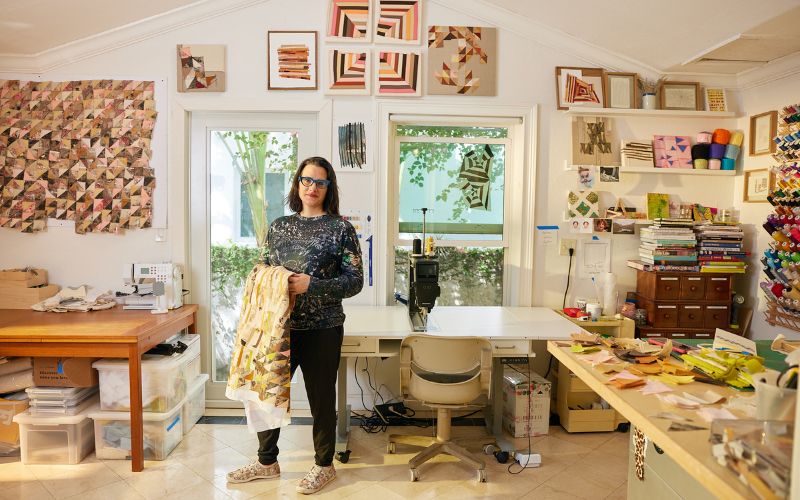
Regina Durante Jestrow in her Miami studio. Photo courtesy of the artist
She learned sewing and crocheting from her mother, and it ignited a passion that would become a lifelong force.
Artwork Archive's Featured Artist Regina Durante Jestrow is an Italian-American textile artist living and working in Miami, Florida.
Her deep-rooted connection to textiles is the bedrock of her artistic practice. While stretching and challenging quilt forms and structures, Jestrow considers the activist values that shaped historic quilt-making traditions.
Through her hand-stitched process, she transforms traditional craft techniques into layered, abstract compositions that merge geometry with personal symbolism. Hand-dyed fabrics, repurposed clothing, and textiles collected from friends and thrift shops are incorporated to create rich surfaces full of personal and cultural resonance. Drawing from the city's vibrant landscape, she blends organic geometry with bold, tropical color palettes and unconventional materials like neoprene, sequins, and faux leather.
The result is a rich tapestry, part homage to Miami's pop culture pulse, part playful experimentation deeply rooted in reverence for American folk art.
We sat down to hear more from Regina Durante Jestrow, including the realization that pushed her quilts from functional to fine art, how she sources her materials, and the operational backbone that allows her to run her studio practice across two galleries and counting.
Read on to see more of Jestrow's work and learn how she became the artist she is today.
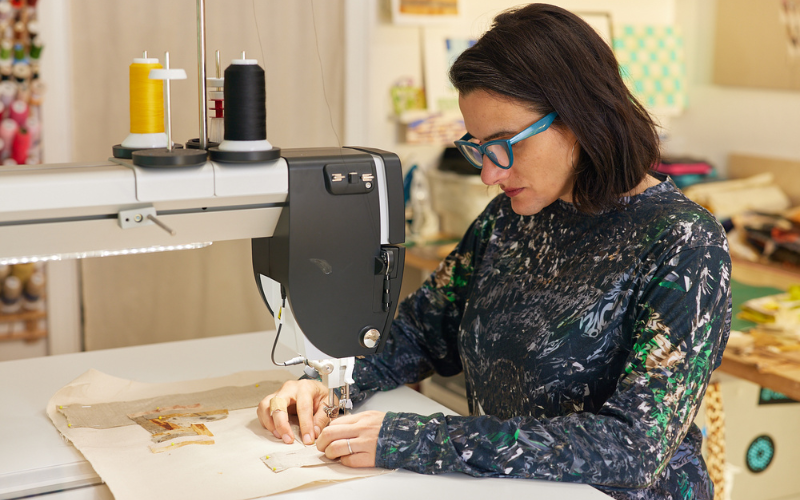
Regina Durante Jestrow at her sewing machine in her Miami studio. Photo courtesy of the artist
How Regina Durante Jestrow Became a Textile Artist
When you think of a quilt, the first thing that probably comes to your mind is something you'd find folded up on the end of your bed. But, stand in front of one of Regina Durante Jestrow's quilts, and the comfort object that's lived in American homes for generations starts to morph into something else.
The silhouette on the wall reads as almost sculptural. Strips of fabric run past the intended edge and triangles meet at sharp, exaggerated points. Hand-dyed cottons sit next to sequins pulled off a thrifted party dress, and a scrap of neoprene shows up tucked between faux leather squares. And yet, tradition is still visible in the pieced block structures and repeated geometries that quilters have been using for two centuries.
Born in Queens and now living and working in Miami, Jestrow came to textiles through her mother. "My mom taught me how to sew and crochet," she tells us. "She's a mad knitter and always has socks on her needles these days." Her earliest pieces served as functional quilts for family members, friends, and her own household, sewn from clothing she thrifted. "It was much less expensive than going to a fabric store, and there was such a great variety of fabrics to choose from in the Miami thrift store."
Somewhere in the years of making functional pieces, quilting stopped being just a thing Jestrow did and started becoming a thing she needed. Her Miami home studio grew to accommodate a sewing machine and dyeing space alongside it, and what had begun as a domestic craft passed from her mother's hands slowly deepened into a creative practice.
Breaking the Rules of Traditional Quilting
As Jestrow's voice, skills, and discipline developed, "a couple of realizations happened" that sparked her interest in moving her quilts from functional to artistic.
"Sometimes, a functional quilt isn't valued as highly as a quilt that hangs on the wall as 'Art,' and I wanted my time and practice to be respected."
Alongside that observation lived another frustration. She had grown weary of matching corners across an entire assembled top, aligning patterns cleanly across seams, and keeping every triangle sharp while every seam stayed closed, "all while making sure there were no holes and that everything was washable once complete." Meeting all those conditions had stopped leaving room for the hand-dyed fabrics she most wanted the viewer to see.
Raw-edge appliqué gave her a way forward. In the technique, fabric shapes are stitched onto a background without turning the edges under, and the raw, exposed edges are left open and intentionally visible. "I found it much more forgiving," Jestrow admits.
"Now my holes and gaps in the patterns are on purpose and exaggerated." The perfectionism she had been striving for turned into the very thing her work now refused, and her artistic voice became her own.
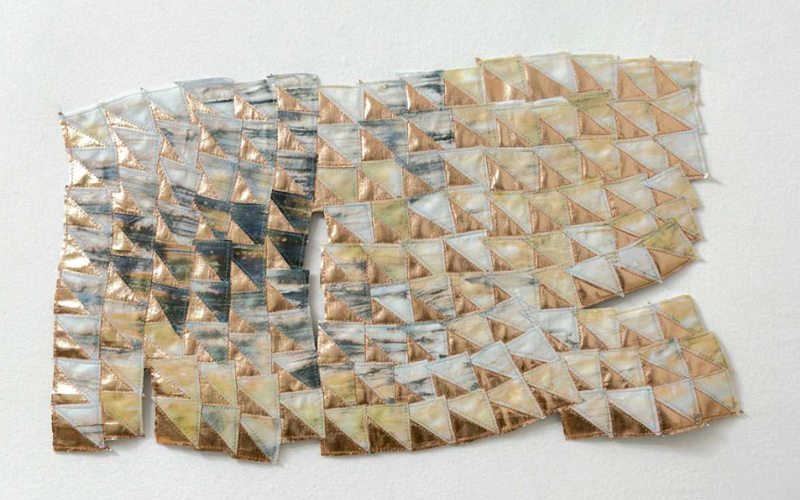
Regina Durante Jestrow, Triangle Grid 5, 16 x 28 in, 2026
Inside Regina Durante Jestrow’s Textile Art Process
Peek into her studio on any given day, and you'll likely find Jestrow doing one of three things. "Either I'm dyeing new fabrics, or I'm thrifting materials, or organizing my stash."
As someone who loves all sorts of fabric, her stash often includes a sequined dress from a secondhand shop in Miami, a length of neoprene, scraps of faux leather, and a bag of unfamiliar fabric a friend handed her the week before.
"As long as the sewing machine can sew it, I use it."
While unconventional, her materials aren't as random as they may seem. Every fabric in her studio carries something with it. The sequined dress reminds her of the reason she moved to Miami in the first place. The neoprene and the faux leather carry the shine and the pop culture pulse the city is built on. Even the choice to keep sourcing secondhand is deliberate: "it feels more eco-friendly to buy secondhand sequin dresses than to buy new plastic-based textiles."
Once the materials are on her worktable, color takes over. "I mix and match different color combinations while thinking about pattern and layout, and once I'm really excited, I clear out space in my studio to start cutting and piecing," she continues. "I try to document my process as I build the work to add some distance and see how the patterns are working out." When the top is fully assembled, she chooses one or two threads and free-motion quilts everything to a felt backing.
No single stage of her creative process is her favorite. "I love starting something new, and I love the satisfaction of finishing, and the middle is how to get there."
Exploring American History Through Contemporary Quilting
Quilts have always carried historical significance. Flour sack quilts were sewn during the Great Depression, when fabric was a luxury most families couldn't afford. Fabric banners were stitched in support and in protest during the women's suffrage movement. War quilts were raffled and sold to raise money for troops and their families. Underground Railroad quilts have long been rumored to have carried coded messages for people escaping slavery. And in Gee's Bend, Alabama, quilts have been assembled for generations from the remnants and clothing of loved ones, used to warm homes through winter and to memorialize the people who wore the cloth first. "Quilting traditions have been passed down through family and have created community," Jestrow notes.
Those histories found her in a research phase during COVID, and inspired her Americana Quilts series. She built the work as a way, in her own words, "for me, as a white woman, to process my personal research around racism in America, Black Lives Matter, and textile history in various cultures." She took the classic Americana quilt patterns, the pieced star blocks and diamond configurations recognizable from any museum survey, and rendered them entirely in over fifty-five different colors of "flesh-toned" fabrics. Podcasts and audiobooks ran in the studio for the months it took her to work through the series.
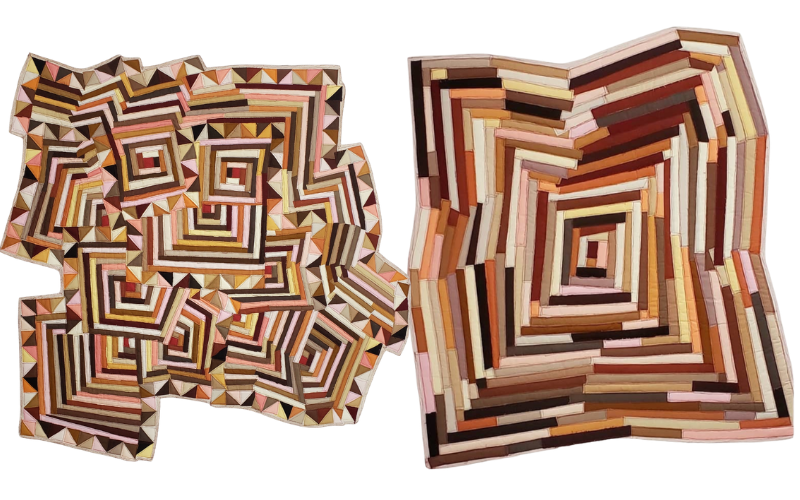 Regina Durante Jestrow, Americana Quilt 34, 49.5 x 52.5 x 0.5 in, Americana Quilt 10, 40 x 35 x 1.5 in, 2020
Redefining Success in a Contemporary Art Career
"Success looks different for everyone."
"To me, success as an artist means having a studio practice that satisfies my soul," Jestrow says. That starts with her Miami home studio, which has room for dyeing on one side and sewing on the other, allowing her to move between the two without leaving the house. Her definition of success expands beyond the studio, too: Residencies with artists from different places. Open studios. Solo shows. Installations in public and unexpected venues where new audiences find her work by accident. Museum and gallery group shows with her quilts hanging beside artists whose careers she's been following for years.
Everything Jestrow counts as success traces back to one shift in how she thinks about what an artist's job actually is.
How Professional Documentation Changed Jestrow’s Art Career
It sounds small, but Jestrow can trace the arc of her career back to a single decision: hiring a professional photographer to shoot her work.
She had been documenting her own pieces for years, doing what most emerging artists do: telling herself that a professional photographer was an expense she couldn't afford. "I didn't think I could afford it when I was younger, but the expense pays for itself." Once the professional images were in her hands, the opportunities, inquiries, and recognition that followed traced directly back to them.
"Great photos are key to great applications and a great web presence."
Proper documentation is just one instance surrounding a larger truth about a career in art: "Art is a business if you want to get seen." Time has to be reserved for the work, and time has to be reserved for the archive, the applications, the social presence, and the in-person showing-up. "You can't just be a studio rat. You need to leave your comfort zone and talk to strangers sometimes."
💡Keep All of Your Images Together:
Professional, high quality images matter across every corner of your business, and Artwork Archive lets you attach multiple images to each artwork record, including installation shots, process photos, and detail views alongside your primary hero image.
Grant panels get the crisp high-res version, Instagram gets the detail shot, and gallery submissions get the full context of how the work has been installed before. All of it lives on one piece record vs. three separate folders in your hard drive.
Using Artwork Archive to Manage a Growing Art Career
Jestrow's work currently lives in the care of two galleries. Baker-Hall in Miami represents her locally, and Ivester Contemporary in Austin will open a solo show of her work in the coming months. Keeping up with both relationships means keeping both galleries current on what's available, what's already sold, what's coming out of the studio, and what's already committed to another show.
Using Artwork Archive, she created two Private Rooms—one shared with the Ivester gallerist for the Austin exhibition, another shared with Baker-Hall covering her full inventory. "It's the easiest way to share high-resolution images, dimensions, details, and pricing for all my work," she explains.
Artwork Archive became Jestrow's operational backbone during COVID, when she was, in her own words, "just making, making, making." She needed a way to organize the work, generate PDF portfolios for applications, and record sales coming in from small pieces posted to Instagram.
Today, in addition to Private Rooms, the Invoice feature tracks Jestrow's sales and payments, Locations keeps her aware of where every piece is at any given time, and Address Labels get generated for pieces getting shipped. And when an application asks for an inventory list, the platform generates a formatted PDF in a few clicks. "It's the fastest way for me to pull out all the details about individual artworks for applications."
💡 Build a Private Room for Every Kind of Scenario:
One Private Room can go to a gallery. Another can go to a specific collector who's been asking about your available work. A third can hold the pieces you're pitching to a curator for a group show.
Each room is custom, can be password-protected, and shows only the work selected, which means you can share your practice at different depths with different people, for different scenarios.
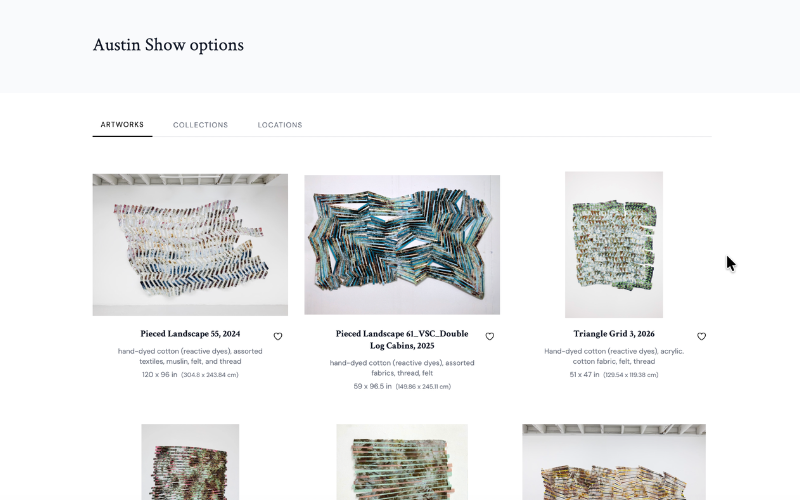 A look at Regina Durante Jestrow's Private Room set up for her Austin show. Screenshot courtesy of the artist
What It Takes to Build a Professional Art Career
"Professionals want to work with professionals," Regina Durante Jestrow says. I
t's the principle behind everything else she'll tell an artist starting out: document your process while it's happening, and document the finished work professionally when the piece is done. Apply only to opportunities that are a real fit, but don't pigeonhole yourself out of an exciting challenge just because it feels outside your usual scope. Dedicate a couple of hours a week to the administrative work — inventory, website, applications, follow-up emails — before the pile grows to the point where you can't catch up.
And finally, "Ask questions when you have them, collaborate when you can, and help other artists."
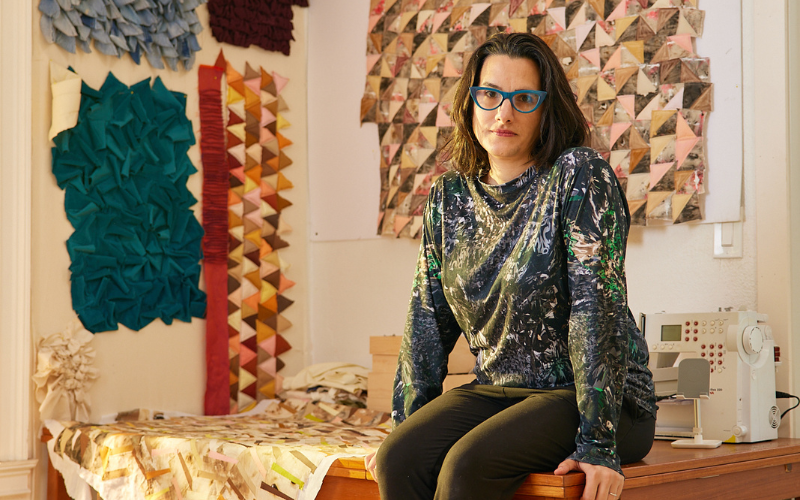
Making the work is one half of Regina Durante Jestrow's practice. Making sure the work gets seen is the other. She's spent years learning how to weave both together, and she'll be the first to tell you that any artist who wants a working career will have to do the same.
Every art career needs an operational backbone. With Artwork Archive, you can handle your art inventory, sales records, and professional artwork images, and more, making it easier for your work to get seen. Try Artwork Archive free for 14 days.