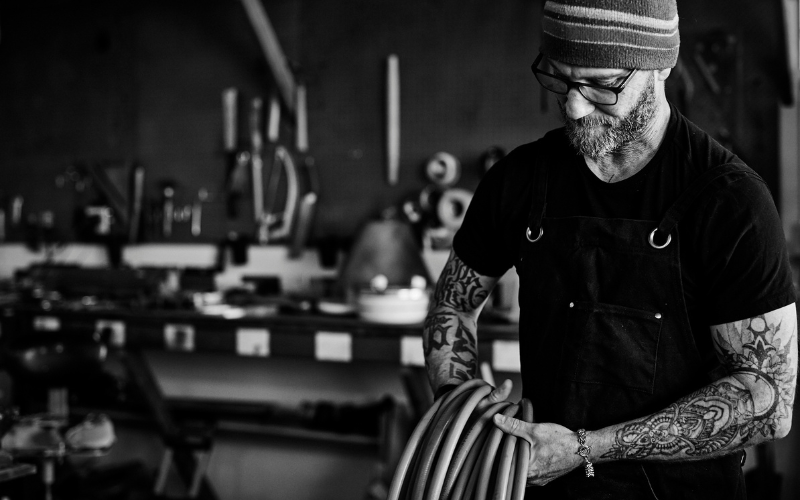
"I think of my pieces as relics—resilient objects unearthed to reveal stories from another time and place."
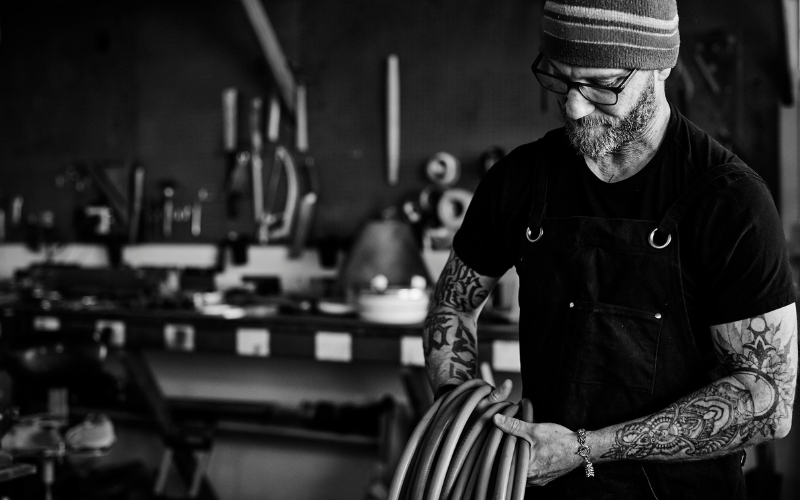
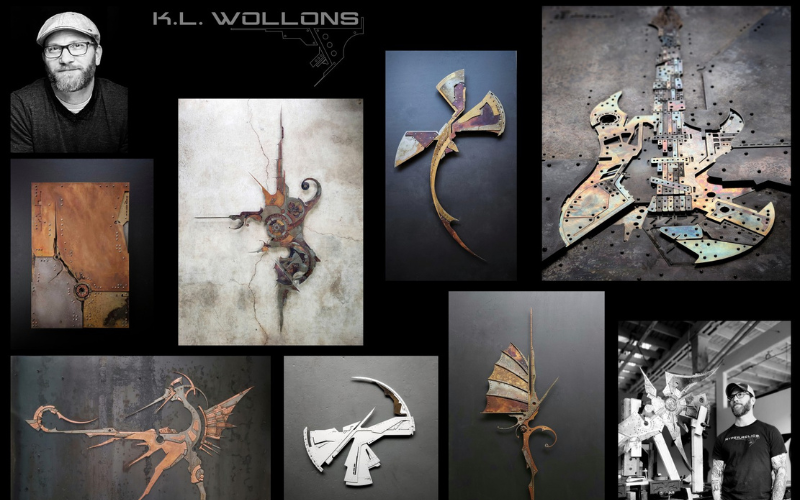
Featured Artist K.L. Wollons creates abstract metal wall reliefs that evoke ancient mystique while embracing modern industrial aesthetics.
Years spent in the aircraft manufacturing industry have influenced the material and construction techniques incorporated in his work. Since he began formally creating work in 2015, the idea of a “hyper relic” has been the driving theme behind every composition. Utilizing a mix of steel, copper, and brass, offset planes are bound together forming abstract structures, casting shadows, and reinforcing a theme of permanence. His subjects, intentionally ambiguous, are untethered to any specific era. Soft, familiar forms merge with sharp, angular planes to create work that feels both old and new, inviting the viewer in for a closer look.
In addition to studio projects, Wollons also specializes in commissioned works, collaborating with musicians, collectors, architects, and designers to create custom metal wall reliefs tailored to unique spaces and visions.
Artwork Archive got to talk with K.L. Wollons about his creative process, how he handles commission work, his favorite business tools, and more.
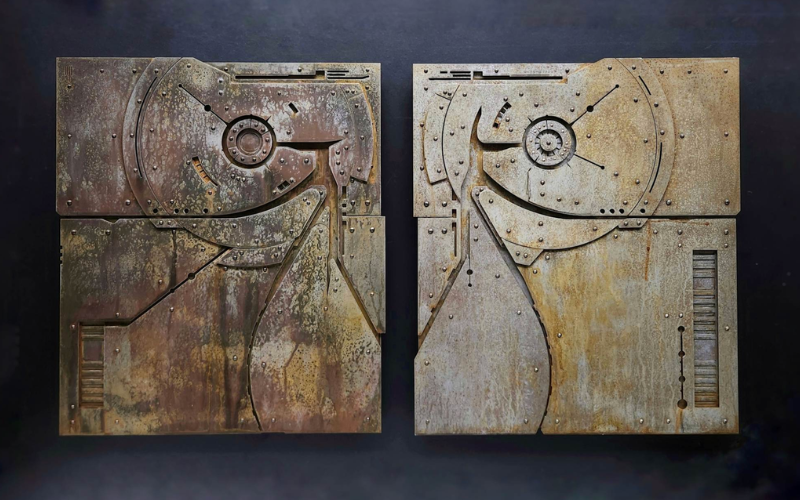
K.L. Wollons, Divisa Fatum (diptych), 18.5 x 34 x 1.5 in
The Sketch That Inspired a Career in Metal Sculpture
It all started with something K.L. Wollons almost threw away.
In 2015, he made a quick, offhand sketch on a small piece of scrap paper. "There was something about the structure of it that just stuck in my mind," he recalls. "I thought of how this shape could be created into a 'thing'.” For the first time, he started thinking seriously about metal as a medium for making art.
Ironically, that sketch never became a piece. But it did crack something open. "It set me off thinking more seriously about creating substantial objects from shapes I found aesthetically pleasing," he explains. And a nudge of encouragement from a few local artists and gallery owners in Portland pushed it the rest of the way. "I can't say enough about how much a little positive encouragement can turbo charge your pursuit when you're new and unsure," he says.
What he didn't fully realize yet was how much his choice of material would carry from another life entirely. The metal, the rivets, the sequential way he'd come to build each piece — all of it traced back to a world he'd already spent years inside.
How Aircraft Manufacturing Influenced His Metal Sculptures
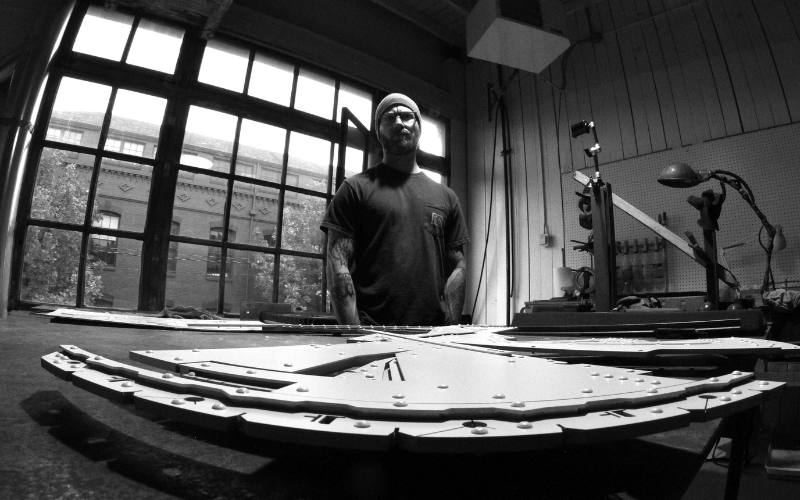
For years, Wollons worked inside aircraft manufacturing: a world built on zero-failure tolerances, meticulous process sequences, and the understanding that a small mistake compounds fast. When he moved into the studio, that world came with him.
"There is no denying my chosen medium is a result of having been exposed to aircraft manufacturing for many years," he admits. Metal bound by rivets are the obvious tell. Less obvious is the rest of it: the linear, sequential build process borrowed from the factory floor, and the hidden engineering every piece requires. "I'm considering what the piece needs to make sure the visual layers are supported, whether it can hang safely, and assuring unnecessary weight is designed out," he explains. "This is a purely analytical exercise with no artistic component."
The harder inheritance from this discipline is the perfectionism Wollons experiences: "I suffer from unhealthy levels of perfectionism with regard to my work." When he started out, every scratch, every poorly set rivet, every odd mark in the material had to be resolved. "I'm actually making a conscious effort, more with each piece, to embrace mistakes and imperfections," he insists. "Now, I consider them as added character and even an added value: human made."
And the more he sits with it, the more deliberate it becomes. "I have an attraction to inelegance," he adds, "a desire to keep an element of my work 'messy.'" The roughness earns its place. "It serves as a limiter that assures my work will never be perceived as pristine." The imperfections, in other words, are doing exactly what they're supposed to.
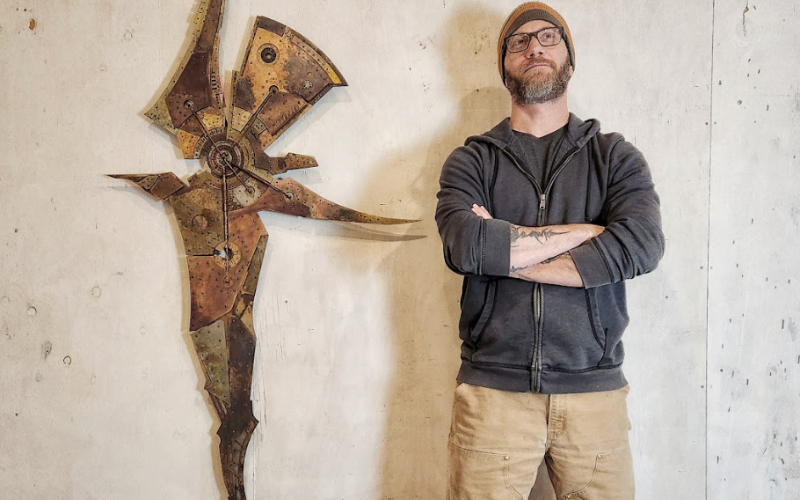
Inside the Process of Making a Metal Sculpture
Every piece starts with a pencil or pen sketch. Then the work goes digital: 2D and 3D CAD development, where Wollons expands the idea, builds the layers, engineers the structure, and sorts the material by metal type and thickness so it's ready to cut. Color treatment comes next. Then assembly — which in his own words breaks down to: “Set up fixtures and rivet, rivet, rivet!” A final pass cleans up cosmetic issues, adds wax, and the piece gets photographed.
The process is long and unforgiving. “With so many processes, there are a lot of opportunities throughout the production to make mistakes, the smallest of which can incur significant time and financial penalties,” he says. But, perhaps ironically, the multi-stage structure is also what keeps him from burning out. Each phase pulls on something different. “Throughout production I get to switch back and forth between pure artistic flow, analytical engineering, and physical fabrication. Just when I’m getting a bit sick of a process, it's typically time to move on to the next.”
If he has to pick a favorite, it’s waxing.
“It symbolizes the end of what can be weeks or months of work. It’s such a simple process, but it’s immensely satisfying — almost meditative for me.” Wax pulls depth out of the metal, he figures, the way glaze does for a painting. And then there’s the smell. “Every wax has a distinct smell that becomes oddly familiar and comforting. I look forward to it filling my workspace. It means I'm almost done!”
💡 Log Every Stage of a Multi-Step Process as a Single Record:
When your work moves through long, sequential production phases like Wollons' does, a single Artwork Archive record can carry the full history. Upload progress images at each stage, add cost entries as materials are used, and update status fields as the piece moves toward completion. By the time you're at the final step, the record is already a complete production log.
Why His Metal Sculptures Look Like Unearthed Relics
The hyper relic concept has been at the center of Wollons's work since 2015, but it's never been something from a specific reference or a period of research. "I tend not to create detailed narratives around pieces for myself or for viewers," he explains. The concept functions thematically, as a way of locating the work in time rather than anchoring it to a story.
The draw is what the premise withholds. Something unearthed from an undefined time, he notes, "implies something revealed that is meant to communicate something yet unknown. "This mystery is what I am drawn to. I can picture lifting any of my pieces from the ground, dusting off the dirt, and the theme still makes perfect sense to me."
The subjects stay deliberately ambiguous: untethered to any specific era, neither fully ancient nor fully modern. Soft familiar forms and sharp angular planes coexist in the same piece without resolving the tension between them. "I've come to accept that I have an attraction to inelegance," he adds, "a desire to keep an element of my work 'messy.'" It serves, in his framing, as "a limiter that assures my work will never be perceived as pristine." Pristine objects don't carry the weight of feeling found. His do.
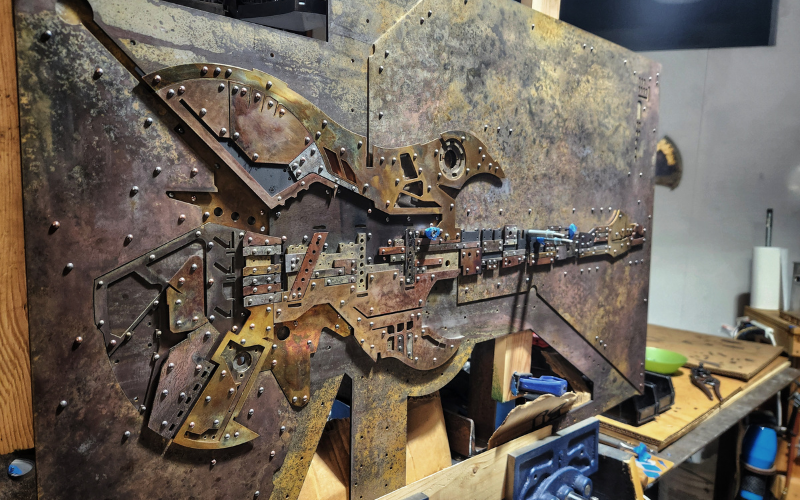
K.L. Wollons, Astral.07 (Commission), 39 x 24 x 2 in
How Wollons Takes Art Commissions Without Losing Creative Control
Commission work is a meaningful part of Wollons's practice. He collaborates with musicians, collectors, architects, and designers on custom pieces built for specific spaces and visions. But the way he approaches it is more selective than it might look from the outside.
His first question going into any new client conversation isn't about the piece at all. "I want to first make sure we get along," he says. He asks about things unrelated to art, reads how someone handles a relaxed exchange, and decides from there. "If conversation is easy, it's a good sign." Someone demanding, rude, or dismissive in a low-stakes conversation, he figures, will only get harder when creative differences come up.
Flexibility is the second thing he's looking for, and "inflexibility is a pretty quick deal breaker." He'll work within a client's ideas and respond to their space and constraints. What he won't do is execute someone else's predetermined vision start to finish. "I can work with someone's ideas, but I have no interest in being a conduit for someone else's vision." Once a commission moves forward, a detailed contract covers expectations, timeline, and how many revisions are included. "Not a minute is spent on a project until this is signed."
Early on, he mispriced commissions regularly, a combination of eagerness to land the work and underestimating how long creative iterations with a client actually take. "I've also fallen for the dreaded, and always untrue, 'you'll get a lot of exposure' line," he adds. On more than one occasion, he lost money. The contract, the vetting, the revision limits — all of it is the infrastructure he built after finding out what happens without it.
Still, he'd tell any artist to try commissions, "if only to get used to a bit of artistic discomfort. You may find the challenge actually pushes your work in a positive direction."
💡 Tracking Comissions in Artwork Archive:
Artwork Archive has a built-in workflow for managing commissions. Create a piece record with a sketch, connect it to the client's contact record, and register the sale to generate an invoice for a deposit. As the project moves forward, you can send iterations, tracks costs, and carry the full payment history through to the final invoice.
→ Get the step-by-step breakdown for managing commissions in Artwork Archive
The Business Skills Every Working Artist Needs
The best mindset shift an artist can make, Wollons believes, has almost nothing to do with making better work. "Acknowledge that you are in business and develop professional habits and behaviors that support your work."
Watch the artists who are really building careers, he says, and you'll see a pattern:
- "They're prepared to speak about their work even if it's not comfortable, because they've practiced the interaction."
- "They can communicate their pricing with confidene because they've developed a formula that removes any uncertainty."
- "They're not rattled by buyers asking for a discount because they know their costs and the value of their time."
- "They're prepared to answer questions about commissions because they've considered the impact this would have on their production schedule or whether they can work under a client's constraints."
- "They can take a payment at a show without fumbling for devices."
"These may seem trivial individually," he acknowledges, "but together they are behaviors that communicate professionalism."
The payoff runs deeper than appearances. A professional mindset, he's found, keeps small operational failures from turning into real stress. And it does something else too, something harder to measure: "It can also instill confidence in your buyers that you are serious about producing work, which may inspire them to become a collector." Answering email promptly, keeping a date commitment, leaving your phone in your pocket during a show... none of it feels significant in the moment. Together, it's the difference between an artist who's easy to trust and one who isn't.
💡 Turn a First-Time Buyer Into a Collector With a Contact Record:
Every buyer you add to Artwork Archive gets a contact record that stores their purchase history, contact details, and any invoices you've sent them. Over time, that record becomes a picture of the relationship — who bought what, when, and for how much. When you're ready to reach out about new work or a commission, the context is already there.
How Artwork Archive Simplifies His Art Inventory and Website
When K.L. Wollons decided to put his work into the world, he knew he'd need a way to organize it. He started with what he had: basic spreadsheets and folders full of pictures. With only a few pieces and no shows behind him yet, that was enough...until it wasn't.
He found Artwork Archive the way a lot of artists do: a successful artist friend mentioned the platform in a conversation about organization. "I figured if he was using it to manage his large art business, it was beyond capable for my art startup," he recalls.
Once he explored it, he says, it was obvious. "Now I use it for everything."
His favorite feature is the web embed integration, which lets him display his portfolio directly on his existing website. He can change images, update pricing, reorder work, show or hide prices, and adjust the layout entirely within Artwork Archive, and every edit reflects on his site automatically. "Implementing the integration code is easy," he notes, "and visually, the layout is clean and seamless with my site design."
💡 Update Your Inventory Once and Let It Reach Everywhere:
The website integration is one of several places your Artwork Archive inventory can pull from. The same piece record that feeds your website can also generate an invoice, populate a tear sheet for a collector, and appear in a private viewing room you share by link. Change the record once and everything stays in sync, so you're not out here keeping four versions of the same info straight in your head.
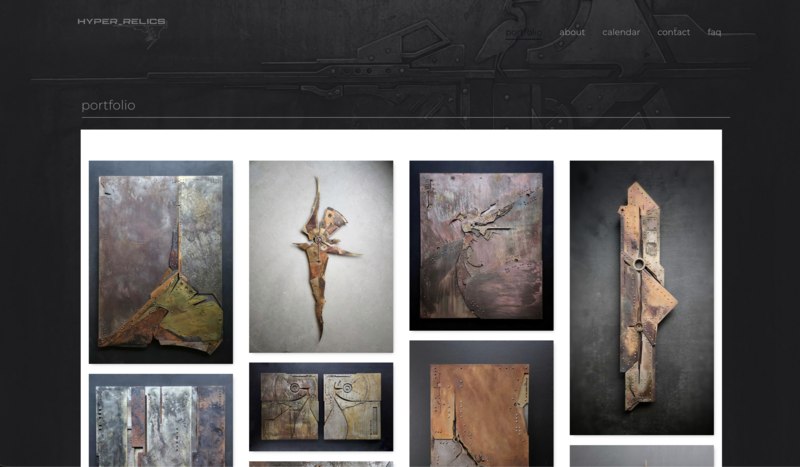
A peek at K.L. Wollon's website, where he has Web Embed set up through Artwork Archive
Why Emerging Artists Should Stop Asking “Do You Like My Art?”
For artists just getting started, Wollons has one piece of advice he keeps coming back to: "Don't make art to appease anyone." And, while you're at it, "resist the urge, however strong, to ask others if they like your art."
"There's no answer to this question that will benefit you," he insists. A yes might tempt you to constrain your style around someone else's approval. Hear a no, and you might abandon a direction that genuinely motivates you. "Even worse, you may become discouraged altogether. No random opinion is worth that."
What he's protecting is something he finds rare and worth guarding. "One of the most beautiful, fulfilling parts of being an artist is when another person is impacted by art that you've made solely because it's attractive or meaningful to you," he says. "Your vision." That connection, someone moved by work you made for no one but yourself, is what keeps his own ideas as pure as he can hold them.
He realizes this isn't easy, "especially if your work doesn't immediately get a reaction or sales are slow (and you need to make rent)"
"You may have the instinct to think, 'I'm making art that no one likes.'" His answer to that is "stop yourself" and keep moving. Make what appeals to you. Change and develop because you're curious, not because someone redirected you. "The payoff of watching someone connect with your work is worth it."
Get Organized So You Can Focus on the Art
No matter what season of your art career you're in, getting serious about your art career doesn’t need to feel overwhelming. A bit of structure now can mean more time and headspace for the work you actually want to be doing.
Artwork Archive helps artists build an online portfolio, stay on top of their inventory, and create things like tear sheets and invoices in just a few clicks. Start a free trial and see how it fits into your own process.