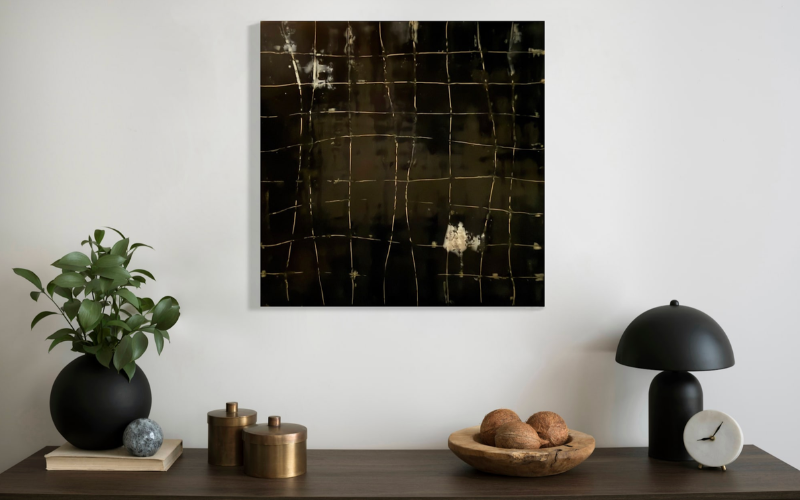
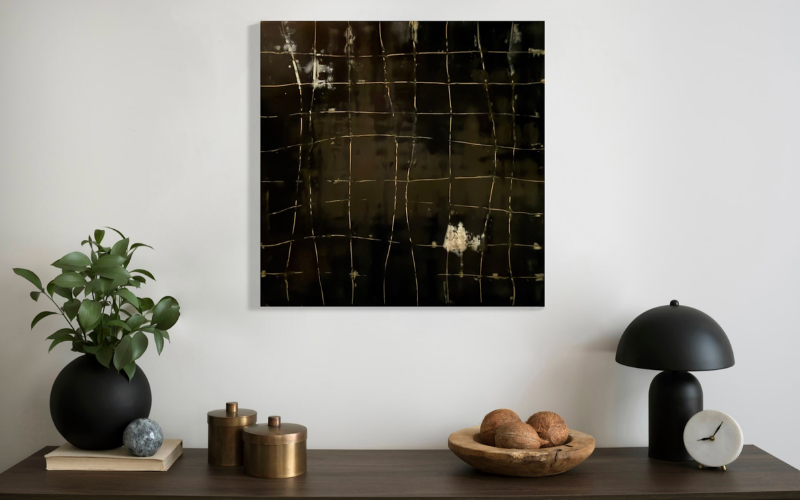
Shima Shanti, All That Remains bottom left, 18 x 18 x 1.5 in 2025
"It’s a labor of love. Bringing out the luminescence of encaustic. Painting with Beeswax. Fusing with fire. Made of Earth's elements."
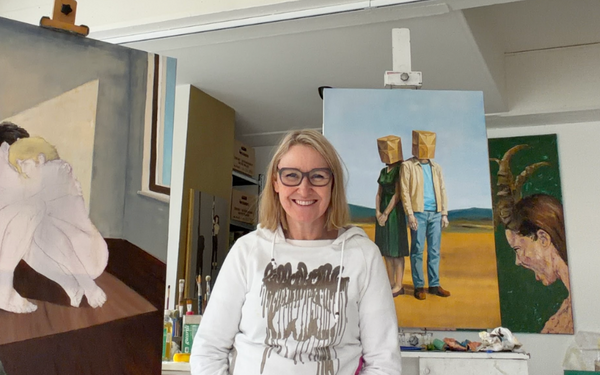
After decades in corporate leadership and six published books, Featured Artist Shima Shanti moved to the California coast and finally stopped resisting the pull to create. She found encaustic almost by accident, an ancient art form built on beeswax and fire that is technically demanding, temperature-sensitive, and completely unforgiving. Despite a humbling first attempt, she was hooked.
Working from her studio in Del Dios, a small lakeside hamlet near San Diego, Shima paints visions of peace: water in motion, spirit flow, the felt texture of something beneath the surface of appearance.
Her palette runs in deep, neutral earth tones, and her compositions are minimal. Yet the work rewards sustained attention with what she calls "unexpected levels of complexity," layers of patina and translucence that take time to reveal themselves.
That attunement to the natural world runs through everything she makes, including her materials: organic beeswax, earth pigments, Damar resin from fir trees, and Baltic birch panels. She attributes growing up surrounded by the open water and endless sky of Montana as what gave her an innate sense of color and composition.
She describes her work as an open-eye meditation, a practice of allowing the energy in each piece to find its own meaning rather than imposing one. The result is work that asks something of the people who encounter it: not effort or understanding, but a willingness to stop, and to feel something they cannot immediately name.
Artwork Archive got to hear more from Shima Shanti, including the mindset shift she says transformed her career, and the moment of chaos at Art Palm Beach that finally convinced her to get serious about her art business.
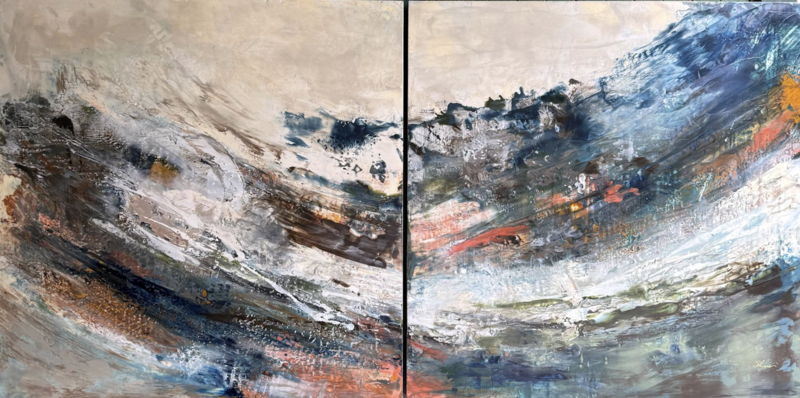
Shima Shanti, Becoming Otherwise-Where I Became diptych, 36 x 72 x 1.5 in, 2026
How Shima Shanti Found Her Artistic Voice Through Encaustic Painting
Somewhere past a long corporate career and six books, settled on the California coast, Shima Shanti carried a creative pull she had stopped trying to suppress. The medium she stumbled into offered no easy welcome. Encaustic is technically demanding and temperature-sensitive, and, she discovered, it does not reward the kind of control that served her everywhere else.
"My first attempt was humbling," she recalls. "The medium was completely unlike anything I had tried."
But there was a moment she remembers clearly: "when I stopped fighting the wax and let it move the way it wanted to move under the torch." That's when something unlocked for her. "The material felt alive. I realized I was not trying to paint a picture; I was collaborating with something."
For Shanti, it all came down to a trade she was finally willing to make. Hand over a little control, and she discovered the medium gave her something she could not have planned on her own.
"When I understood that encaustic required me to surrender a little of my own control, I knew it was mine."
Inside Shima Shanti’s Encaustic Painting Process
A finished encaustic painting hides most of the labor that made it. By the time Shanti puts any color down, she's already spent days masking panel edges, sanding the surface with encaustic gesso, and building three to five layers of clear wax, fusing each one with a torch.
"This is not preamble," she insists. "It's an essential ritual. Each layer adds depth and translucence to everything that comes after."
When the painting itself begins, she works flat on a table, laying bold strokes of molten beeswax and pure earth pigment. "I have an idea of where to begin," she says, "but I am never certain of the outcome." Then she reaches for the torch again: "That's where the real painting happens. The fusing. The fire. You cannot control it entirely, and that's exactly the point." It's her favorite part of the whole process: "The wax transforms under the torch and something unexpected always emerges."
She works in the pre-dawn quiet, "the owls retreating and the hummingbirds just beginning," and the layering settles into a meditation. As for knowing when to stop, she trusts a single feeling. "I know a piece is finished when I see what I feel in my heart reflected back at me from the panel." The emotion sometimes arrives only after the work is done, and sometimes it stays hidden even from her, a private message waiting for the right viewer.
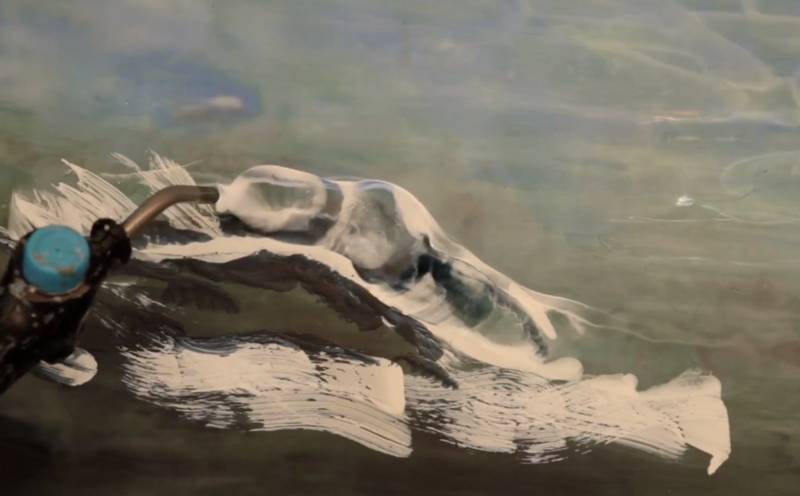
A look at Shima Shanti's process, as she takes a torch to one of her birch panels. Image courtesy of the artist
How Shima Shanti Connects Art, Meditation, and Spirit
Shima Shanti splits her studio mornings into two camps, depending on the day. On ordinary mornings, painting serves as a way of processing her own emotional state, what she terms "a way of getting out of my own way."
On her strongest days, though, the source sits outside of her entirely. As a piece comes together, she registers the presence of something larger than herself. "I call my art my connection to Spirit," she explains.
Within that meditative state, authorship inverts. "The painting starts to lead," she notes. "I follow."
What she hopes a finished painting offers is "the kind of peace that does not require anything of you," and the wish behind it is simple. "I want a person to stop. In our world, we do not stop. We scroll past everything."
A painting that makes someone pause, she believes, does more than hold their attention.
"What gets awakened is the part of us that already knows how to be still. We just forget. Art reminds us."
How Her Definition of Success as an Artist Changed
Shanti entered the art world equipped with a corporate definition of success: sales figures, exhibition tallies, the prestige of the venue. "Those things matter, practically speaking," she maintains, and her exhibition record bears that version of success, from Art Palm Beach to the Hamptons, Scottsdale, and Los Angeles.
But now, she applies a deeper measure: "Success to me now is whether I was true to the painting," she tells us, "whether I stayed in the process long enough to let the work become what it needed to be rather than what I thought it should be."
As most working artists know, sometimes the right painting and the sellable one are the same, and sometimes they're not. For a while early on, Shima had been split, weighing "what I wanted to make versus what I thought people wanted to see," and she found no way through it. "It was a creative dead end." But throughout her career, she's "learned to trust the painting."
Getting to that point came down to one mindset switch: "I stopped thinking and returned to my essence as an intuitive artist. "The moment I allowed the work to speak for itself, the audience found it." She puts the reason simply, "authenticity is magnetic," and she trusts the people buying to feel it. "You cannot fake it in a painting, and collectors who spend time with art know the difference."
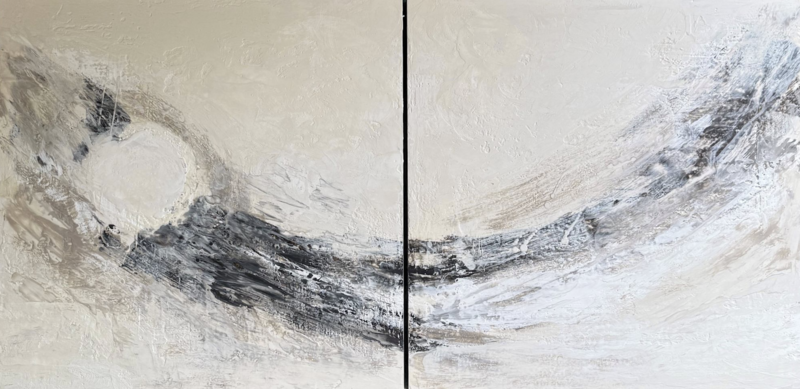
Shima Shanti, What Remains, Unheld, 36 x 72 x 1.5 in 2026
Why Artists Need a System for Managing Their Inventory
Trusting the work is one thing in the studio. Carrying it across the country is another. Shanti keeps a demanding exhibition schedule, with work moving between her studio, galleries, and fairs in several states at once, and for years the logistics of all that movement nearly undid her.
The breaking point came one year in the days before Art Palm Beach. She was coordinating gallery consignments across several states and building new work at the same time, with no reliable record of where anything was. Then a gallery called to confirm a piece was on its way.
"I genuinely did not know which painting they meant, where it was, or what I had priced it at," she recalls.
She had run her whole inventory by hand, with spreadsheets, handwritten notes, and a running thread of emails to galleries about what was where and what had sold. Pieces went missing, prices got misquoted, work shipped to the wrong show. "It cost me time, money, and embarrassment," she explains, and the lesson stayed with her.
"The business side of being an artist does not get easier on its own. You have to build systems for it."
She knew exactly what she was looking for. "I needed a platform built for the way artists actually work," she notes, "one that understood provenance, consignment, exhibition history, and image documentation all in one place." Artwork Archive checked every box. "It was built for artists, not adapted for them."
Her go-to features are Consignment Reports and Location Tracking. Before a show, she pulls up every piece at a gallery, cross-checks it against what has sold, and knows what she's working with, with no calls to make and "no spreadsheet archaeology." Now, the full record of each work travels with it, provenance and exhibition history and images together. "That kind of institutional memory used to live only in my head. Now it lives somewhere I can actually access it."
💡 Answer the Gallery Call Before It Comes:
A Consignment Report shows you every piece a gallery is holding, what it's priced at, and what has already sold, so the call asking you to confirm a delivery has an answer ready before you pick up. Pair it with Location Tracking, which logs each move a piece makes between your studio, a gallery, and a fair, and you can see where your whole inventory is at any moment.
Start Documenting Your Art Career From Day One
By now, Shima Shanti has assembled the kind of career an emerging artist might strive for: a demanding exhibition schedule, work in galleries across the country, and a body of work she can account for down to the last piece. So when she talks to artists at the beginning of their careers, her advice breaks down to this:
"Spare no expense on your materials and no effort on your preparation," she urges, "but be infinitely patient with your process." Then the checklist:
- build your archive from the very first piece
- document everything
- price with intention
- and show up.
"The business of being an artist is real and you have to take it seriously."
The second half is the one she cares about most. All the discipline in the world means nothing if you lose the reason you started.
"Stay in the studio. Paint when nothing is selling. Let the work lead you somewhere you did not expect."
Shima Shanti arrived at this work late, after a long career spent measuring everything she did. Encaustic taught her to measure differently, and keeps teaching her the same thing: "The career follows the art, not the other way around."
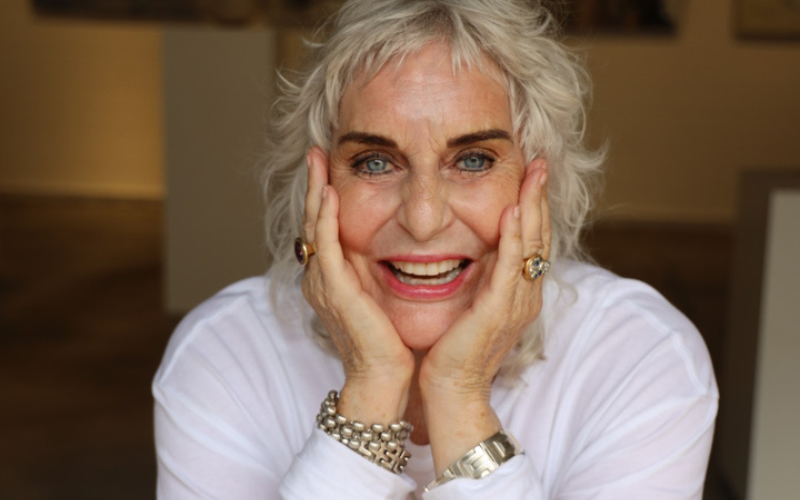
Build a More Organized Art Career
No matter what season of your art career you're in, getting serious about your art career doesn’t need to feel overwhelming. A bit of structure now can mean more time and headspace for the work you actually want to be doing.
Artwork Archive helps artists build an online portfolio, stay on top of their inventory, and create things like tear sheets and invoices in just a few clicks. Start a free trial and see how it fits into your own process.