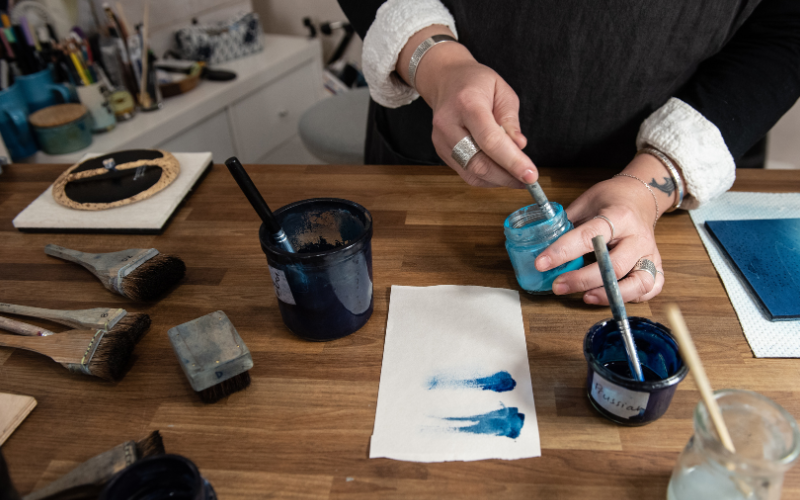
 Featured Artist Mara Cozzolino prepares water-based pigments in her studio, where color, paper, and process all play a central role in her mokuhanga practice. Photo courtesy of the artist.
The Art of Mokuhanga: Inside Mara Cozzolino’s Woodblock Printing Practice
A sheet of handmade paper rests on top of a carved block of wood. Pigment and water sit in shallow dishes nearby. In her hands, a bamboo baren moves across the surface in steady circles, pressing color from wood into fiber.
This is the daily rhythm of Italian printmaker, and Artwork Archive's Featured Artist, Mara Cozzolino.
Born in Turin, Italy, Cozzolino mader her first relief print at just eleven years old. The process stayed with her long before she knew it would shape her career. Today, her practice centers entirely on mokuhanga, the traditional Japanese technique of water-based woodblock printing historically used in iconic ukiyo-e prints. From her studio in northwest Italy, this artist designs, carves, and hand-prints intricate landscapes drawn from the natural world.
Artwork Archive got the chance to speak with Mara Cozzolino about the slow craft of woodblock printing, the mindset required to sustain a studio practice, and the systems that help her run the business side of her work.
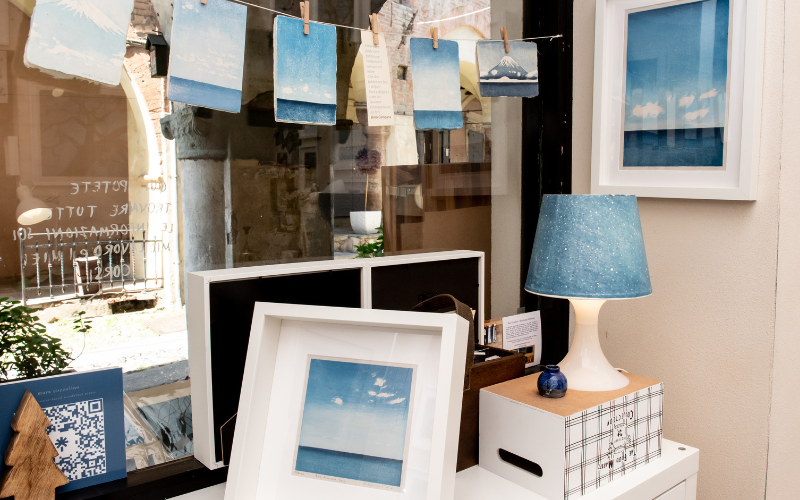 A display of Mara Cozzolino’s prints highlights the luminous skies, seascapes, and transitions that run through her work. Photo courtesy of the artist
How a Mokuhanga Woodblock Print Takes Shape
Most of Mara Cozzolino's ideas begin in passing. Walking through her town, traveling, or simply looking up at the sky outside her window.
She gathers reference photos as she moves through her life, collecting fragments of branches, landscapes, and shifting cloud formations that catch her attention. Later, those photos return to the studio, where they wait to be transformed into sketches.
"I never copy directly from photos," she explains. "Most of the time I make mental collages.” A branch from one place could merge with a horizon from another. A cloud appears where it never existed...
Some of those preliminary drawings develop digitally on her iPad, using layers in much the same way she will later build the print itself. Mokuhanga relies on multiple blocks for multiple colors, so even the sketch already has to think ahead.
Eventually, the drawing transfers onto wood. Then the carving tools come out.
This is where Cozzolino settles in.
From Carved Block to Finished Print
Spend enough time talking with printmakers and one theme will surface again and again: patience. The medium demands it. Wood, water, pigment, paper. Every step asks the artist to slow down and pay attention.
In relief printmaking, the image emerges through subtraction. Anything carved away from the surface will not print. As Cozzolino puts it, “If I want to print a branch, I need to carve away everything that is not that branch.”
The process requires careful planning. Each color in the final image needing its own wooden block, carved separately and aligned during printing. A single composition may involve multiple surfaces, each one carrying part of the whole.
Even with all that preparation, carving remains the part she loves most. On this, she's certain: “Carving is definitely my favorite part of the process.”
While drawing demands intense creative focus, carving allows something different to happen in Cozzolino's mind. “Carving takes time,” she points out, “sometimes days or weeks for a single design. During that time I start thinking about the next works or planning a series.” The rhythm becomes almost meditative: While her hands stay with the block in front of her, other ideas begin forming.
Once every block is carved, the printing begins.
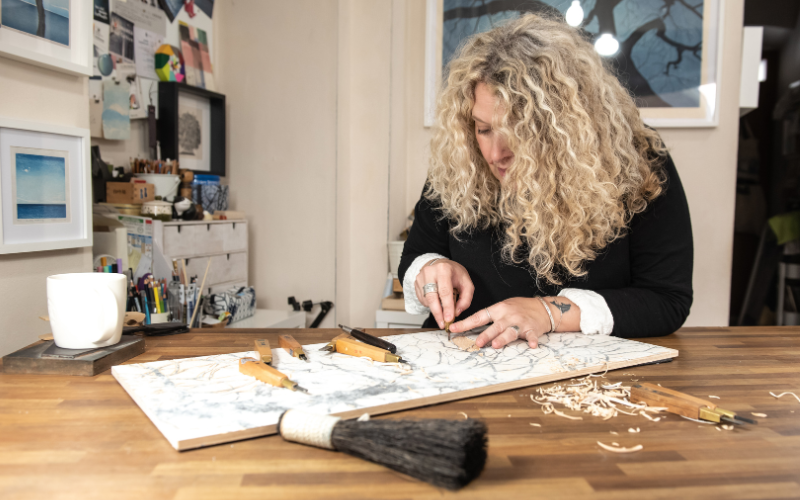
Pigment and water are brushed directly onto the wood surface. Paper is placed carefully over the block. Instead of a printing press, Cozzolino transfers the image by hand using a bamboo tool called a baren.
Most of these works exist as editions, which, as she explains, means printing more than one copy and numbering each impression.
She rarely prints the full edition in one sitting. “I usually print small batches at a time. I don’t like printing the whole edition in one go. I prefer taking my time.”
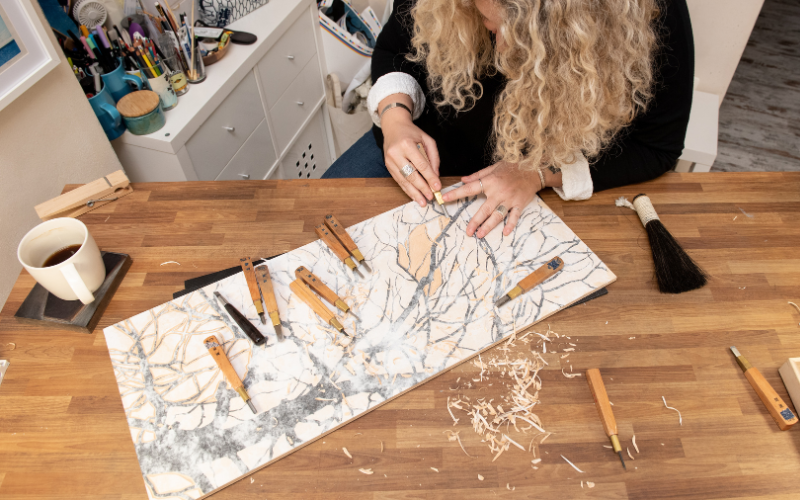 In her studio, Mara Cozzolino carves a woodblock by hand, part of the slow and deliberate mokuhanga process that shapes each print. Photo courtesy of the artist
The Challenge of Managing Print Editions
Printing in editions introduces a practical challenge.
A single image exists in multiple impressions, each one numbered, and each one may eventually end up somewhere different. One print might go to a gallery. Another to a collector. Others remain in the studio, waiting for the next exhibition or sale.
For a printmaker, that means organization quickly becomes part of the job, and Cozzolino remembers the moment she realized how easily inventory can slip out of sync.
“This luckily only happened to me once and at the very beginning,” she says, recalling a time she sold a print online that she didn’t actually have anymore. “But it was very embarrassing, and I promised myself it would never happen again.”
After that experience, keeping track of inventory stopped feeling optional.
How Printmakers Can Track and Manage Editions
If you work in editions, treat inventory updates as part of the artwork’s lifecycle, not something to deal with later.
When each impression has a clear record of where it went and whether it is still available, you are far less likely to lose track of what is actually on hand.
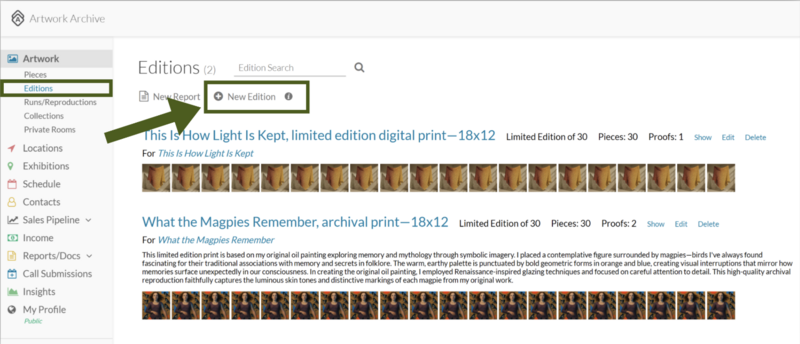
Use Artwork Archive's Editions feature to create Edition Sets, add individual pieces, manage limited and open editions, and track everything in one place.
Finding a New Artistic Direction Through Printmaking
Mokuhanga did more than introduce a new technique into Cozzolino’s studio. Overtime, it gradually reshaped the direction of the work itself.
Printmaking had been part of her life for years. She pulled her first relief print at eleven, then later began experimenting with traditional Western etching. But those processes came with chemicals and solvents she found increasingly hard to ignore. “Traditional etching was quite toxic,” she points out.
In 2009, an unexpected event forced a pause in her studio practice altogether. A house fire destroyed much of her work and studio materials, and it took time before she returned to making art. When she did, she came back with a clearer sense of what she no longer wanted in the studio: “I didn’t want to use anything toxic in my practice anymore.”
While searching for alternatives, she discovered contemporary mokuhanga—the Japanese method of water-based woodblock printing built around wood, water, pigment, and paper.
The materials immediately resonated. “I completely fell in love with the medium. The cleanliness of wood, water, pigment and paper was what I really needed at the time.”
A short introductory workshop confirmed her curiosity. Soon after, she was awarded a grant from the Japanese nonprofit MI-LAB to study the technique in Japan, spending forty days between Tokyo and Fuji-Kawaguchiko learning from experienced practitioners.
The experience reshaped the way she thought about image-making. Rather than using mokuhanga to translate the kinds of pictures she had already been making, she began asking what the medium itself “was asking me to make.”
Working with wood led her toward trees. Water-based pigments naturally pointed toward skies and seascapes. Then, during the lockdowns of 2020, clouds entered the work as she spent long stretches at a studio table beside a window. “Looking at the sky every day gave me strength,” she recalls. “And great inspiration.”
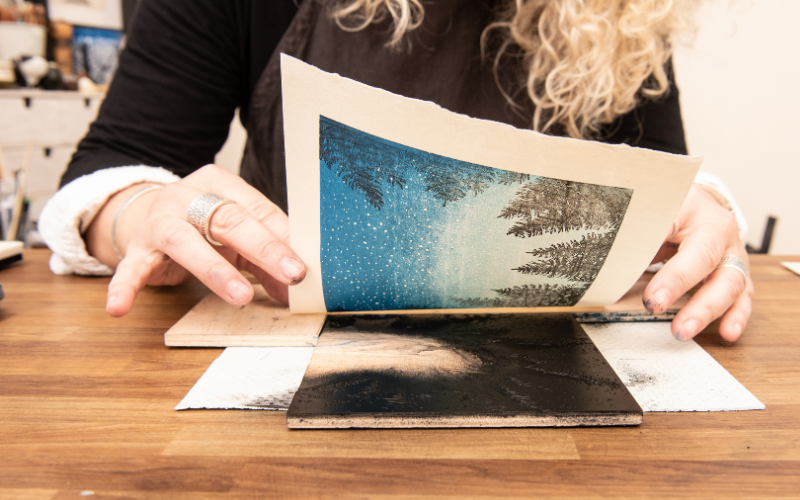 Cozzolino lifts a fresh print from the block, revealing one of her layered scenes inspired by trees, sky, and the natural world.
How the Natural World Becomes Part of Mara Cozzolino’s Process
As Cozzolino’s relationship with mokuhanga deepened, the natural world began entering her work in a second way. It remained the subject of the image, but in some projects it also became part of the material process.
One series, Memento, focuses on burned trees from wildfires in the valley where she lives. Instead of traditional ink, she created pigment using soot gathered directly from the charred bark of those same trees.
Another project, Printing with the Sea, explores environmental change in the Mediterranean. For these prints, Cozzolino replaced fresh water with seawater while printing several of her coastal landscapes. The resulting works are intentionally unpredictable. Salt and minerals may slowly alter the paper over time, leaving visible traces of the environment in which the prints were made.
That uncertainty was part of the point. The works were never meant for sale. They were meant, in her words, “to record the changes that may happen to the prints themselves.”
Both series were later selected for the international printmaking conference IMPACT —first in Bristol in 2022 and then again in Canada the following year.
Through these projects, the landscape moves beyond subject matter. It becomes part of the process itself.
Why Artists Should Archive More Than Finished Work
Even when a piece is not meant to be sold, it still belongs in your archive.
Recording experimental works, material notes, and project context helps preserve the full story of your practice and makes it easier to reference those works later in exhibitions, applications, and writing.
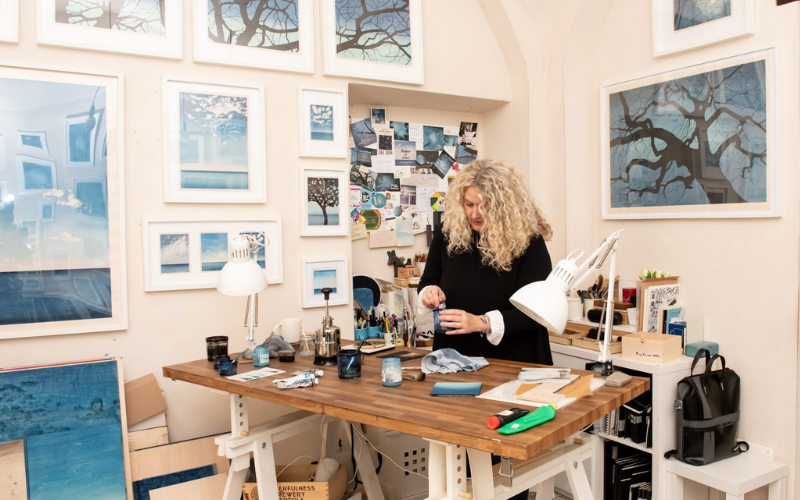 Surrounded by prints, sketches, and source material, Mara Cozzolino works in her studio. Photo courtesy of the artist
Why Professional Artists Need a Consistent Studio Routine
For all the patience involved in her craft, Mara Cozzolino speaks about her career with clear practicality:
“If you want art to be your job,” she says, “you need to treat it like a job.”
The romantic idea of waiting for inspiration does not hold up for long inside a working studio. She jokes about the fantasy of artists “sipping coffee or tea in their studio waiting for the muse,” but her own experience has taught her something less romantic and more useful: "practice, practice, practice."
Her days follow a simple structure. Morning and early afternoon are reserved for carving and printing, when her concentration is strongest. Then administrative tasks, like applications, gallery communication, documentation, and record keeping, happen later in the day.
Even her listening habits change depending on the stage of work.
Drawing requires silence. Carving invites audiobooks or television series playing in the background. Printing has its own soundtrack entirely.
“If I find the right piece of music, I can listen to it on repeat for days," she laughs, “It drives my husband crazy!"
How to Keep Your Artwork, Editions, and Exhibitions Organized
Keeping track of the work is part of the job, too.
Cozzolino first came to Artwork Archive while looking for a way to present her portfolio online. What she wanted was something “elegant and simple, and also easy to use.”
At first, that was enough. But over time, the platform became useful for much more than presentation.
Now she uses it to keep her inventory updated, follow which works are still available, and see where particular prints have ended up. For an edition-based practice, that kind of visibility matters. It helps her know which galleries have particular pieces and how many impressions are still available.
She also uses the platform to hold the more technical side of the work: how a print was made, how many blocks were involved, which paper she used, which colors or pigments shaped the final image. Some of that stays private as part of her own records. Some of it can be shared with collectors or curators who want a closer understanding of the piece. “I can decide what to share with the public and what’s just for my business information.”
Because she often works in series, she loves being able to upload similar-sized works by copying an existing entry and changing the specifics, a small shortcut that saves time when adding new prints. More recently, she has also started using the Exhibition and Submission tools, and plans to bring her gallery information into the system as well.
What began as an online portfolio now functions as a fuller archive of the work. “I have everything in one place.”
Use Your Art Archive to Simplify Your Art Practice
Your archive should do more than hold information. It should make everyday things easier, like sharing your portfolio, finding artwork details quickly, or checking your exhibition history when an opportunity comes up.
Want to see how more artists are using these tools in real life? Join our next webinar, where we’ll walk through favorite features and show you how to adapt them to your own workflow!
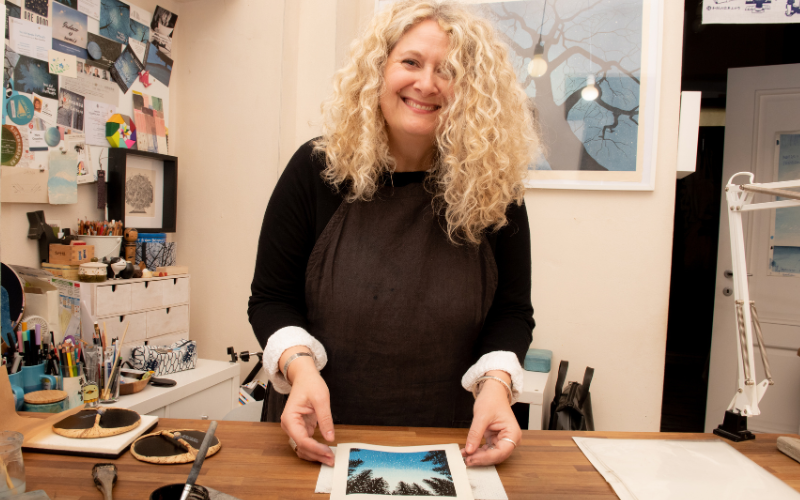 Featured Artist Mara Cozzolino stands in her studio with a newly printed work, offering a glimpse into the hands-on process behind her mokuhanga landscapes. Photo courtesy of the artist
Advice for Artists Starting Their Careers
When asked what advice she would offer artists starting their careers, Mara Cozzolino comes back to the same things she has built into her own life: practice, structure, and a way of working that can hold up over time.
“Give yourself a schedule,” she reiterates. “Set goals, even small ones. Keep track of your process and your progress.”
You can feel that advice in the way she works. In the hours she protects for carving and printing, the records she keeps, and in the consistent, unglamorous routines that keep the work moving.
Documentation matters. Systems matter. The business side of art cannot be ignored if the goal is a sustainable career.
At the same time, she offers one final reminder. "The most important thing should always be the artwork.”
No matter where you are in your art journey, getting your business side in order doesn’t have to feel overwhelming. A bit of structure now can mean more time and headspace for the work you actually want to be doing.
Artwork Archive helps artists build an online portfolio, stay on top of their inventory, and create things like tear sheets and invoices in just a few clicks. Start a free trial and see how it fits into your own process.