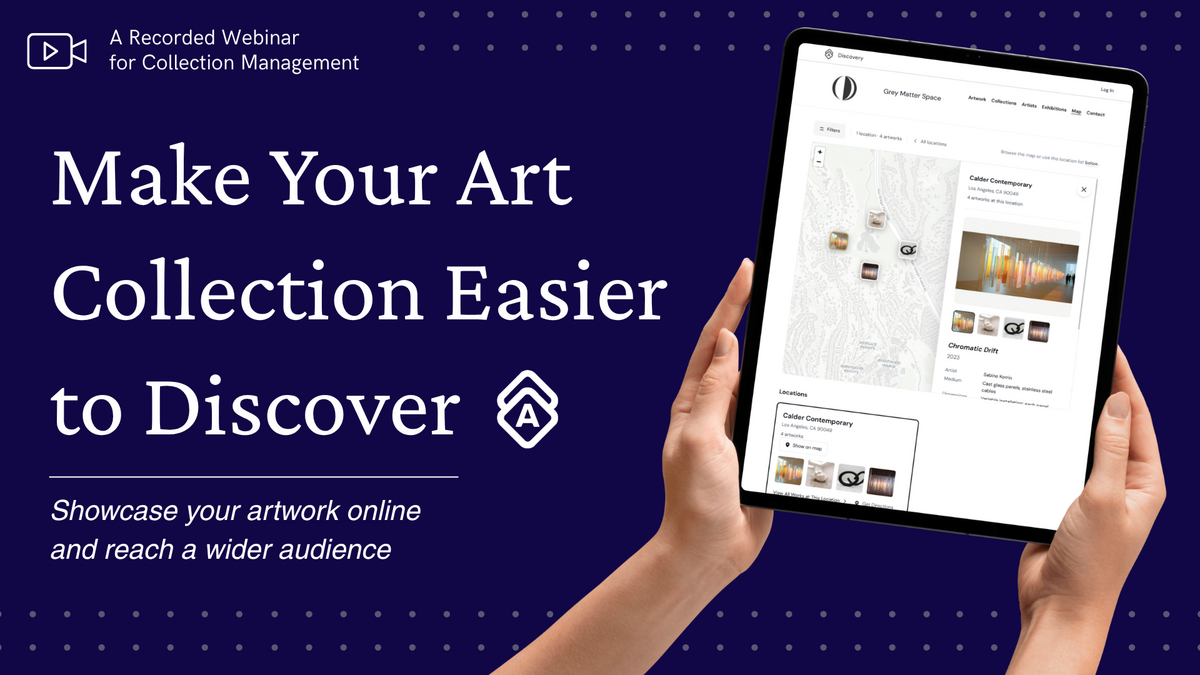
 An online collection can do more than display artwork; it can connect people with stories, artists, and places.
Bringing an art collection online is not simply a digitization project. Done thoughtfully, it can help researchers narrow an inquiry, prepare students for their first museum visit, preserve an artist’s story, connect public art across an entire city, and demonstrate an organization’s impact long after an exhibition closes.
In Artwork Archive’s recent webinar, Make Your Art Collection Easier to Discover, we spoke with two arts leaders approaching online access from very different settings:
- Jasmine Herrera, Interim Director of the University Art Museum at New Mexico State University
- paris cian, Senior Public Art Project Manager at Arts New Orleans
NMSU’s University Art Museum uses digital access to make an academic collection more useful to students, faculty, researchers, and the public. Arts New Orleans brings geographically dispersed murals, sculptures, and civic artworks together as a connected citywide collection.
Their experiences surfaced an important lesson: an online collection creates the most value when it does more than display objects. It should help people find a meaningful point of entry, understand what they are seeing, connect online discovery with physical experience, and know what to do next.
Here are some of the biggest insights from the conversation.
1. Online access can make in-person research more manageable
The University Art Museum holds more than 2,000 Mexican retablos, which is the largest collection of its kind in the United States. Although the museum now has a permanent gallery for the retablos, only a small portion can be exhibited at once.
Publishing the collection online allows researchers to search by subject, iconography, saints, and other areas of interest before requesting an appointment.
Instead of asking the museum’s small team to pull dozens of objects from storage, a researcher can explore the collection remotely, identify the ten works most relevant to their project, and arrive with a more focused request.
This benefits both sides:
- Researchers can begin their work from anywhere.
- Museum staff can prepare more efficiently.
- Fragile objects do not need to be handled unnecessarily.
- The physical visit can become more focused and productive.
The takeaway is not that digital access replaces direct encounters with artwork. It can help people prepare for—and make better use of—the opportunity to engage in person.
2. Showing more online does not necessarily discourage a visit
Organizations sometimes worry that publishing extensive collection or exhibition information will give too much away. Jasmine has observed something different at the University Art Museum.
Students often look online before entering an unfamiliar place or trying a new experience. Installation photographs, artwork records, and exhibition information can help them understand what they will encounter and feel more confident walking through the museum’s doors.
This was particularly valuable for a performance-based exhibition. By seeing the gallery and learning something about the experience in advance, students could arrive with fewer uncertainties without having the entire experience revealed.
As Jasmine explained, online access “kind of does the opposite” of replacing a visit: it helps students feel comfortable because they know what they are walking into.
For students who have limited previous experience with museums or galleries, that familiarity can be an important form of access.
3. An exhibition can continue creating value after it closes
The University Art Museum embeds exhibitions from Artwork Archive directly into the museum’s institutional website. This allows visitors to explore installation images, individual objects, artist information, and interpretive material even after a physical exhibition has come down.
The museum continues to see traffic to these past exhibition pages. That ongoing engagement does more than preserve a programmatic record, it also helps the museum demonstrate its reach.
When NMSU’s new museum building opened in February 2020, it almost immediately had to close because of the pandemic. The team moved its inaugural exhibition online and captured the resulting web traffic. Those figures later helped support grant applications.
This offers a broader way to think about institutional impact. Attendance is not limited to the number of people who cross a gallery threshold. Online exhibitions can support:
- Continued teaching and research
- Long-term access to curatorial work
- Grant and impact reporting
- Artist visibility
- Future inquiries about images, loans, and related scholarship
A temporary exhibition does not have to become a temporary resource.
4. A public collection record can be a form of support for artists
For Arts New Orleans, bringing public art online is not only about documenting municipal assets. It creates a lasting place for artists and their work.
Public artworks may remain in place for decades while artists move, their practices evolve, websites disappear, or members of the community pass away. A centralized public record preserves the relationship between the artwork, its creator, and the community for which it was made.
Speaking as both an artist and a public art administrator, paris described this continued documentation as a form of institutional care:
“The work that we’re doing with an artist is not ending at their commission.”
An artist can share their Arts New Orleans profile when applying for a grant or introducing their work to a funder, collector, or community partner. Years later, family members can also use the archive to rediscover work created by a relative.
The “aha” moment here is that collection documentation does not only serve the organization. It can become professional infrastructure for the artists represented within it.
5. Document the making of the artwork—not only the finished object
A photograph, title, medium, and location may identify a public artwork, but they rarely capture its full story.
Arts New Orleans intentionally documents artists during the commissioning and fabrication process. Staff and collaborators visit studios, conduct interviews, photograph works in progress, and ask artists about questions such as:
- How did they arrive at the idea?
- Why did they choose a particular place or material?
- Which community members contributed?
- How might the commission influence the artist’s future practice?
For projects such as The Mirage by Trinity Barriere and Pause Here, The Land Is Speaking by Jamar Duval Pierre and Young Artist Movement (YAM), this documentation preserves the involvement of young artists and community collaborators alongside the finished artwork.
These interviews, videos, process images, credits, and interpretive details are then brought together within the artwork record. Visitors can encounter the complete context—not merely the final object.
The best time to collect this information is while the work is being made. Trying to reconstruct it years later is much harder, and some voices may no longer be available.
6. Maps connect digital discovery with physical place
A public art collection does not sit within one building. It may be spread across parks, libraries, city offices, transit corridors, and neighborhoods.
Arts New Orleans uses an interactive map to turn those individual works into a connected collection. A resident can discover artwork in their neighborhood. A visitor can plan a route. Someone who encounters a mural unexpectedly can scan a QR code, learn about the artist, watch a process video, and find other works nearby.
The map therefore supports discovery in both directions:
- Someone can begin online and then visit the artwork.
- Someone can begin with a physical encounter and then continue exploring online.
This same approach can benefit universities, hospitals, airports, corporate campuses, and other organizations with collections distributed across multiple buildings or locations.
7. Public access requires thoughtful limits
Making a collection discoverable does not mean publishing every piece of information in its database.
Both panelists described maintaining detailed internal records while deliberately selecting what should appear publicly. Condition reports, valuations, conservation records, donor information, and other sensitive details remain available to authorized staff without being published.
The larger challenge is often not deciding what to hide. It is determining what a small team can realistically maintain.
A sustainable approach may mean:
- Beginning with a distinctive collection or priority exhibition
- Publishing records in phases
- Creating online exhibitions for major shows first
- Assigning clear responsibility for photography and documentation
- Building public access into existing workflows
- Improving records over time instead of waiting for a “finished” archive
As paris noted, creating and preserving an archive requires real staff attention. The goal is not to publish everything at once, but to establish a practice the organization can continue.
8. Accessibility is shared work
An online collection is only meaningfully public if people with disabilities can use it.
Artwork Archive’s redesigned Public Profiles and website embeds are designed and maintained to conform with WCAG 2.1 Level AA. They support keyboard navigation, screen readers, text resizing, appropriate color contrast, clear page structure, consistent navigation, and properly identified forms and error messages.
The platform provides the technical foundation, but organizations shape the accessibility of the content placed within it. That includes:
- Writing meaningful alternative text
- Providing clear object descriptions
- Captioning and transcribing media
- Uploading accessible documents
- Maintaining accurate, understandable information
Accessibility should therefore be part of the documentation and publishing process from the beginning and not an addition made after the collection is online.
For public institutions, this work is especially timely. Under the Department of Justice’s updated Title II schedule, larger state and local government entities generally have until April 26, 2027 to meet WCAG 2.1 Level AA, while smaller entities and special district governments generally have until April 26, 2028.
Public Profile or website embed?
The webinar also clarified a common question about Artwork Archive’s two public-sharing options.
A Public Profile is a ready-to-use destination for a collection hosted by Artwork Archive. Visitors can explore published artwork, artists, collections, exhibitions, maps, news, and organizational information in one place.
A website embed brings selected collection content directly into an organization’s existing website. To a visitor, the material feels like part of that website, while the information continues to come from the records maintained in Artwork Archive.
Organizations can use either option or combine them. In both cases, staff can update the underlying collection record once rather than maintaining separate sets of public information.
How to begin making a collection more discoverable
The examples shared by NMSU and Arts New Orleans suggest a practical starting point:
- Define your audience. Are you trying to reach students, researchers, residents, tourists, donors, artists, or another community?
- Choose a meaningful place to begin. Start with a distinctive collection, major exhibition, geographic area, or group of records with strong documentation.
- Decide what should remain internal. Establish publishing standards for sensitive, incomplete, or restricted information.
- Capture context early. Gather artist interviews, process images, collaborators, community histories, and interpretive information while it is still readily available.
- Create several paths into the collection. Use collections, exhibitions, artists, themes, filters, and maps to support different kinds of discovery.
- Make the next step clear. Help visitors plan a visit, request research access, inquire about image rights, propose a loan, or contact the organization.
- Build accessibility into the workflow. Add alternative text, captions, transcripts, and accessible documents as content is prepared.
- Treat the archive as a continuing practice. Launch with what you can sustain and improve it over time.
A discoverable collection is not simply one that appears online. It is one that gives people a meaningful way in, and a reason to continue exploring.
Explore the participating collections:


