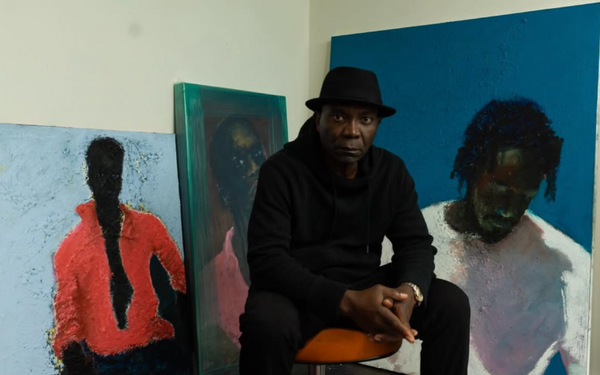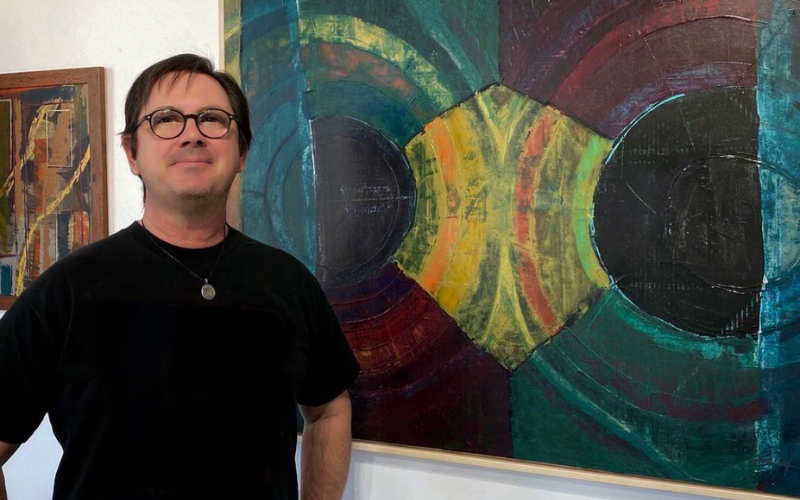
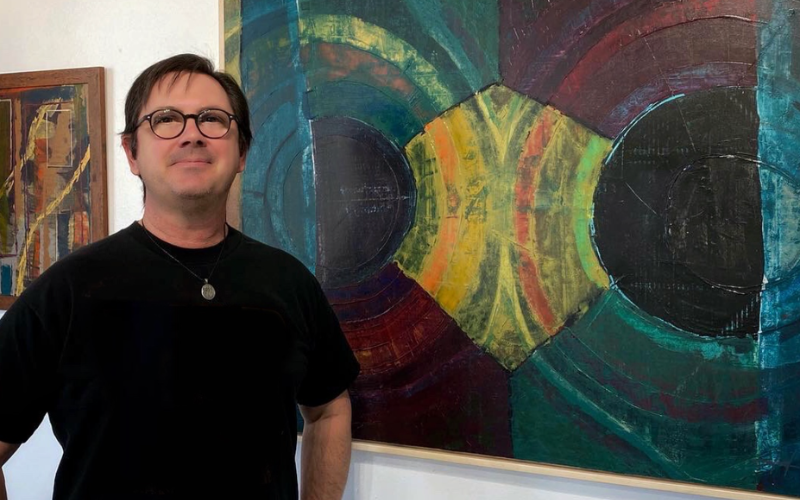
Featured Artist W.S. Cranmore with one of his abstract paintings, where geometric circles, bold color, and layered texture carry the autobiographical stories, and the music, behind his work.
There are artists who listen to music while they work, and then there is W.S. Cranmore.
For this week's Featured Artist, music is more than something simply playing in the background while he paints. It's part of the identity of the work itself.
W.S. Cranmore is an abstract artist whose paintings occupy an intriguing space between Geometric Abstraction, Expressionism, and Pop Art. Bold lines, geometric patterns, unconventional borders, and unexpected compositions give his work a distinctive visual language, but the stories behind the paintings are often much more personal...and much more musical.
Cranmore describes his work as autobiographical: a visual record of places, experiences, memories, and moments that have shaped his life. Most of those memories are summoned through music.
Artwork Archive got a chance to chat with the artist about the music that moves through his studio, the memories hiding inside his paintings, and the surreal moment when his artwork captured the attention of his musical hero.
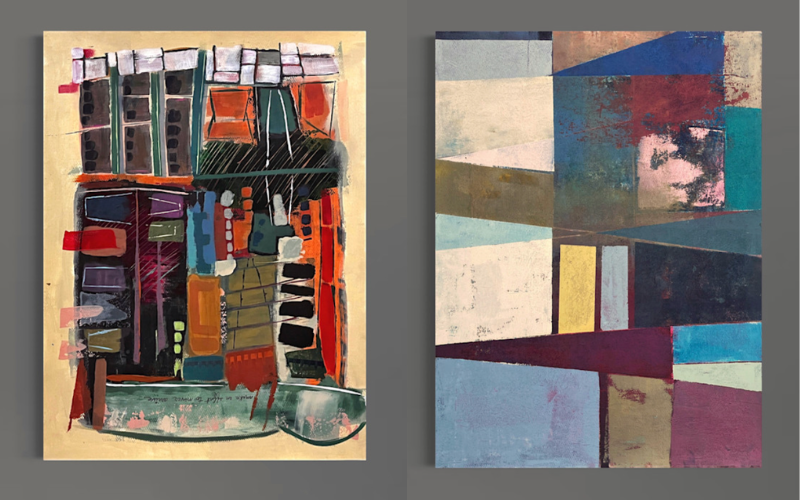 W.S. Cranmore, Songs of So Many, 24 x 18 x .25 in, 2026 | Partitions, 24 x 18 x .25 in, 2026
Inside W.S. Cranmore's Music-Driven Painting Process
The first thing W.S. Cranmore does when he starts a painting is, nothing. "My process begins with a few minutes of silence and stillness in the studio," Cranmore tells us. "No work or prep, just being still. It helps me focus and move away from distractions." Then comes the music. He puts on a random playlist and begins painting, describing this part of the process "like throwing your line out into the water to see what will bite." He listens as he works, waiting for something to bite.
"There comes a point when a certain piece of music profoundly resonates with what I'm creating," he goes on to say, "and it's time to switch from the general playlist to that music artist exclusively." From there, that musician becomes part of the painting's process, its own accompanying soundtrack that doesn't stop playing until the piece is finished. Cranmore knows there's always a reason one artist's music is clicking with his work, though he admits he doesn't always know what that reason is.
What he does know is how "music is the door that allows memory, emotion, and visualization to come through," and that door can lead almost anywhere.
Why W.S. Cranmore Calls His Abstract Paintings Autobiographical
The more abstract a Cranmore painting is, the easier it might be to forget there's a specific story underneath it. "I sometimes get odd reactions from people when I tell them my work is autobiographical," he says.
Even he didn't set out to turn his canvases into a diary, and for a while he didn't realize he had. "It was kind of a side effect I discovered after I began making art," he explains. "I honestly didn't expect that to happen." Still, his body of work became autobiographical: a journal of times, events, experiences, and memories of his life.
Those memories don't have to remain recognizable to be meaningful. Cranmore chases the "underlying beauty of cracks and blemishes, contrasting styles and colors, half finished ideas and overworked thoughts" rather than symmetry or polish. He reads it as a reflection of "a life of ups and downs," and of a long fascination with the physical deterioration he notices everywhere around him. "I consider it natural abstraction," he adds.
His memories become raw material, summoned by music and transformed into something with their own visual life. A memory might resurface as an image, a color, an angle, or some other impression that eventually finds its way into the composition. "I've recalled instances I've forgotten about, and I'm so grateful for that," he shares. "Isn't art incredible?"
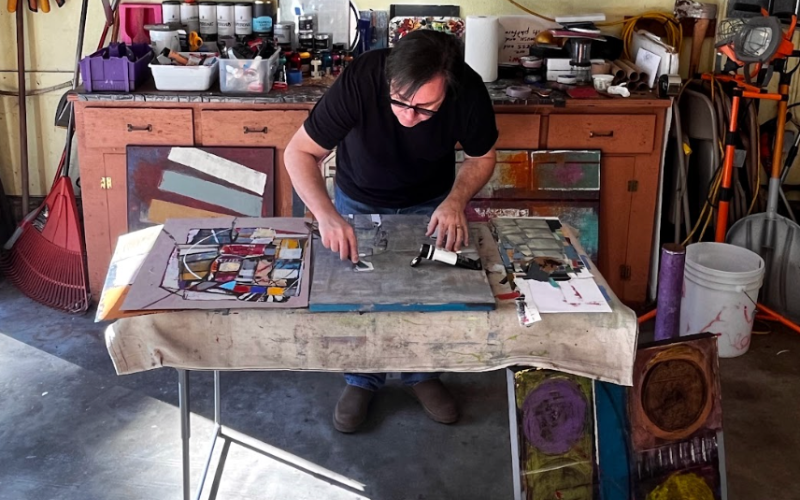
W.S. Cranmore in the studio, where every painting starts in silence and gets built around the music playing through the room. Image courtesy of the artist
How W.S. Cranmore Pairs Paintings With Music, Wine-and-Cheese Style
If music is an integral part of how a painting comes to life, there must be a way for some of it to stay with the work once it leaves the studio.
"That's been an ever evolving idea," Cranmore explains. "I've gone back and forth on how to best present the pairing." His hope is that a viewer would ideally play the music behind a work while taking it in, "much like a wine and cheese pairing," with the two reaching for something "more ethereal" together.
He's experimented with playing playlists at exhibitions and including links to the music in social media posts. Now, he's thinking about a more direct approach: "It dawned on me recently that I could also include that music information on the back of the paintings. I just need to remember to do that."
While music offers a deeper way into his work, Cranmore is careful about how much of the story he gives his viewers. "Overall, conversations are still the best way to discuss art and music," he believes. He'll "give a general overview of what music I was listening to and the mood of the piece," but often keeps the more autobiographical details to himself. "I don't go into specifics as to which personal memories were evoked," he tells us. "I don't want that to influence what they're seeing and feeling."
The result is an invitation rather than an explanation. While music is certainly the biggest influence behind his work, and can give us another piece of each painting's story, the interpretation of that story remains our own.
Create a Scannable QR Code Label for Every Piece:
A piece of artwork can change hands, move between exhibitions, spend time in storage, or end up halfway across the country. Artwork/QR Code Labels take the guesswork out of keeping your art organized and professionally presented.
Artwork Archive QR Code Labels can link directly to an internal Piece Record, a public artwork page, or a custom URL (like a link to the song or Spotify playlist behind a Cranmore painting). Add one to the back of a piece to give yourself, a gallery, or a collector quick access to the information that matters without relying on a paper label, a separate spreadsheet, or an email.
Create QR Code Labels for your artwork.
The Painting That Connected W.S. Cranmore With His Musical Hero
A lot of people have musical heroes—favorite artists that fill our ears for years. So when Cranmore's creative process did what it always does, moving from a wide-open playlist to a single artist on repeat, landing on Elvis Costello felt entirely natural. Every so often, though, a song comes on mid-painting and immediately assumes the driver's seat.
He was painting to Costello and Costello alone when the song Kid About It, from the album Imperial Bedroom, "changed the whole creative direction" of the piece. "It was kind of exhilarating, actually," Cranmore reflects. "There was a whole new energy to the painting that's hard to describe." He listened to that single track exclusively, looping it over and over again until the painting was done. The finished piece, titled Our Lady of the Signal, was then posted to his social media channels with a note attached: Play Kid About It while you take it in.
About a week later, Cranmore received a private Twitter message that he couldn't quite believe. "I thought it was some sort of spam message at first," he recalls, "or that his account was hacked." But the sender was Elvis Costello himself, inquiring about the painting, the music pairing, and the story behind it. "After a very nice conversation in which he told me the story behind Kid About It, he acquired my painting."
Costello later offered his own words on Cranmore's work, containing a line that "still floors" the artist:
"I feel every opportunity must be taken to draw the eye to the art of W.S. Cranmore."
—Elvis Costello
It would be a remarkable thing to read from anyone. But from the iconic artist whose song had redirected the work, it bordered on surreal. "How often does one hear such high praise from their musical hero?" Cranmore wonders. A while later, on an Oregon tour stop, the two met face to face: "It was a fantastic occasion with a fantastic person."
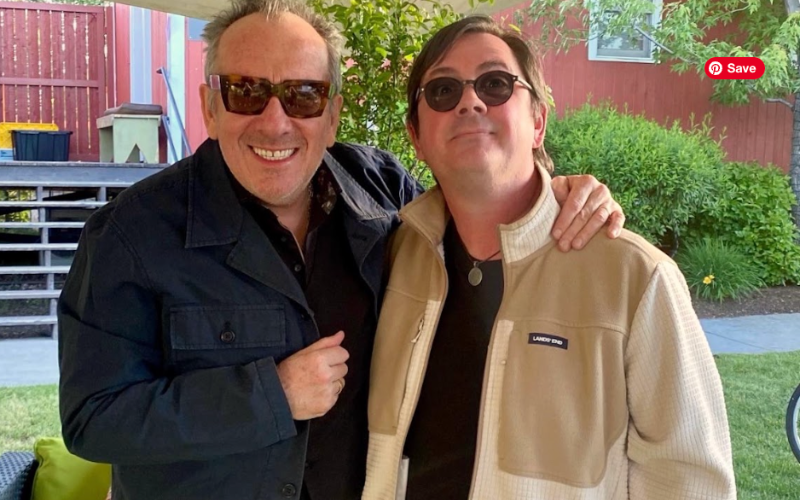
Elvis Costello and W.S. Cranmore meeting in person. Photo courtesy of the artist
The Rejected Exhibition That Taught W.S. Cranmore the Business of Art
Hearing incredible praise from an icon is the kind of career moment a lot of artists dream about. But long before Elvis Costello slid into his DMs, Cranmore was standing outside a gallery with two rejected paintings and no idea what he'd done wrong.
"I'll never forget this incident," he shares with us. "A couple of my paintings were accepted in a group exhibition, and I was beyond thrilled." On delivery day, however, he showed up to the gallery only to have his work turned away at the door.
The problems were small, fixable, and completely off his radar as an emerging artist. The paintings weren't wired to hang, the edges hadn't been painted, and he had no documentation. "I was brand new at this and had no idea what was required by galleries," he recalls. It was a crash course in one of the less romantic realities of being an artist.
"It was discouraging, but I didn't give up," he says. Instead, the experience became a turning point, an early lesson in just how much exists around the actual making of the artwork. It made him realize: "I needed to educate and familiarize myself with all aspects of an art career."
Years later, he can "say that was a turning point" for his career. Now, the documentation, the presentation, and the systems he eventually built his practice around can all be traced back to the very first exhibition he ever (almost) had.
How Artwork Archive Replaced W.S. Cranmore’s Pen-and-Pad Record Keeping
After the exhibition lesson, and resolved to get somewhat organized, Cranmore did what a lot of emerging artists do: he grabbed a pen and a pad. But inventory records, sales, email lists, all of it piled up faster than he could write it down, and what he did write down had a way of disappearing. "I was losing everything," he admits. "It was a hassle." His handwritten records had gotten away from him, and while he can't point to one dramatic moment that sparked a change, the slow pileup eventually became "the straw that broke the camel's back."
An artist he admired and followed online posted about Artwork Archive, praising what it did for their practice. His interest was piqued. "It sounded great, so I looked into it," he remembers. "I knew right away it was exactly what I needed to stay organized." The tasks that had defeated his pad and pen suddenly became manageable. He found it "so much easier to upload and categorize artwork, and unbelievably easy to keep records of sales and conversations." The platform also filled gaps he didn't even know were there. "As a matter of fact, it was through Artwork Archive that I learned about Certificates of Authenticity and Provenance," some of the very documentation whose absence had cost him an exhibition all those years earlier.
Now, apart from organizing his records, he's using Artwork Archive to send new work out into the world. His favorite feature, Private Rooms, gives him a way to create presentations for open calls, exhibition proposals, and collectors who want a closer look. He even recently used a Private Room to launch his latest series, Recollections. "The versatility is incredible," he adds, "It's something I can't live without."
Share Your Work With a Personalized Viewing Experience:
Give your own audience a professional, clean, and impressive viewing experience with Private Rooms.
Bring any collection of pieces together: a new series, a proposal, an exhibition, a collector presentation, work you're submitting for an opportunity, etc. Instead of sending someone an email with a pile of image attachments, give them one place to explore the work.
Try it: Create your own Private Room
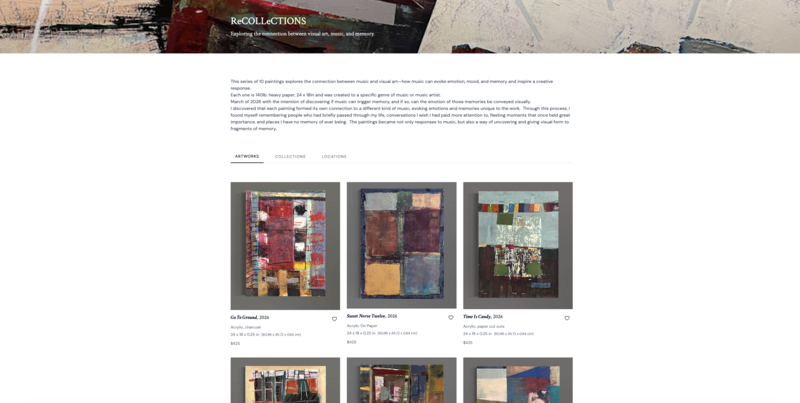 Cranmore's Private Room of his RecoLLections series is a great example of how the artwork itself can be only one part of the experience. Elevate the experience with Private Rooms
What W.S. Cranmore Wants Artists to Know Before They Begin
If there's one thing we can learn from Cranmore's stories, it's that an art career rarely follows the neat little path you might imagine (or hope for). Sometimes a gallery rejects your work because you forgot to paint the edges, and sometimes you get to meet Elvis Costello face to face after he acquired one of your paintings.
You really can't plan for all of it.
What you can do, Cranmore believes, is know what you're signing up for. "One should understand up front the amount of time and effort an art career demands," he suggests. "If it's truly what you want, you have to devote yourself entirely." An art career brings "accomplishment, purpose, beauty, and joy." You also have to "expect frustration, discouragement, and long periods of nothing happening."
"It's a package deal and it's glorious."
"Focus on your art first and foremost," he urges. "Always remember why you're an artist. It's not for likes and follows, it's not for celebrity or status, it's because there's something inside of you that needs to be expressed."
"You and the world need that more than any viral video."
Maybe that's the most valuable lesson Cranmore leaves us with: keep the art at the center, even when everything around it gets complicated. Keep making art for the reason you became an artist in the first place. The frustrating parts will come, and they're not evidence you're doing it wrong. The accomplishment, purpose, beauty, and joy of an art career will come too. A rejected exhibition can teach you everything you didn't know you needed to learn. A lost record can send you searching for, and finding, a better system. And sometimes, a painting made for no reason other than that you needed to make it might just end with Elvis Costello in your DMs.
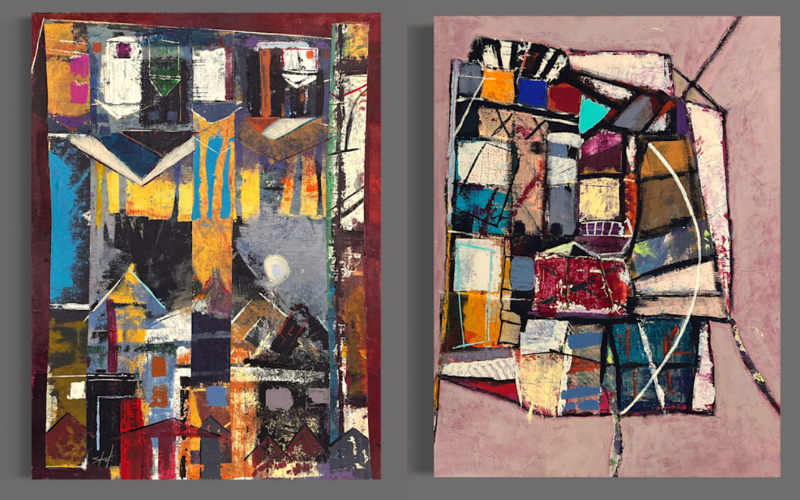
W.S. Cranmore, Caught In A Cocktail Hour, 24 x 18 x .25 in, 2026 | Call Me Underground, 24 x 18 x .25 in, 2026
Artwork Archive gives you one place to organize your art inventory, sales records, professional artwork images, and more so you can spend more time making your work. Try Artwork Archive free for 14 days.