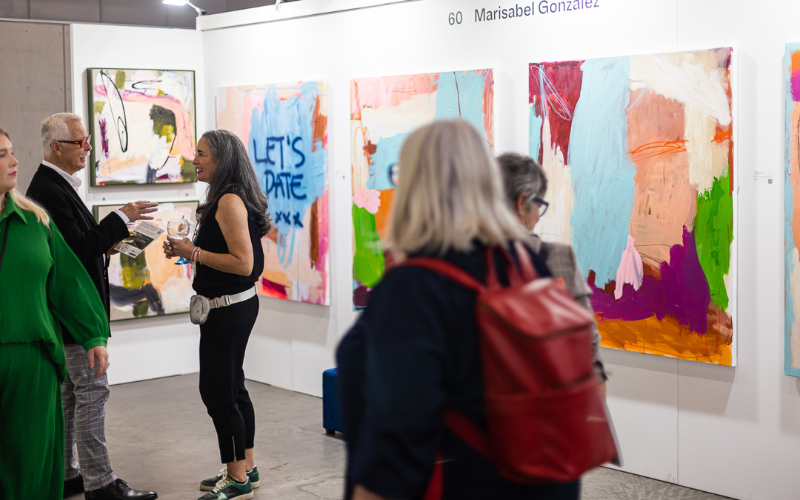
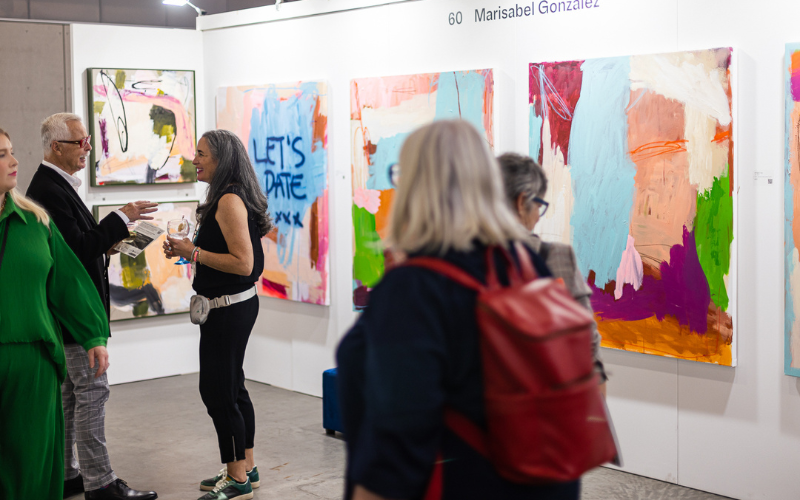
Image courtesy of Artwork Archive artist Marisabel Gonzalez
What Does Your Booth Say About You?
Art fair season is here. Calendars are filling up, work is getting prepped, and a lot of you are about to spend a weekend (or a few) standing inside a 10x10 space that's making impressions and decisions on your behalf.
Whether you've thought about it or not, your booth shapes what people assume about you as an artist.
Knowing what yours is doing well (and what blindspots it may have) could change how you show up to your next art fair. So, we sorted through six of the most common booth types we see at art fairs and markets and what each one is signaling to the people walking past.
Here’s what your booth might be saying about you...
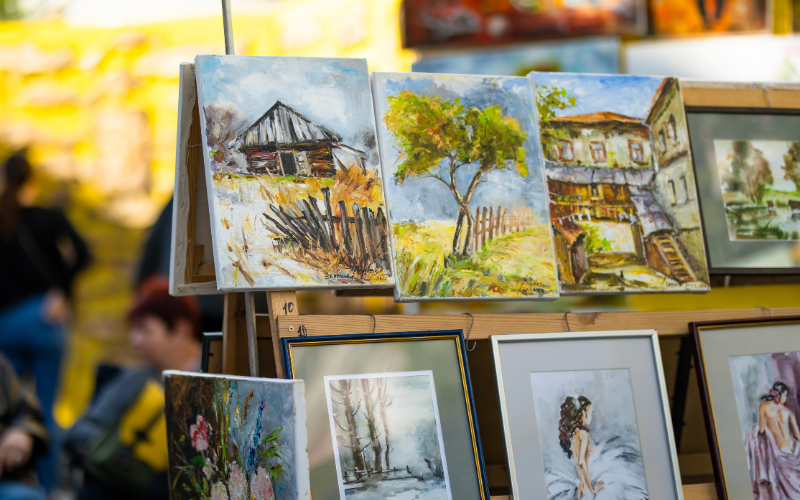
© MNstudio via Canva.com
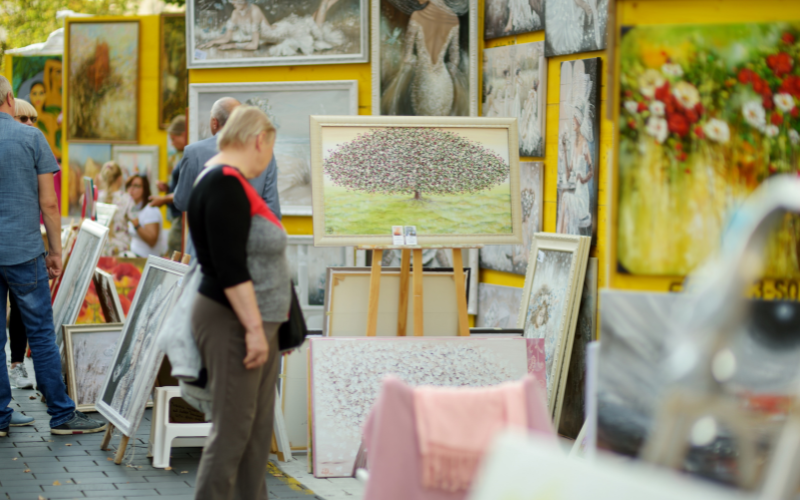
The “I Brought Everything I’ve Ever Made” Booth
Says: “There’s a lot to discover here.”
The wall is full. The table is full. You couldn't bear leaving anything behind... so you brought it all.
You’re giving people range while showing how much you make, how many directions you can go, and what you're experimenting with. For some buyers, it feels exciting. They like the sense that there’s more to uncover, and more to notice if they stay a little longer.
What it’s doing well:
At its best, this booth feels abundant. There's likely something here for almost everyone walking by, and you're giving people the feeling that they might find a piece to take home. You're inviting onlookers into the full range of what you make, and that openness can read as confidence (when it's done well). The energy of an abundant booth also tends to attract conversation. People linger longer because there's more to look at, and ask more questions when there's more to ask about.
Where it can be stronger:
The challenge is that abundance can start working against you when everything is asking for equal attention. Good work can disappear when none of it has room to stand out, and collectors/buyers can get decision fatigue. Also, you're likely to run into trouble if every piece was chosen individually, with no thought to how the wall reads as a whole. Pricing tiers are also worth thinking about ahead of time. A booth this dense usually has work at multiple price points, and collectors get overwhelmed when they can't quickly tell what's $200 and what's $2,000.
A few things to think about:
- Give the booth a clearer visual hierarchy. Try grouping your inventory by color, scale, or series a few weeks before the fair, and then build out your booth wall in a sketch before you build it in real life.
- Pick one or two "anchor" pieces meant to lead the eye, and let everything else support them rather than compete with them.
- Try clustering work loosely by price range, so a casual buyer drawn to the smaller, accessible pieces doesn't have to ask about every label.
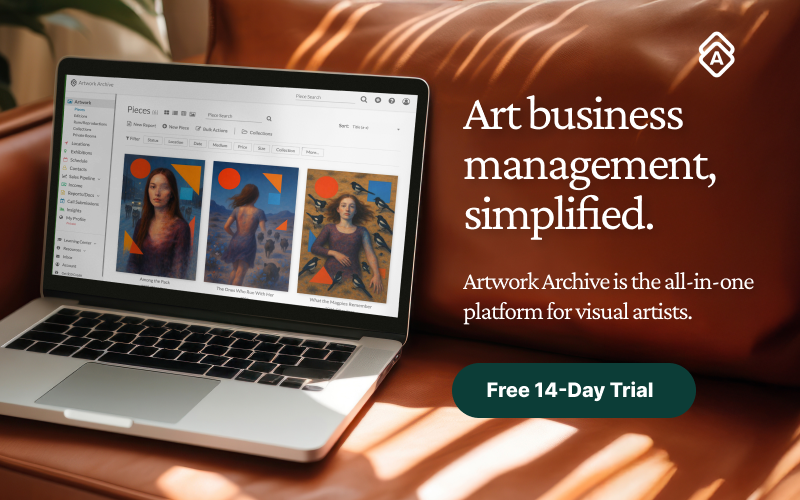
- Use Artwork Archive's Collections, Tags, or Private Rooms so you can see how the work looks together.
The Conversational Booth
Says: “Let me tell you about it.”
This booth has a living, breathing center of gravity, and that’s you. The setup may be simple, polished, improvised, beautiful, or somewhere in between, but the real engine is the artist’s presence. You’re warm and know how to talk about the work without sounding rehearsed. You can read the room. You know when to give someone space and when to offer a way in.
What it's doing well:
People often remember this booth because of you. They leave with a stronger connection to the work because someone helped build the bridge between looking and understanding. The booth says the work matters, of course, but the conversation with you is part of the experience.
What makes this type so strong is that it can make people feel welcomed even if they’re not seasoned collectors, unsure what to ask, or feel intimidated.
Where it can be stronger:
The thing to watch out for is over-relying on your own energy to carry the whole experience. If your booth only really works when you’re standing in it, talking, guiding, explaining, then it may lose some power when someone walks by during the one minute you’re taking a sip of water or talking to someone else.
Try to build a little of your voice into the booth itself:
- Start with the wall text: two or three sentences in your real voice, hung somewhere visible, that says what you're doing and why. If you can write it the way you'd say it out loud, it works.
- Signage that goes beyond price tags is another easy upgrade. Small cards next to grouped work that name the series, give a one-line context, and maybe note the medium. Think about it as giving people a way to start the conversation in their head before they start it with you.
- Use a QR code on an artwork label that links to a piece record. Every piece in your inventory can carry your own commentary, materials notes, and the story of how it was made. Visitors who want to go deeper get to, on their own time, without needing your full attention to do it.
© JR via Canva.com
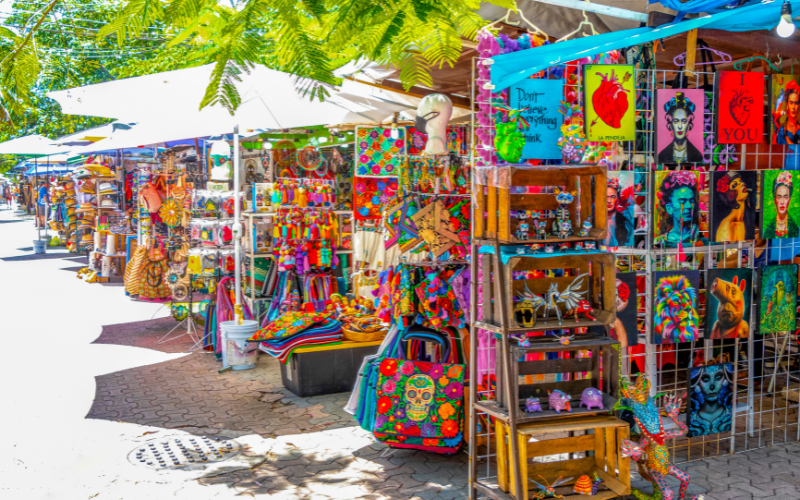
The Color-Lover Booth
Says: “You Can't Miss Me”
If color is the first thing people remember about your work, this is your booth. The palette does the heavy lifting on the front end, pulling people in from across the floor before they've registered a single subject matter or technique. Whether the artwork is bold, saturated, playful, luminous, or highly stylized, people feel it around them before they fully process it.
What it's doing well:
At its best, this booth feels alive and memorable. It gives people something easy to describe or refer to later, which matters more than artists sometimes think. And it has enough presence to interrupt the visual blur that can happen when someone has already looked at twenty booths in a row.
Where it can be stronger:
The first challenge with a Color-Lover booth is what we'd call the "wow, but not for me" problem. Colorful booths tend to get really positive reactions compared to other booth types, which sounds great until you notice you're not converting sales at the same rate than the reactions might suggest. Visual impact gets people to stop, but you still need a second layer waiting for them when they do.
Try this:
- Ask better questions than "any questions about the work?" When someone is clearly responding to your booth but stalling, try "which one are you drawn to most?" or "is there a color in your home this would live with?" These move them from passive admiration into active visualization, which is the bridge between wow and buy now.
- Hang one piece in a way that demands a closer look. A small, intricate work next to a large statement piece, or a painting at a slightly unexpected eye level, creates a pause point. Visitors who lean in to look closer at one piece tend to stay longer overall, and longer stays translate directly to higher conversion.
- Add a layer of story underneath the color logic. Keep grouping by palette, since that's what makes your booth cohesive, but within each color grouping, arrange pieces so they tell a small story. A group of warm-toned pieces might move from morning to evening, or from one location to another, or from a wide view to a close-up. The buyer walks the wall and gets the color hit first, then notices there's something more thoughtful happening within it.
The other issue a lot of color-forward booths run into is when a buyer can't mentally pull a single piece out of the wall. We would call this "the chord vs. the solo." Saturated work often reads beautifully as a whole, because the colors play off each other and the booth itself feels like one big harmonic composition. But, the minute a buyer tries to picture a single piece alone in their living room, the magic can dim. Your job is to help each piece hold its own as a solo object, not just as part of the ensemble.
Try this:
- Include a few "in context" reference shots to share with hesitant buyers. Upload in-situ photos (your pieces hanging above a couch, in a hallway, or in a kitchen) to each piece record in Artwork Archive, then generate a QR code label that links directly to those images. A small sign in your booth that says something like "Curious what this looks like at home? Scan here" answers the question they're already asking themselves ("can I actually live with this?") without you having to ask it for them.
- Vary the scale across your booth on purpose. A wall of similarly sized work reads as one big visual block, which makes individual pieces hard to mentally separate. Mixing scales (a large statement piece next to a few smaller works, or one oversized anchor surrounded by mid-sized pieces) gives each piece its own visual identity and helps buyers register them as individual works.
The Process Booth
Says: “I want you to understand how this work comes to life.”
This booth gives people more than a finished surface. It gives them a way into the making. Maybe there are sketches, studies, material samples, in-progress images, or small clues in the way things are labeled and grouped. Maybe the work itself already carries process so clearly that the whole booth feels like an invitation into the studio.
What it's doing well:
When this works, it makes the booth feel layered and generous. People get to see the mind and hands behind your artwork, and the decisions behind everything. That can be especially powerful for buyers who connect more deeply once they understand what goes into a piece.
A process-forward booth often helps people stay longer. It gives them something to ask about and makes the work feel dimensional in a different way.
Where it can be stronger:
The thing to be careful of here is turning the booth into a mini classroom when what people really want is an encounter with the art itself. The strongest process-forward booths build context into the work rather than relying on external materials to do the explaining, and don't compete with the finished pieces for attention.
A few directions worth experimenting with:
- A small "from the studio" zine or printed handout that someone can take home, with a handful of process images and a few sentences in your voice about what you're working on right now.
- A single anchor piece displayed alongside the actual tools used to make it, presented as a thoughtful pairing rather than a how-to demonstration.
- A finished work shown next to a small in-progress photo at exactly the same scale, so visitors see the before and after in a single glance
Keeping your process notes inside your Piece Records on Artwork Archive means you have ready-made language for labels, captions, handouts, and post-fair follow-up emails without rewriting it all from scratch at every fair.
© MNstudio via Canva.com
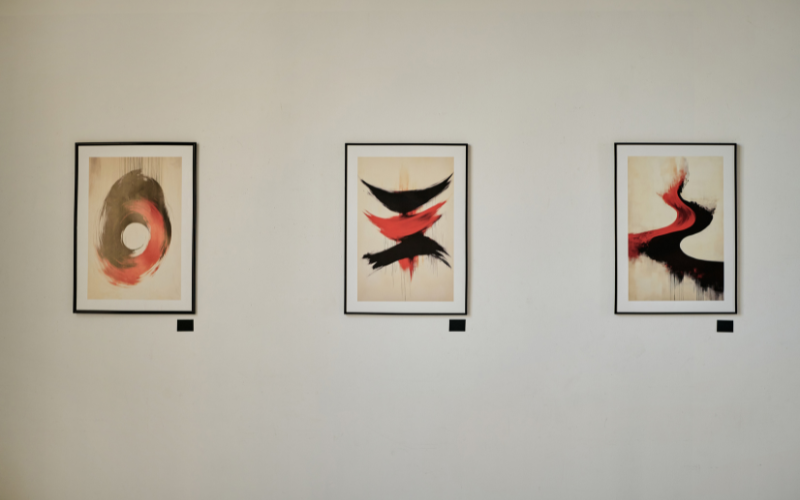
The Clean and Minimal Booth
Says “I want you to really look at each piece.”
You're trusting the work here with this one. It doesn't feel the need to crowd the walls or fill every possible inch. There’s breathing room and restraint. The space itself becomes part of the presentation, helping each piece feel more intentional and worthy of attention.
What it's doing well:
When it works, this booth can signal incredible confidence. It suggests an artist who isn’t trying to prove everything all at once. It can also create a sense of calm in the middle of an art fair, which is no small thing.
The strongest minimal booths look effortless and are anything but. Restraint at this level requires deep knowledge of your own body of work, because every piece you don't bring is a decision, and every piece you do bring has to earn its place against everything else you could have hung instead. The artists who run minimal booths well usually have a clear read on which of their pieces are anchors, which are supporting works, and which ones don't belong in this particular booth even though they're strong on their own.
Where it can be stronger:
If you're having trouble editing:
- Before the fair, pull together a long list of every piece you're considering bringing, and then cut it in half. Then cut it in half again. Notice what you keep wanting to add back and ask whether it's because the piece genuinely belongs or because you're nervous about the booth feeling empty. Most minimal booths suffer from last-minute additions made out of anxiety. Trust your edit.
- Build a "fair edit" Collection inside Artwork Archive a few weeks before the show to give you a working list you can revise without committing to anything physical. Seeing the pieces grouped together in one view lets you spot tonal conflicts, palette clashes, or compositional issues before you're standing in the booth at setup time.
If you're holding back a little too much: A minimal booth shows visitors a deliberately small slice of your practice, which means if there’s too little context, people can admire it without knowing how to enter it. Find subtle ways to gesture toward the larger body of work without breaking the spaciousness of the display.
- A small, beautifully designed lookbook or printed Portfolio Pages on a side table, with a curated selection of your other work, gives serious visitors something to browse if they want to see more.
- A single piece labeled with a note like "part of a series of twelve" creates curiosity about what else exists
- A short bio paragraph that names what you're working on right now, what's coming up, or what direction the work is moving, plants a seed that lasts beyond the fair.
The follow-up game matters a lot for minimalist booths, because the visitors most drawn to restraint and confidence tend to be slower, more deliberate buyers who rarely purchase at the fair itself. Capture every meaningful interaction in your Artwork Archive Contacts, with a note about which piece caught their attention. A week or two after the fair, send those visitors a Private Room of related works from your inventory to continue the conversation. Your minimal booth gave them a glimpse. The follow-up gives them the larger view. Both work together to build the kind of long-term collector relationship this booth type is uniquely positioned to attract.
The Collector-Friendly Booth
Says: “I make it easy for someone to buy from me.”
There's something deeply reassuring about a booth that feels easy to navigate: when prices are visible, the layout makes sense, and the information is clear. This booth signals readiness and tells people they're encouraged to be interested and that interest can go somewhere.
What it's doing well:
You're signaling that you respect people’s time, attention, and hesitation. It says you understand that an art fair booth is not only a display to look at pretty artwork, but it can also be an environment where decisions get made.
At its best, this booth feels calm and confident. People know what they’re looking at, what range of price points exists, and how to take the next step if they want to.
Where it can be stronger:
The risk with a collector-friendly booth is that the same clarity that makes it easy to buy from can make it feel a little corporate. Sometimes a booth like this is too functional that it starts to lose some of the personality and atmosphere that drew people in to begin with.
So, layer warmth on top of it. Keep the practical structure, but make sure the booth still feels like your world. Think about the small choices that signal a human being is showing their artwork:
- A short artist statement in your own voice somewhere visible.
- Pricing presented in a non-generic way (think a hand-lettered card next to each piece, a small frame around your price list, or labels printed in a typeface that matches the rest of your branding.)
The same idea goes for how you act in the booth. Highly functional, collector-friendly booths can sometimes train artists to talk in efficient transactional terms. Push back on it. When someone asks about a piece, lead with the story rather than the specs. Specs are already on the label. The key here is balance. Let the booth handle the logistics so you can focus on the things only a real conversation can deliver.
© Bruno Coelho via Canva.com
What all successful art fair booths have in common:
The strongest booths at art fairs usually share a few things, like the knowledge that the booth itself is the smallest part of the equation. Almost everything that determines whether a fair weekend goes well happens long before the booth is set up, in the weeks and months of inventory tracking, pricing decisions, collector outreach, and fair selection that almost nobody at the actual fair ever sees.
Most of this invisible work is what we're here for. Inventory, pricing, contacts, follow-ups, sales records, all living in one place that doesn't fall apart the second you get back from a fair and try to update everything from memory. Whether you're prepping for your first fair or your fiftieth, staying organized is what makes each booth stronger than the last.
Artwork Archive can help you build an online portfolio, stay on top of their inventory, and generate things like tear sheets, invoices, and Private Rooms in just a few clicks, so the parts of your business that hold up your booth are working for you between fairs too. Start a free trial and see how it fits into your own process.
What booth are you? Click here to let us know and join our conversation.
Of all the decisions that shape your time at an art fair, picking the right one to show up to is where it all starts:
Our 2026 Art Opportunity Guide is built to help, with a curated lineup of art fairs, festivals, markets, and other art opportunities across the world worth knowing about as you plan the year ahead.