Courtney Minor on Creating Art About Identity, Belonging, and Otherness
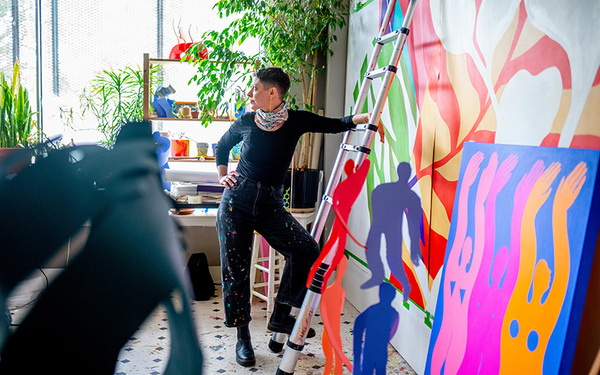
Working out of Jersey City, with a second studio reaching into Manhattan, Artwork Archive's Featured Artist is focused on telling the stories of those who feel "Other'd" by society. "I feel obligated to reflect stories of all the types of people I feel drawn to," the artist states.
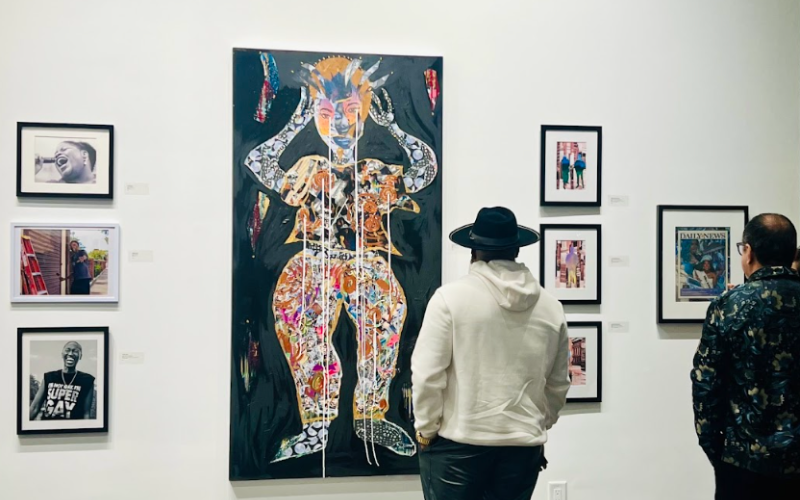
Courtney Minor’s style features heavy use of color, maximalism, pattern, assemblage, and emotion conveyed by the rawness of her application process. Every layer of her work is load-bearing, and rewards those who look for longer than a glance.
She is, by her own description, acutely aware of her body and her feelings and unable to say either out loud. So she paints, collages, and experiments. Pulling from her formative years in Houston, TX, and her travels abroad, she seeks to tell the stories of those rarely heard by mainstream society, including her own.
Artwork Archive sat down to hear more from Courtney Minor, including the moment that pushed her work toward Otherness as a central theme, and how she uses Artwork Archive to keep track of a practice that lives across two studios.
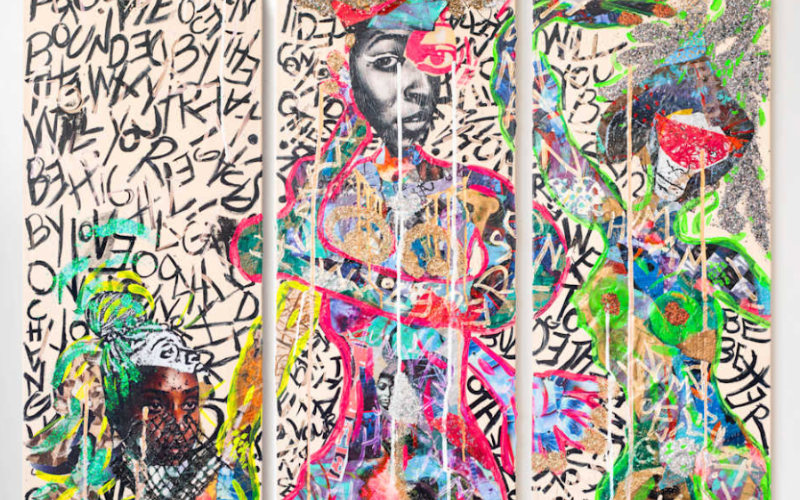
Courtney Minor, Daughters of Calm Dissension, triptych, 64” x 44” Inspired by the film Daughters of the Dust and April 2025 moment in time where Black America protests by being joyful.
How Courtney Minor’s New Humans Series Imagines Life Beyond Otherness
Every piece begins the same way for Minor: "I dwell on an idea."
Once an idea shows up, she sits with it, turning it over in her mind, giving it time to gather mass until it asks for a form. This dwelling is what produced the body of work she calls New Humans.
In 2020, while the world was in lockdown and everyone argued about who belonged where, Minor was running a different thought experiment. What if every group that had ever been made to feel Other—by ethnicity, by sexuality, by gender, by anything—simply left? Pooled their resources, pointed themselves toward the cosmos, and went looking for somewhere else to be?
"Similar to how Protestants left England for the US in search of freedoms," she offers. "Though the irony isn't lost on me." The people who came to America fleeing persecution went on to do plenty of persecuting once they arrived. But in Minor's version, the Othered keep going.
"This got me spiraling around how these groups would physically evolve in their newly discovered homes away from Earth on various planets."
The collage figures of New Humans are her answer: bodies stitched together from many parts, imagined for futures that haven't happened yet, each one a guess at what freedom from gravity and inherited hierarchy might do to a person over enough generations.
Planning Large-Scale Murals Without Losing Spontaneity
She calls her creative process stream of consciousness, and that holds true across her body of work. But still, some parts of her process change depending on what the idea calls for.
For her textile pieces and linen canvases, Minor works organically, one mark following the last. A mural, however, is a different animal, and scale changes her opening move. "I've learned to map out my ideas via digital sketchbook first when creating larger murals," she tells us.
Once the composition is locked, the mark-making goes back to her usual mode: layered, intuitive, packed with the kinds of details you only catch on a closer look...like the backwards words.
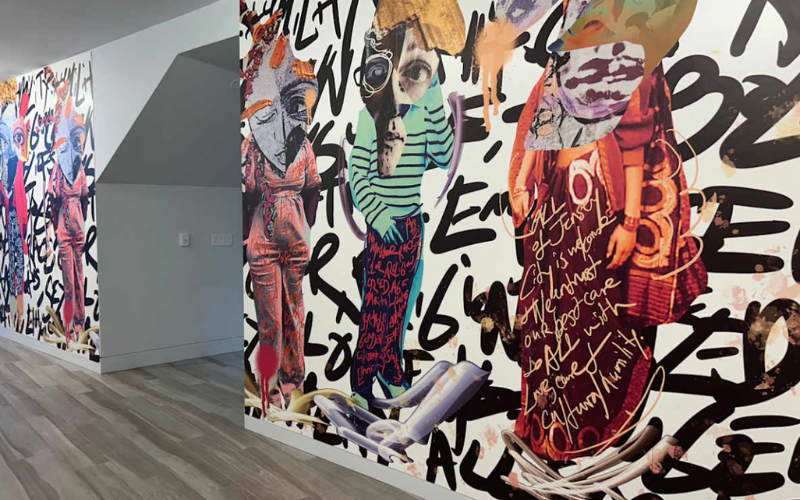
Cultural humility vinyl mural installed on site at Southampton African American Museum from May through July 2025 as part of “Doors Into My Life” solo exhibition
Reversed Text and Hidden Messages in Courtney Minor’s Art
Stand in front of Courtney Minor's pieces long enough and you'll notice that the majority of text is reversed.
This is on purpose, and the purpose, as she explains, is double: "One to make the viewer pause and really focus and decipher the work. The second to hide messages in plain sight."
To actually receive what the artist is saying, to absorb the work at its fullest, you have to stop, hold still, and look a little harder. Her message is always there, but it's only legible to those who slow down long enough to read it.
Balancing Creative Fulfillment With the Business of Art
Minor tells us she has feelings she can't easily say out loud, so her artwork is where they go.
"I use art as therapy," she says. "It's successful if I feel my bottled up thoughts and emotions are unleashed."
This is her working definition of success, one she's had to come to on her own. "Being an artist is a state of mind. I had to learn that. You are a successful artist whether or not you make a sale, in my opinion."
Now, she's not saying that sales don't matter. Of course they do. But sales aren't how she decides whether a piece was worth making. A piece can succeed by Minor's measure before it ever leaves her studio, and she's trained herself to count that as the win it is.
Still, the studio has to sell work to operate, and Minor is honest about which pieces tend to go first. "I've learned to let go of sentimentality as I've progressed as an artist, or I would never sell anything."
Her smallest pieces, the ones she has the most personal attachment to, are usually the ones collectors claim. Selling them is what keeps the studio running, which means part of the job is releasing exactly the work she would otherwise have held onto.
The painting succeeds the moment she finishes it. The studio sustains itself when she lets the painting go. Both things are true at the same time, and Minor has built her practice around understanding the difference.
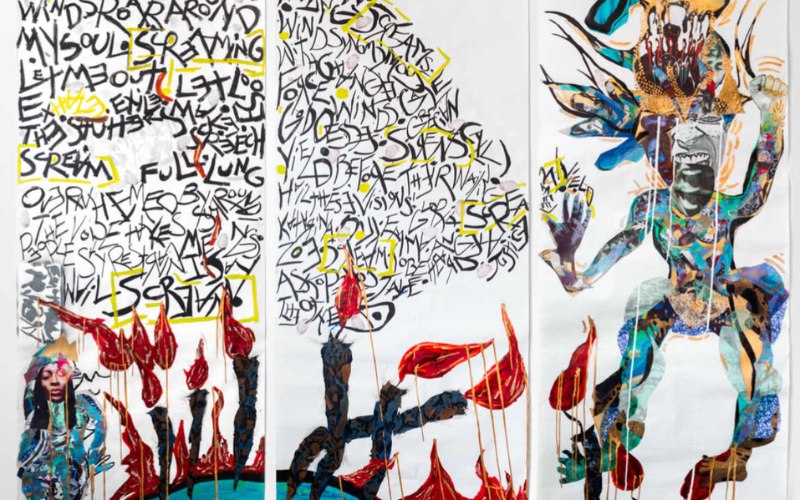 Courtney Minor, Screaming Siren / 2024 Me, 96 x 108 in. Extra large work focused on making your voice heard loud and proud like a sirens call in sea. Created during art residency in Skopelos Greece
The Art Inventory System That Changed Courtney Minor’s Art Practice
For most of her career, Courtney Minor was producing work faster than she could keep track of. This sounds like a good problem to have...until you're the artist trying to respond to a gallery inquiry while searching through three different folders and a notebook just to find out where one specific piece currently is.
Her work was moving between her Jersey City studio, a second space in Manhattan, the hands of various consultants, and the storage closets of a few galleries, so knowing which piece was where stopped being easy to track.
"I didn't have a system, paperwork, or inventory accounting," she remembers. "So, my first step to taking the next step was organizing my art space, contacts, and documentation."
Artwork Archive was her solution, the operating backbone her studio had been missing, and "key to enabling and simplifying my art business into a single space."
"Everything shifted when I started to organize my art."
The platform let her finally meet the professional demands of her art practice. "If I get a request to loan a piece, or create a new work, or design something personal, everything is seamlessly in the Artwork Archive system."
She uses the Report feature regularly to pull current inventory, and Private Rooms to share curated selections with art consultants who are evaluating her work. "I'm able to provide artwork details in a clean, automated format due to Artwork Archive," she explains. And people take notice. On various occasions, gallerists, couriers, and brokers have all remarked on the professionalism of her materials.
💡 Tool Spotlight: Consignment Reports
Courtney Minor uses Reports regularly, and the Consignment Report earns its keep when a gallery wants to know exactly what they have of yours on their walls. Pull a consignment report by location and you get a clean PDF showing every piece currently with that gallery, with images, dimensions, pricing, and dates.
Consignment Reports also:
- Outline sales terms
- Describe artwork care
- Establish clear guidelines for the consignment process
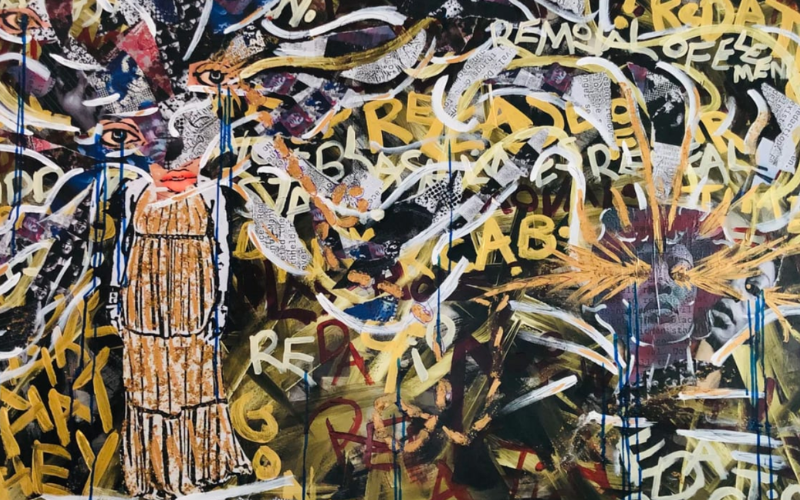
Courtney Minor, Redaction(s), 30 x 40 x 1 in
Why Emerging Artists Should Get Organized Early
The advice Minor gives other artists is the advice she had to learn for herself, after years of producing work without a way to keep track of it.
"Organize yourself sooner versus later. It makes you appear more professional to prospective clients and galleries."
Over time, she's learned that the artists who continue to receive opportunities are the artists whose materials show up looking like they came from someone running a business. Current pricing, clean inventory records, the ability to answer a gallery inquiry the same day they ask.
All unglamorous parts of an artist's career, yes. But the earlier you start, the longer that infrastructure has to compound, and the more likely you are to thrive.
Creating Art That Helps People See Themselves
Courtney Minor hopes her work lets people see into a world, a feeling, or a person that reflects themselves. A figure built from many parts, set in a field of color, ringed by doodles, carrying a phrase across the chest written so you have to stop and decode it.
"Much of art is a statement about our current reality, and I feel obligated to reflect stories of all the types of people I feel drawn to."
Everything in her practice is built around getting that hope into the world where someone can encounter it. The idea-dwelling, the discipline of letting go of the pieces she would most like to keep, the inventory system holding her practice together across two studios. All of it points to the same thing: the next piece, and the one after that, created for the people she'll always feel drawn to.
Spend Less Time Managing Your Art and More Time Making It
A professional art practice comes with a lot to keep track of. Artwork Archive brings your artwork inventory, locations, contacts, sales, and documentation together in one place, so the business of being an artist doesn’t get in the way of making the work that matters.A professional art practice comes with a lot to keep track of. Artwork Archive brings your artwork inventory, locations, contacts, sales, and documentation together in one place, so the business of being an artist doesn’t get in the way of making the work that matters.
Try Artwork Archive free for 14 days.