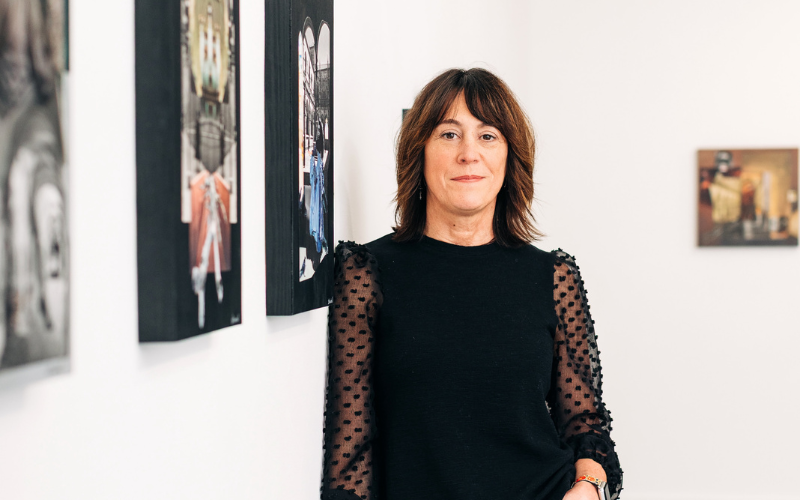
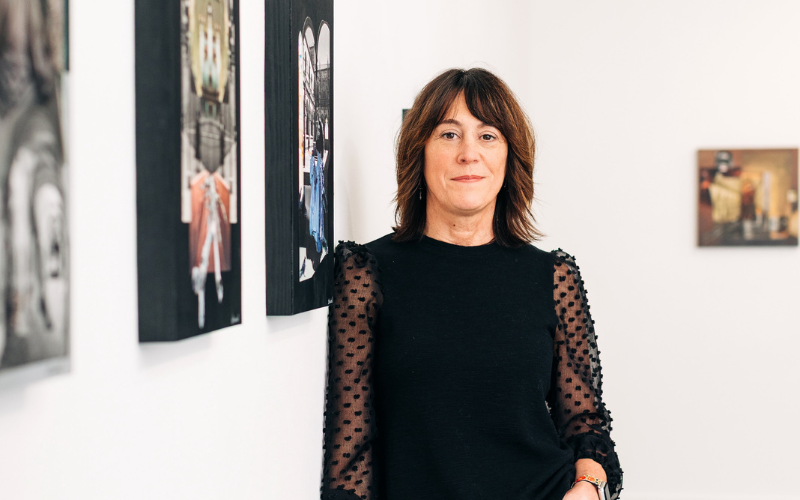
Inside the Architecture of Shawn Marshall’s Collages
"I don't see a flat surface; I see a site to be built upon." Shawn Marshall's studio holds labeled drawers and organized bins of vintage imagery collected from donated magazines, personal book collections, and years of slow, deliberate hunting.
It's with these materials that this week's Featured Artist constructs worlds that are seductive on the surface and structurally unstable underneath. Her collages are surreal in their logic: scale collapses, spaces contradict themselves, and beauty operates as both invitation and trap.
Marshall came to her art practice through architecture, and approaches collage the same way an architect approaches a site: thinking in sections and layers, considering how materials interact at different levels of depth, treating every element as part of a deliberate structural whole.
Across her work, she examines how gendered identities are learned and how figures are placed inside spaces saturated with power they were never taught to question.
Marshall is drawn to what she describes as the moment "when aesthetic pleasure tips into interrogation, when a surface that initially reads as ornamental reveals itself as a compressed anatomy of consumerism, desire, and constraint." Her work, built around the slow reveal of what a surface is actually made of, asks the viewer to keep looking.
We got a chance to chat with Shawn Marshall about how her background in architecture shapes her studio practice, how she sources and selects the vintage materials that go into her work, and how she stays organized across a practice that spans multiple galleries, collections, and exhibitions.
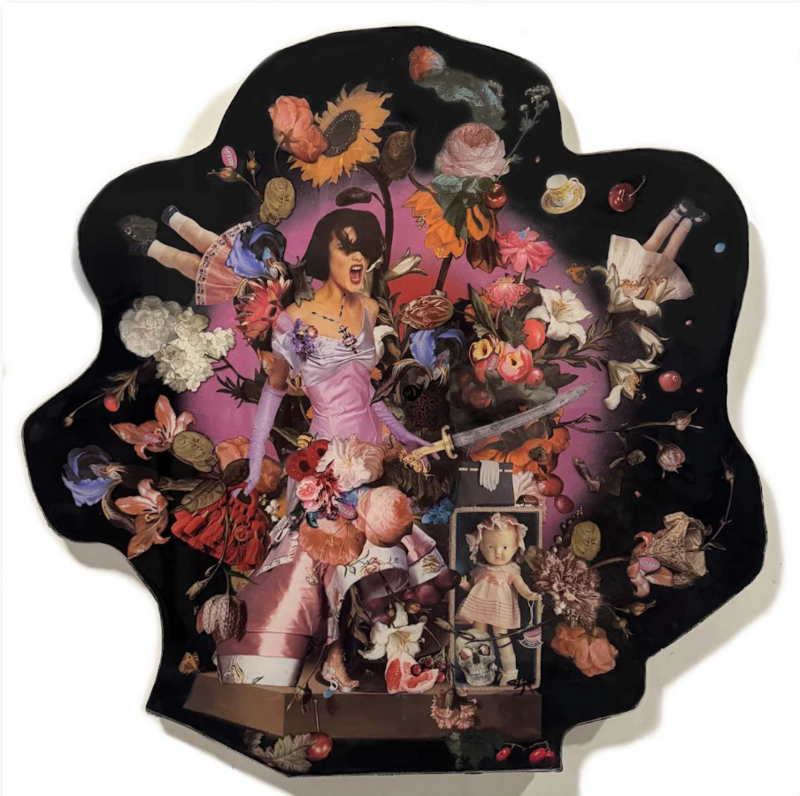
Shawn Marshall, The Rage of Venus, 2026, 30 x 30 x 1.5 in
The Architectural Precision Behind Her Collages
Before Marshall was ever a mixed media artist, she was an architecture student building scale models by hand. For seven years, precision was the only acceptable standard. "I used x-acto knives to build architectural models, a process where precision was imperative," she recalls. "I carry that same precision into my work today, using those same tools to hand-cut each element of my collages with a level of detail and control that comes from years of model-making."
She doesn't build models anymore. But stand in front of one of her mixed media collages layered with botanical clippings, fashion imagery, and domestic objects, sealed under a luminous pour of resin, and it becomes clear her architectural way of thinking never really left.
"I don't see a flat surface," she insists. "I see a site to be built upon."
The Archive of Vintage Imagery Behind Her Mixed Media Art
The composition phase of any given piece can take months, and begins with what Marshall calls "a dedicated period of curation." Moving through vintage magazines and books, she's in search of materials that feel "familiar but carries a subversive undertone." The imagery of femininity as it has been sold and circulated, ready to be taken apart.
Paper weight matters here. So does print quality. The resin process is unforgiving, and every image she selects has to hold up technically as well as narratively, capable of withstanding what she's about to ask of it. "I'm essentially building a piece by considering how light and shadow move through different levels of paper and gloss," she explains, "treating the final work as a constructed environment where every meticulously cut edge and every layer of resin is part of a deliberate, structural whole."
What doesn't make the cut goes into the bins and labeled drawers that fill her studio, a physical archive of imagery waiting for the right context. "I view this as an archive of potential stories," she describes. "Often, an image I discovered years ago will suddenly become the perfect missing link for a piece I am building today."
She commits to the first layer only after finding what she refers to as "a specific narrative tension within a strong composition." Before that moment arrives (sometimes weeks, sometimes months into the curation process) nothing gets glued down.
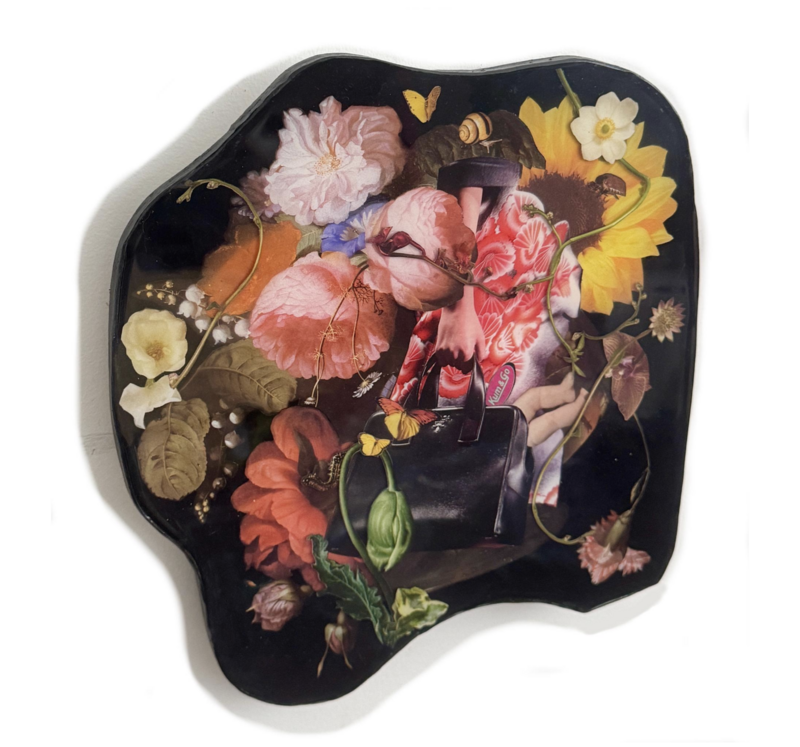
Shawn Marshall, Vanity 8, 2025, 11 x 11 x 12 in
The Hidden Technique Behind Her Seamless Collages
Once the composition is set, Marshall's process becomes, by her own description, about 90% planned. Years of working with paper and resin have given her enough technical fluency to anticipate how materials will behave, a hard-won control that didn't come very often early in her practice. "When I first began working in this medium, much of my time was spent reactively, trying to correct or conceal paper ripples and resin bleeds," she remembers.
The remaining 10% she holds open on purpose. "I have learned to embrace the occasional, unpredictable resin bleed as a creative opportunity," she says. "Rather than seeing these moments as errors to be covered up, I now lean into the layering process, using additional collage elements and resin pours to build upon those spontaneous marks."
What visitors to her work almost never know is that there is an invisible step embedded in the construction of every piece. Before gluing down nearly every scrap of paper, Marshall paints its raw edges. "It's a tedious and time-consuming step," she acknowledges, "but it's worth the effort because it tricks the eye into seeing a single, integrated image instead of a layered assembly." The seams disappear, allowing the surface to be read as whole.
💡Artwork Archive Tip: Build a Material Archive Your Future Self Can Search
When your practice involves sourcing, testing, and waiting on specific materials, logging those details per artwork record means you build a searchable reference over time.
Artwork Archive lets you document medium, materials, and process notes on every piece, so you know exactly what worked (and what didn't) when you're ready to replicate a finish or brief a conservator years from now.
Why Artists Should Treat Rejection as Research
Marshall's approach to her professional life runs on the same logic as her studio practice: deliberate, iterative, and built by accumulated experience.
She reframes rejection entirely. "Shift your perspective from 'asking for permission' to 'building visibility,'" she offers.
"Rejection isn't a dead end; it's a signal to iterate."
Apply often enough, and the emotional weight of any single 'no' decreases. Apply often enough, and your professional materials improve. Apply often enough, and the decision-makers who pass on you this cycle may remember your name for the next one.
Success, in her view, is something you build through volume and consistency, not something granted to you by a single 'yes.'
💡 Artwork Archive Tip: Find opportunities worth applying to
Shawn Marshall's advice is to apply often, but that requires a steady pipeline of opportunities to apply to. Artwork Archive's opportunity guides round up grants, open calls, residencies, and exhibition opportunities so the research is already done for you. Show up, apply, iterate.
How Better Artwork Documentation Transformed Her Art Business
The business side of her practice took longer to bring under control. For years, Marshall kept loose records — "very loose," she says — and paid for it every tax season. "It's still not a part of the job I enjoy, and I'm definitely still learning," she admits, "but I've realized that good documentation is the only way to protect my time and my sanity in the long run."
After a period of rapid growth and a significant volume of sales, she realized she had lost the paper trail. She knew her work was out in the world, but she couldn't always remember the provenance, the exhibition history, or the final sale price. So, she turned to Artwork Archive, and found that it restructured her entire workflow.
"Having the ability to generate Certificates of Authenticity and private viewing rooms in just a few clicks transformed my workflow from reactive to professional."
Private Rooms are her favorite. "When I'm pitching to a gallery or applying for a show, I can send a single, professional link that acts as a custom digital exhibition," she continues. "Since all my data — pricing, dimensions, and materials — is already in the system, I only have to enter it once. It completely eliminates the repetitive task of re-typing specs every time I want to share my work."
Shawn Marshall's studio runs on precision. Now, the business side does too.
💡 Artwork Archive Tip: Replace the Attachment Chain with a Single Shareable Link
Gallery pitches and show applications often involve sending multiple files, re-typing specs, and following up when things get lost. Private Rooms let you share a single, professionally designed link with all your artwork details already populated — no reformatting, no repeated data entry.
Recipients get a clean presentation; you get a record of what you sent and when.
→ Create your first Private Room
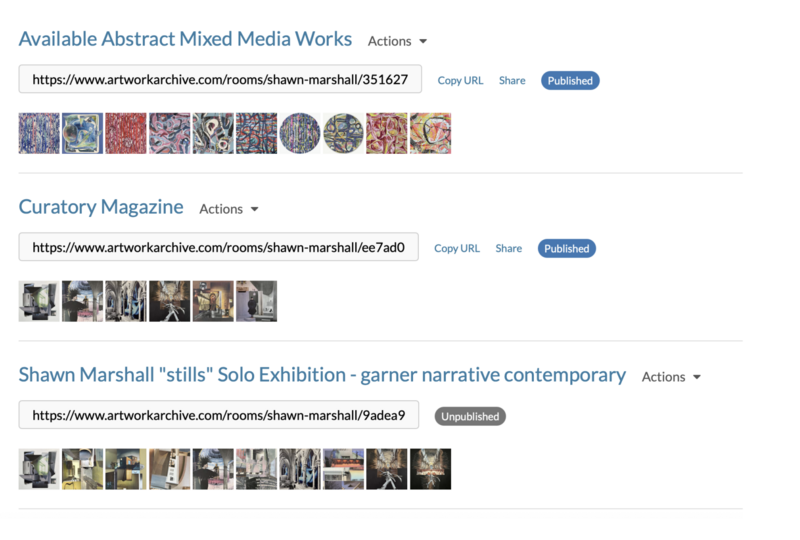
A look at Shawn Marshall's list of Private Rooms on Artwork Archive. Screenshot courtesy of the artist
Making “Ugly” Art Is Part of Creative Growth
Marshall's advice to artists starting out returns to a principle she's lived: the breakthrough pieces exist downstream of the bad ones, and the only way to reach them is through consistent output.
"Focus on output over perfection," she urges. "Push through the stages of making 'ugly' work because it's a prerequisite for growth." There's no shortcut around the volume of work that a sustainable career is built on. Not a lucky break. Not a single gallery relationship. Years of consistent output, of hard work, each one building the precision and the archive and the paper trail that makes the next one possible. "Trust that the volume of your work will eventually lead to the quality you're aiming for."
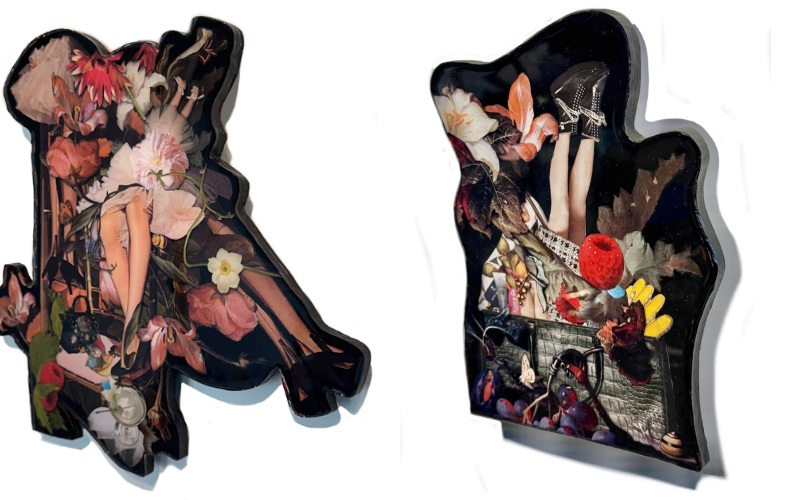
Shawn Marshall, Vanity 1, 2025, 14 x 16 x 2 in & Vanity 5, 2025, 9 x 6 x 2 in
No matter what season of your art career you're in, getting serious about your art career doesn’t need to feel overwhelming. A bit of structure now can mean more time and headspace for the work you actually want to be doing.
Artwork Archive helps artists build an online portfolio, stay on top of their inventory, and create things like tear sheets and invoices in just a few clicks. Start a free trial and see how it fits into your own process.