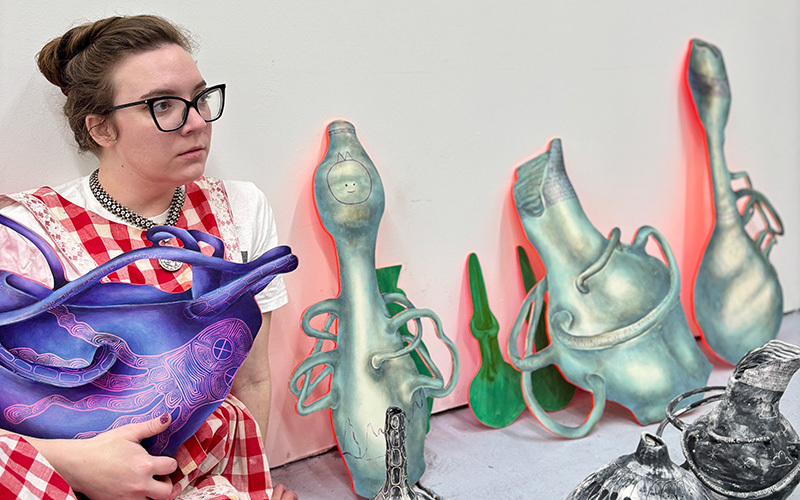
 Featured Artist Cat Rigdon's Dallas painting studio contains an imagined trove of ancient artifacts.
"I like to remind artists that we can create our own rules when creating and marketing our work. Always question your way of thinking and if one of the rules needs to change—challenge it!"
In Featured Artist Cat Rigdon's practice, the ancient world inspires distinctly modern artworks.
Her ceramics, paintings, and drawings are rooted in memories of her childhood in Cyprus, where she would explore the ruins of old civilizations and stumble upon ancient burial sites.
She now works from a pair of studios in Dallas: one for the multi-handled ceramic vessels she creates in the folk Cypriot pottery manner she learned as a child, the other for the paintings of statuettes, amphoras, and other ancient objects she renders on fluorescent acrylic sheets.
"I believe that one only knows an object if they are able to hold it," Cat explains, drawing on years of cataloging ancient artifacts. "To feel its weight and textures is to know how its maker approached creating!"
Read on to see how Featured Artist Cat Rigdon remixes ancient traditions in her contemporary art practice, how her childhood spent exploring archaeological sites instilled a love of art objects, and how she found the right tools to keep her multifaceted art practice running smoothly.
 A Rigdon family photo of ruins in Cyprus.
How Cat’s Childhood Abroad Fueled a Lifetime of Creativity
For a lot of kids, growing up in the late 1990s and early 2000s meant video games and trips to the mall. But Cat spent her formative years exploring ancient archaeological sites and abandoned monasteries in Cyprus.
Nestled in the eastern Mediterranean, the island has seen empires rise and fall, civilizations come and go, and has seen its fair share of conflict as well: “The island of Cyprus has a long history of invasion with each invader taking and leaving a piece of Cypriot culture from the Turkish, to the British, to the Egyptians, and the Assyrians!”
By the time that Cat came to live along the far western coast of the island, the ruins and the countryside became her playground.
“One of my favorite early memories was when we lived in Chlorakas, my brother, sister, and I went towards the bamboo groves surrounding the Tomb of the Kings,” an ancient complex from the fourth century BC. “Unknowingly, we cut through the grove and stumbled into the non-public part of the site. It felt like we stumbled into our own secret world and we played among the ruins.”
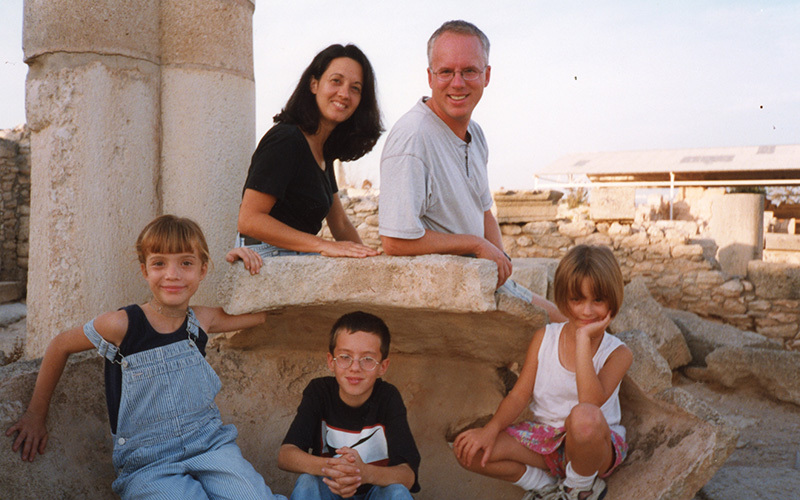 The ancient archaeological sites that Cat explored during her childhood have infused every aspect of her practice today.
Being surrounded by the monumental remains of ancient cultures seeped into her psyche. “Our parents encouraged us to explore and be curious,” she recalls, “so with every move our family made we would set out to investigate what secrets the land held.”
“I had no idea that these would be such important memories,” she admits. “At the time it was just ‘childhood.’”
But as she tells Artwork Archive, these formative experiences of exploring places where history has left its mark would ultimately form the foundation for an artistic practice obsessed with the traces of the long-lost past.
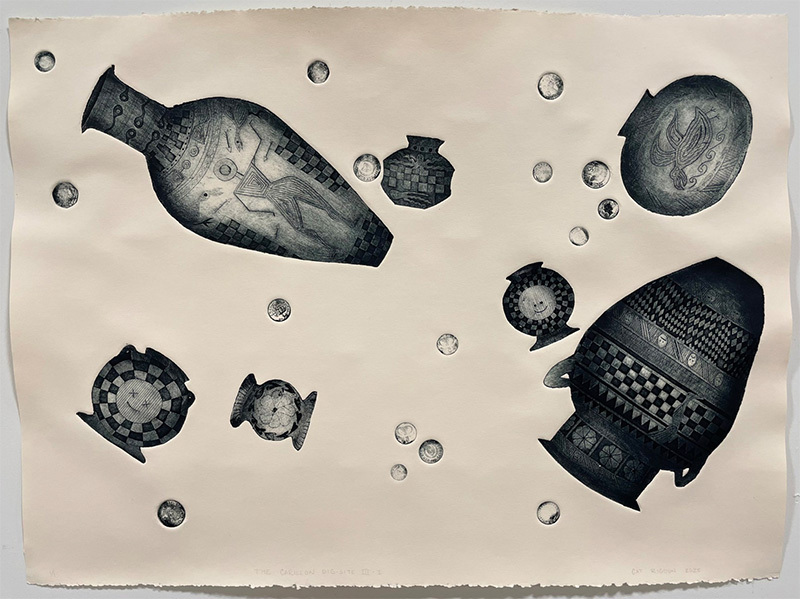 Cat Rigdon, The Carillon Dig-Site III-I, 2023, Collagraph in relief ink on Stonehenge paper, 22.5 x 30 in
How Cat Learned to Value Artworks as Physical Objects
Cat’s family eventually returned to the United States, where she received a degree in painting from Texas State University. Finding her way in the job market after graduating, she lucked into another experience that would profoundly shape her artistic philosophy: she became an object specialist and cataloger at an art auction company.
“In the auction world, catalogers touch thousands of objects every year,” she explains. “I was so fortunate to have had the experience of handling thousands and thousands of objects including ceramics (good and bad examples) from around the world and ancient artifacts as well.”
This hands-on experience with the art objects that so many people only get to see in books provided her with crucial insights into how a well-crafted object feels, what its presence is like in a room, how it rests in the hand.
“I was initially terrified of handling the ancient Egyptian shabtis,” figurines buried with the dead, some from as long ago as four thousand years. “Like how am I the person responsible for collecting the information on this precious and powerful object of death!?”
But with time, she came to find that there was no substitute for actually holding an object. And as an artist herself, it gave her insights into how she could approach her own artworks.
“I believe that one only knows an object if they are able to hold it,” she says. “To feel its weight and textures is to know how its maker approached creating!”
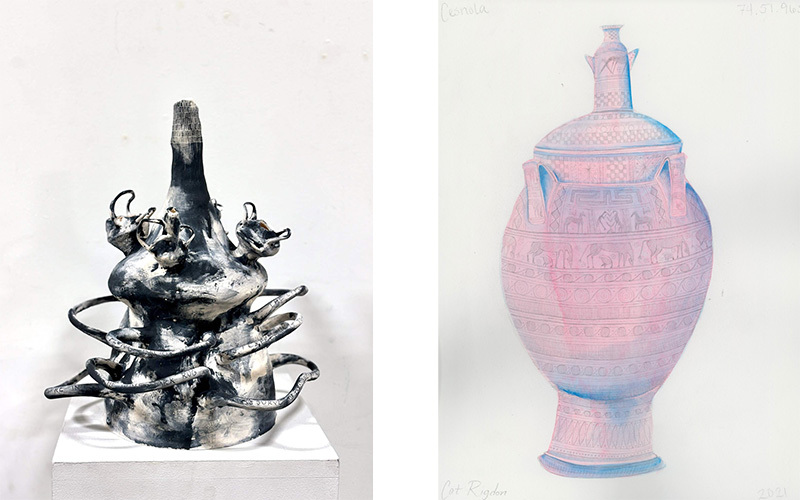 Cat Rigdon, Cyprus Hall Vessel, 2025, Underglaze on bisqued ceramic, 15.5 x 12.5 x 13 in, and Cesnola Lidded Krater 74.51.965, 2021, Gouache on Arches, 15 x 11 in
Cat Keeps Two Studios For Her Two Art Mediums
Today, Cat’s studio practice draws from the deep well of her past experiences, without being too bound to tradition.
She has one studio for her ceramics that she shares with her mom, and another in Dallas’s Tin District that she uses for her paintings and administrative work.
“I generally start in the ceramic studio with creating long coils to build my multi-handled vessels,” she told Artwork Archive. “These pieces are made in a similar manner to the folk Cypriot pottery tradition I learnt as a child and loosen me up creatively!”
She has found that working with the clay requires a particular kind of attention: “The clay has a life of its own and I often have to bend to its whims—I am learning to be more patient with the medium and schedule drying times.”
Her ceramic pieces are ambitious vessels that sprawl beyond their traditional confines. Though one might recall an ancient amphora, the object’s amorphous proportions, the fresh designs etched into its matte glaze, and the overlapping handles make it into something totally contemporary. In their strangeness, they call to mind an archaeological discovery made by an alien thousands of years in the future.
Once her ceramic work is done for the day, she moves to her painting studio, which has less clay dust and more opportunities to meet up with her community.
“I like having this more public-facing space that gives me opportunities to chat with my peers and entertain visitors,” she offers. “I also keep most of my research materials and larger computer monitor at this studio… to have a separate space to work on my writing, grant applications, and administrative tasks.”
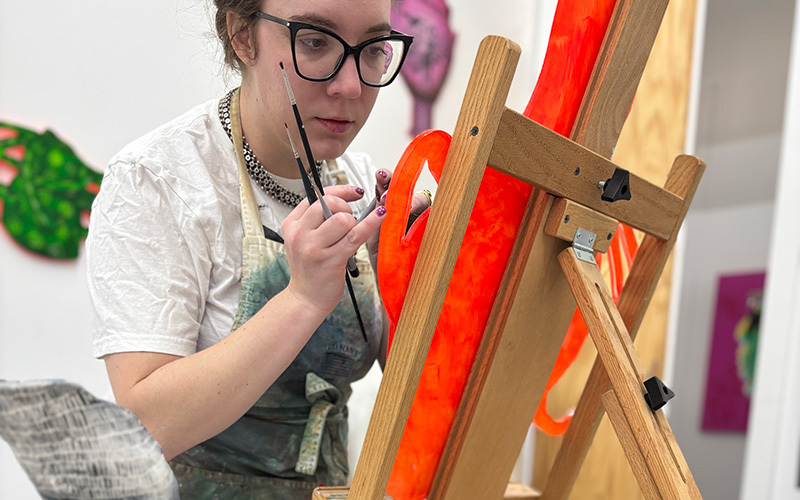 Cat gets her painting substrates custom-cut from fluorescent acrylic sheets to enhance their virbancy against the wall.
How Cat Makes Her Paintings Glow
Once Cat is in her painting studio, her ceramics are still on her mind.
“These works are often direct representations of the works coming out of my ceramic studio,” she explains of her electric-colored paintings. “It is very satisfying seeing a larger scale painting paired with its ceramic original.”
Her painting technique is distinctive and offers surprises for viewers: “I have my painting substrates custom-cut from fluorescent acrylic sheets (it’s why my pieces glow!) and then use oil paint and graphite to render the objects.”
Painted in bright pinks, greens, and purples, these pieces gesture toward ancient history while looking completely contemporary.
“I feel like people are often surprised when they learn that my paintings are not prints,” she tells Artwork Archive. “My paint layers are super thin and can deceive the eye!”
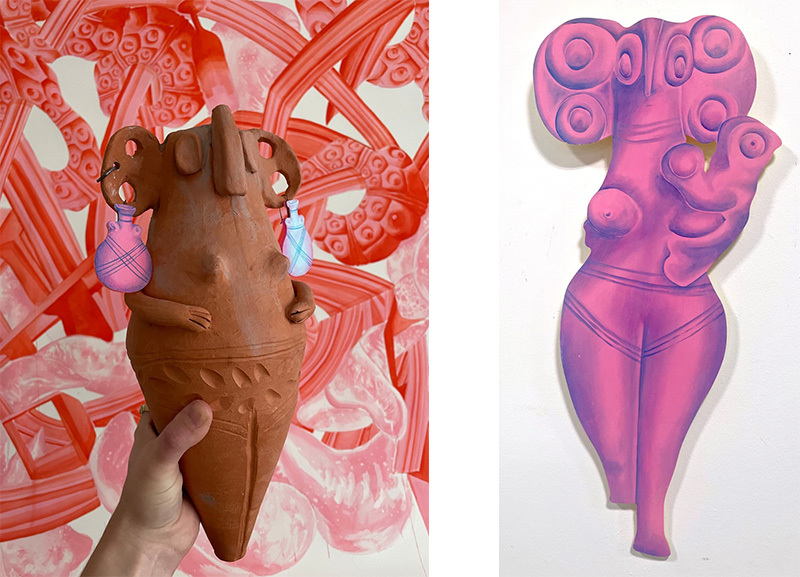 Cat Rigdon, Alchemical homunculus prototype, 2021, Terracotta with oil painted acrylic earrings with sterling silver fittings, and Cesnola Lady with Baby 74.51.1545, 2021, Oil on Acrylic Panel, 19.25 x 9.25 in
When Cat Realized She Needed Better Art Business Management
The years that Cat spent cataloging historical objects left her with a deep appreciation for the importance of robust record-keeping in her own art practice.
As her art career was ramping up, she found she was creating a lot of “random inventory sheets.” It was a headache, and worse, it was distracting her in the studio.
“Creating inventory reports and catalog pages for gallerists and collectors was taking up too much of my time,” she remembers.
Then she discovered Artwork Archive, which she has found to be a powerful way of keeping track of her growing art practice.
“I didn’t think that I would be using the platform every day,” she admits, “but here I am 5 years later with an always active Artwork Archive tab open on my computer and phone.”
Best of all, Artwork Archive is available wherever Cat needs it: “My favorite feature is its fluidity between the desktop and mobile platform. I can efficiently pull together a professional-looking PDF on the go.”
She’s found it so useful, she's even going to use it for her workplace: “I am about to start an additional Artwork Archive account to catalog the artwork for the foundation I work for. I am so excited!”
Cat's Artwork Archive Pro-Tip:
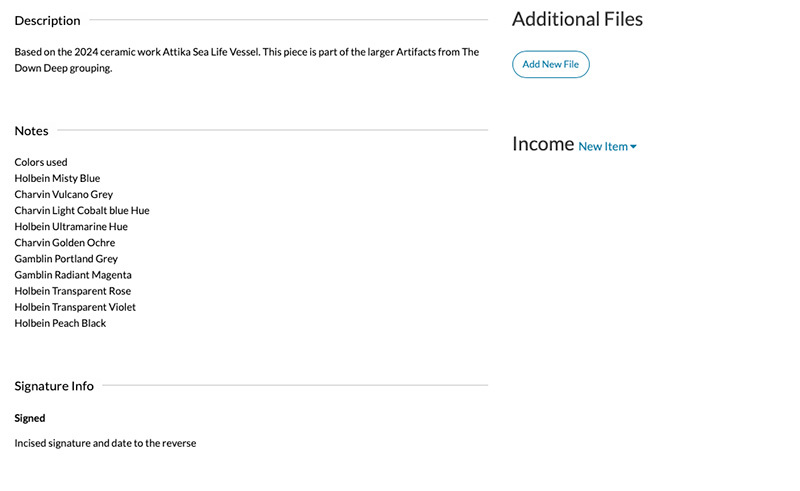
Cat Rigdon loves that she can use Artwork Archive's Notes feature to log the glazes she uses for her ceramics pieces, providing her with a robust materials history that she can refer back to in the future.
What could you track about your art practice with the right tools?
Cat's Advice to Artists Looking For Gallery Representation—And Beyond
Cat’s artistic journey hasn’t been without its challenges, particularly in navigating gallery relationships. Her advice to artists is simple, but borne of difficult personal experience.
“I spent several years with a gallery, in desperation for representation, that could not give me a clear marketing timeline for an upcoming show and then lost several of my pieces (which I have marked appropriately in Artwork Archive),” she recounts. “It was obviously not a good fit and had to go through an emotional break-up with them.”
Too often, artists can feel like they’re at the mercy of galleries to sell their work, or foundations to offer them that grant, or any outside force to confirm their legitimacy. But it doesn’t have to be this way.
“I like to remind artists that we can create our own rules when creating and marketing our work,” and she urges artists to not let accepted ways of running your art business stand in the way of how you want to run it.
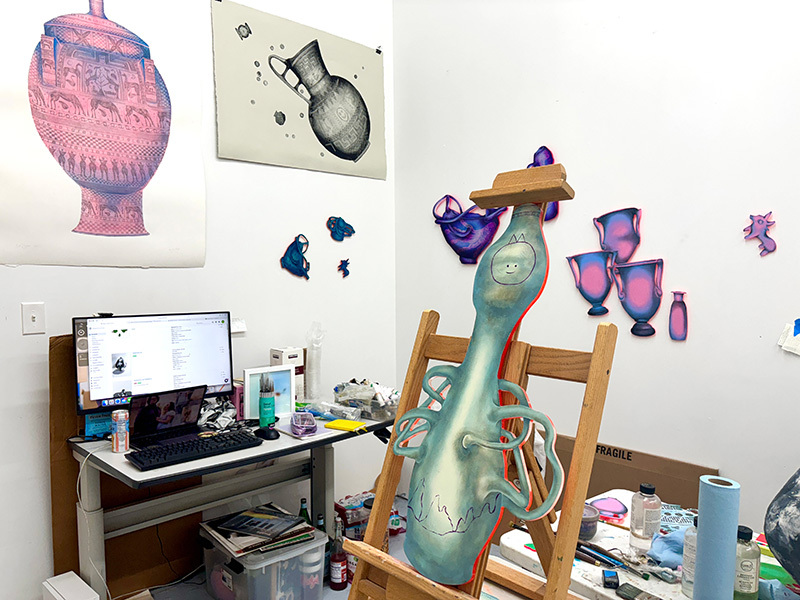 Cat's painting studio in action.
These days, she has a much more casual relationship with a few galleries who she has found she really clicks with.
“Finding a gallery is similar to dating,” she shares. “We all need to spend time looking for gallerists who have similar values, communication skills, and who we genuinely like.”
She trusts their business practices more, and there’s a level of transparency between her and the galleries that just makes it so much easier for them to work together. She’s forged a way through the thorny artist-gallery relationship by looking deep inside to find how she wants to be treated by a gallery—and she says every artist should do the same:
“Always question your way of thinking and if one of the rules needs to change—challenge it!”
From her ceramic studio to her painting space, Cat Rigdon keeps Artwork Archive open on every device. Join thousands of artists who have discovered that the right organizational tools can unleash your creativity: start your free 14-day trial today.