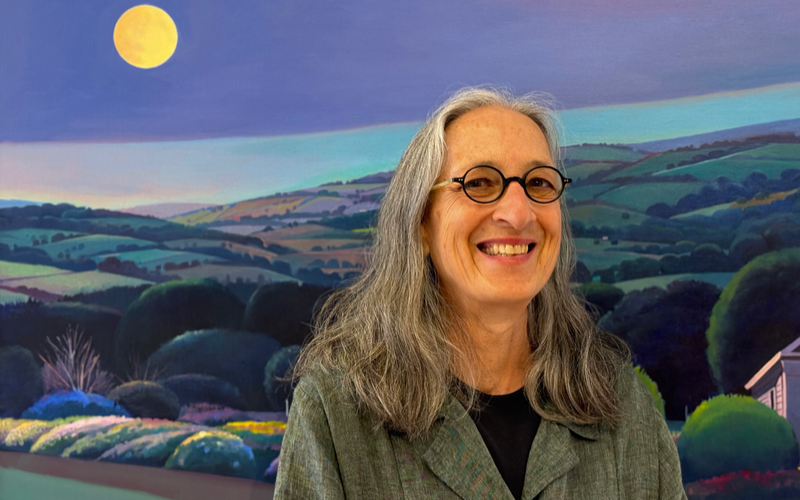
"In small-town America, so often left behind by the modern world, I find beauty of the ordinary everywhere I look."
It's a landscape made of beautiful, broken-down things. Rusted, abandoned farm equipment sags against a barn door under strips of peeling clapboard. An empty factory allows light through windowless frames. And a one-lane gravel road juts to the side of the highway, like a pale, rocky scar carved into the earth. Each serves as a physical reminder of human presence, holding memories and pieces of history as the modern world moves on.
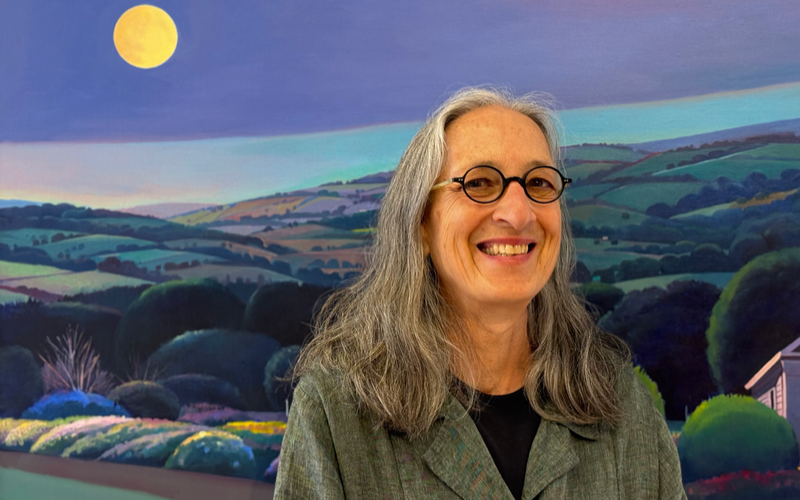
Featured Artist Susan Abbott paints these left-behind corners of the country. The barnyards, backyards, and faded main streets turn luminous in her studio, built from invented colors and edited shapes. Abbott's landscapes possess that hazy feeling of a half-remembered dream you can't quite place. And yet, they also anchor a deep sense of nostalgia, familiar to anyone who has ever traveled a back road. She's been chasing that feeling for decades, and it all started somewhere she never expected.
We got the chance to chat with the artist about the moment that changed her subject matter, the philosophy behind it, and how she keeps the business side of her art practice running.
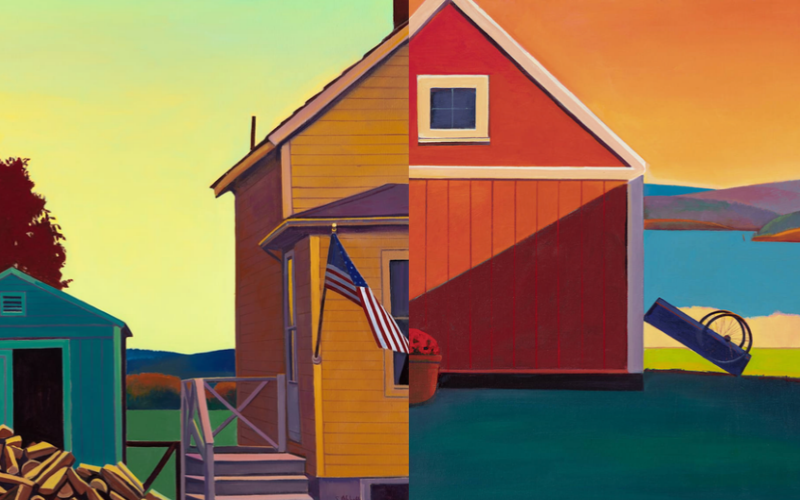
Susan Abbott, Flag and Woodpile, 34 x 34 in | Red Barn, Late Afternoon, 24 x 24 in
How a Classically Trained Painter Found a New Subject From a Car Window
There are certain places that stay with us, lodging deep within our consciousness until something brings them back to light.
Growing up in Washington, DC, Susan Abbott remembers an early passion for art that filled her family home. Her artist father constantly encouraged her drawing and painting, while she learned the tactile, textile art of embroidery and quilting from her mother. When she wasn't creating, she was out exploring the woods and streams surrounding her neighborhood. "Those favorite childhood activities gave me a love of hand craft and nature," she reflects. But as her professional training took over, the childhood woods faded into the background as she spent a bit more time indoors. For years, she honed her craft through the rigorous, formal training of still life and classical figure painting. "In undergrad and graduate school, I studied with Grace Hartigan and Israel Hershberg," Abbott recalls of her BFA at the Maryland Institute College of Art and her MFA at the Hoffberger School of Painting. "After that and for the next decade, I painted large-scale watercolor still life."
Then, one morning, she caught a glimpse of something from a car window.
Twenty-five years ago, Abbott moved to Vermont "for the most impractical of reasons: love at first sight." Driving through a small Vermont town while on vacation, she caught a glimpse of a stream running through a big backyard. The ordinary place that had been lodged deep within her came rushing back to the surface. "Suddenly, I was transported to my childhood, to a time before the creeks in my own hometown were culverted and the yards subdivided." It was an unexpected recognition, "like a memory of home, and I was hooked."
Her "love at first sight" sparked a total shift in both her subject matter and her physical location. Before long, she moved, trading the paved streets of DC for the rural heart of New England. Now, decades later, Abbott is still finding endless inspiration in the almost-forgotten, work-a-day patchwork of small towns and two-lane roads.
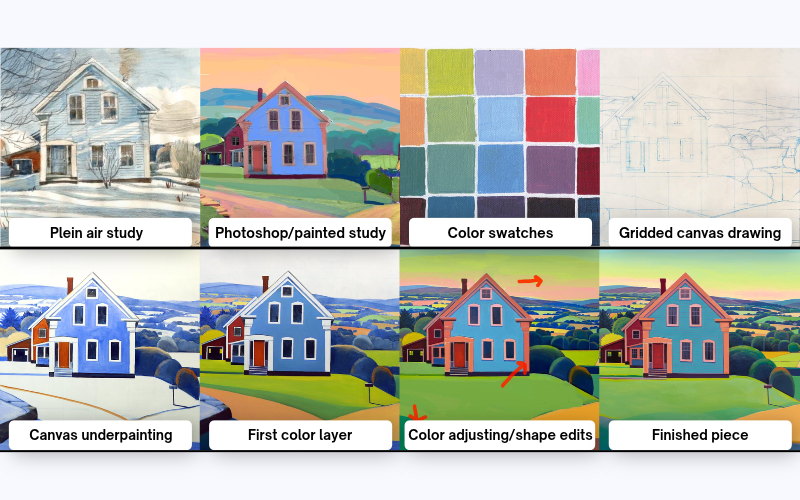
Creative process of Blue House, Summer Morning, 40 x 50 in. See more details of her full process here.
Inside Susan Abbott's Creative Process: Editing, Inventing, and Color as Music
If you ask Susan Abbott what exactly pulls her into the rolling hills and desolate street corners of a rural town, she'd tell you she's chasing an abstract puzzle. "What I'm most drawn to is the unusual, unexpected juxtaposition of shapes within the landscape," she describes. "I find I'm more often attracted to the abstraction of looking between things, rather than the normalcy of looking straight at them." Many of her reference photos and drawings are from a moving car, or by the side of the road. "I always keep a sketchbook in my car in case I'm inspired by what I see out the window," she tells us.
She thinks about color the way a composer thinks about music. "Color is like music," she insists. "Painters are using notes, scales, chords, and harmonies to create a composition." And, like with music, to work with color confidently takes many hours of observation and experimentation. While indeed time-consuming, for Abbott, "thinking about, mixing, applying, and adjusting color is pure pleasure."
Her creative process is a mix of her classical training and digital experimentation, and it's what she used to bring Blue House, Summer Morning to life. The piece began on a freezing winter morning, as she (quite fittingly) sat in her car. Drawn to one home's unusual blue hue and elegant lines, she captured a fast, true-to-form sketch. That drawing was just the starting point. Back in her studio, the sketches are imported into Photoshop to alter and finalize the composition before translating it to a gridded canvas. "I'll keep working with my sketches and photo references, combining and heavily editing them," and using the digital workspace to test big changes. "That may include removing or inventing landscape features to make a stronger composition." Then, the piece goes through a deliberate sequence of value washes, palette grids, and color adjustments, all in search of those perfect musical chords.
It's a meticulous, but joyful process (mostly). "Trying to decide if there's any more to do is my least favorite part," she mentions. "All the other stages I enjoy!" When Blue House, Summer Morning is "finally unified in color and design, and communicates a feeling of peace and warmth, I'm finished."
The Japanese Concept Behind Abbott's Weathered American Landscapes
There's an undeniable pull in an old weathered house or an empty stretch of road that compels Abbott to pull over, sketch, and begin a new piece. Yet, while Vermont served as the catalyst for her subject matter, the specific geography her pieces represent has become less important. "Whether the painting is inspired by New England or New Mexico, I want the forms and colors to reflect my feelings about that landscape," she says, "what it was like for me to be at that place, at that time of day, and in that season."
Abbott has long been drawn to something about these ordinary places, all somewhat broken down, absorbed by signs of age and passing time. But for years, she couldn't quite find the right words to explain why they drew her in. Then, the Japanese concept of wabi-sabi helped her recognize what she finds so compelling about her subjects. Wabi-sabi, an ancient philosophy of traditional Japanese beauty, embraces the aged, modest, imperfect, and mysterious. As author Richard Powell writes, the concept "nurtures all that is authentic by acknowledging three simple realities: nothing lasts, nothing is finished, and nothing is perfect." For Abbott, this explained why a rotten, leaning porch or a rusted silo could elicit a kind of lonely, unexplainable beauty. With their worn surfaces, unassuming details, and traces of lives lived, “you see all of that in the left-behind places of small town and rural America,” she reflects.
Wabi-sabi also offers an explanation to the original, life-changing, "love at first sight" glimpse out her car window all those years ago. The creek she saw running through that backyard in Vermont caught her attention not because it was a beautiful landscape, but because it triggered a wave of nostalgia for her own unculverted childhood. That feeling, along with a profound sense of memory, is what she's spent the last few decades chasing across the country and capturing on canvas. It's also why her scenes can feel strangely familiar, as if they belong to a shared memory we all have.
Viewers of her work describe the same thing. Occasionally, Abbott will get messages through Artwork Archive, her website, or on Instagram, all with their own (yet strikingly similar) interpretations of her paintings. One wrote of feeling "overwhelmed with nostalgia for places never been, yet known; for childhood memories long gone, but just beneath the surface." Another called a piece "a time portal, a healing, joy-bringing connection to a very happy time." These notes mean a great deal to Abbott, who spends most of her days working alone in her studio. "I'm so grateful when someone who has been moved by my work reaches out," she shares. "We artists don't know how our work is received once it goes into the world." So to hear that a painting has brought someone back to a cherished memory, or made them long for a place they've never seen, is to discover that the feeling she's chasing can be shared, and travels much farther than the backyards of New England.
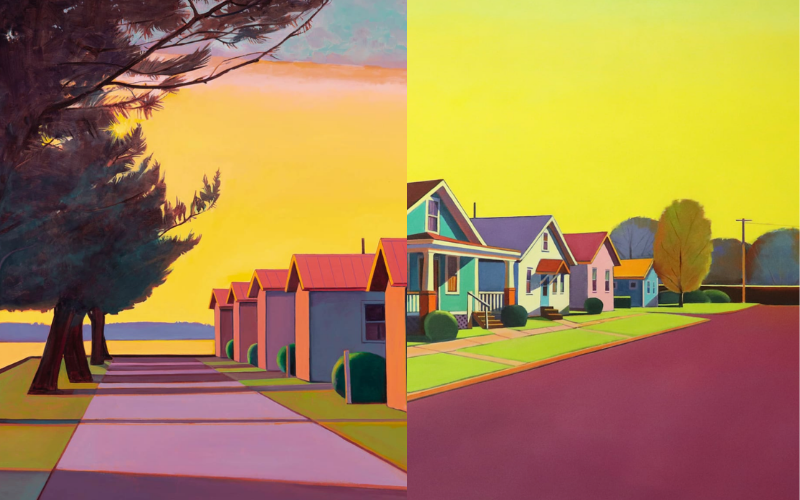
Susan Abbott, To the Water, 44 x 44 in | To the Train Tracks, 40 x 40 in
The Reality Behind a Full-Time Art Practice
A full working day for this artist includes plenty of work that never makes it onto the canvas. After quiet early mornings of reading and writing, she tackles the household tasks and business responsibilities that keep her practice running. Around 10 a.m., she walks a mile down the dirt road to her studio. "Being outside looking at trees and the sky is a nice start to my workday," she says. Then she settles in to paint for the afternoon, usually aiming to be home for dinner with her husband. Abbott aims for 20 to 40 hours at the easel each week, with deadlines for galleries and commissions keeping her on a schedule. "Keeping painting front and center, ahead of the many other activities that make a life, requires pretty much constant thought and planning," she admits. "Inertia and resistance are waiting in the wings for most of us." The chores, the planning, and the business tasks all serve the same end, which is getting her in front of a canvas. "The only time I really feel like I'm working is when I have a paint brush in my hand."
Another part of the job is staying connected to other artists. Abbott and several artist friends meet over Zoom to share work in progress and talk about the realities of their careers. Their conversations can be a place to work through professional challenges, exchange advice, or hear about an opportunity worth pursuing. "Having a community is really helpful, both personally and with the business side of things," she explains. But networking didn't come naturally at first. "Like many painters, I'm a happy introvert, so it took awhile to figure out the pleasure and value of peer relationships." Over time she came to see how powerful it was to have other artists in her corner, those who understand the work and the life around it.
💡 Keep Your Whole Network in One Place:
Collectors, gallerists, and fellow artists are easy to lose across inboxes, Instagram DMs, business cards, and old emails. Contact Records on Artwork Archive give you one place to store everyone in your professional circle. Track the pieces they've seen, the conversations you've had, and the sales you've made to make sure the relationships you build stay organized.
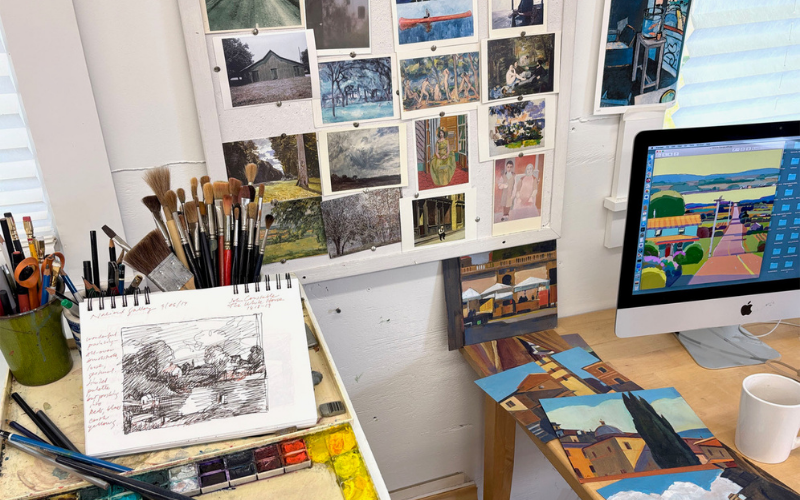
An inside look at Susan Abbott's studio, in the middle of a work in progress. Photo courtesy of the artist
How Artwork Archive Became Susan Abbott's Inventory Hub
An artist's body of work has a way of growing beyond the reach of whatever system first seemed "good enough."
For years, Abbott's inventory system involved slides, 4 x 5 photographs, and a database that required cross-referencing. It worked, but it was tedious, and the thought of losing important files to a hard-drive failure was never far away. She tried other digital programs, hoping to find a better way to manage her records, but "found them overly complicated." She needed something that would help her organize her work without becoming another dreaded project to manage.
Artwork Archive offered the solution: a straightforward platform that connects each painting's image with the details she needs, including size, medium, price, and location. "Just having all that information in one place is a huge help," she says. "It's all online, secure, and very easy to use and to customize." Her gallery inventories live in the same place, in what she calls "a 'one stop' inventory hub that's user friendly and affordable." The platform now supports other parts of her business, too. Abbott uses Private Rooms to share work with collectors and galleries, and links her "Available" pieces to her website so interested buyers can see what's for sale. Her inbox stays active, as she's "contacted multiple times a week via the messaging inbox by potential purchasers." There are other tools she plans to explore as time allows, including Collections, which would help group her paintings by series or subject. For now, she values having the essentials covered and knowing where to find them, and points to the fact that an organized business gives her more time to actually create.
As a professional artist, Abbott is responsible for a body of work that continues to grow, move between locations, and find new audiences. Having an inventory hub she can rely on makes that responsibility a lot easier to manage. "I'm grateful to Artwork Archive for providing myself and other artists with this immensely useful resource."
💡 Let Your Website Update Itself:
The hours you usually spend keeping your website portfolio current are hours spent away from creating more art. But by embedding your Artwork Archive Public Profile on your own site, every update you make, new work added, or piece marked sold, is automatically synced. No more double entry or outdated website portfolios.
→ Get Your Universal Embed Code (for virtually any website)
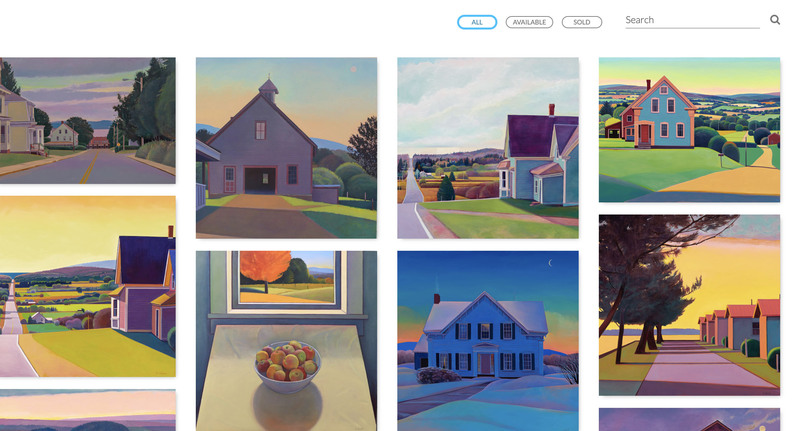
A look at Susan Abbott's Public Profile, which she embedded into her personal website. Photo courtesy of the artist
What Keeps Susan Abbott Painting Small-Town America
A life built around painting takes more than a willingness to spend hours alone in the studio. It requires the ability to keep showing up, even when inspiration doesn't, even when the business side needs attention, and even when things get hard.
"The best mindset is to not want to do any work other than be an artist," Abbott believes. For her, that means defining success on your own terms, and, with all the planning and persistence it demands, eventually taking the leap into self-employment. "Trust that you'll land on your feet," she urges. It also means being prepared for the emotional stakes. "We're creating from an intimate and personal space, and releasing that effort into the world to possibly be rejected or criticized," she says, acknowledging the vulnerability that comes with being an artist. "Our ego and sense of self-worth is meshed with our creative work, and if you give yourself an out when the going gets tough, you'll probably not continue as a professional artist."
That kind of grit explains how she keeps going. But again, to understand why, we return to the stream in a stranger's backyard that brought her back to her childhood. Look through her work at the dream-like scenes filled with two-lane roads, empty factories, quiet barnyards, and main streets that have seen better days. Some of these physical places are likely gone already, swallowed by subdivisions or smothered by newly poured concrete. But the feelings they stir and the memories they carry will forever exist. The nostalgic history Susan Abbott captures of small-town America remains safe on her canvas, made permanent through the dedicated practice of an artist who keeps showing up.
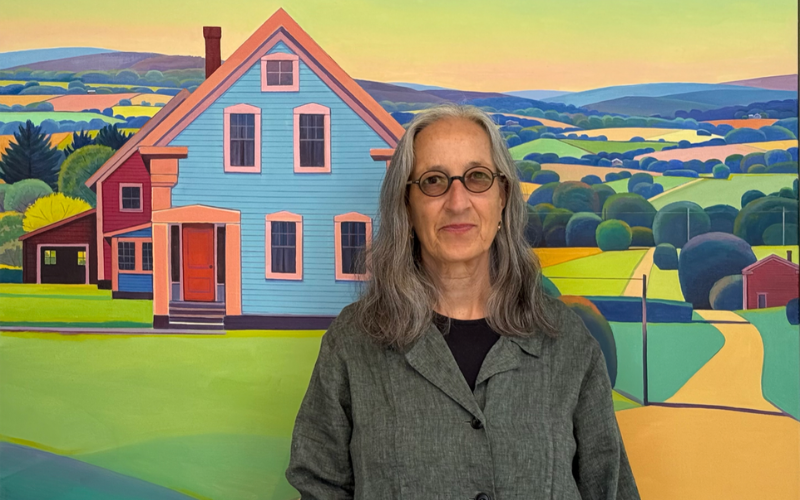
Artwork Archive gives you one place to organize your art inventory, sales records, professional artwork images, and more so you can spend more time making your work. Try Artwork Archive free for 14 days.