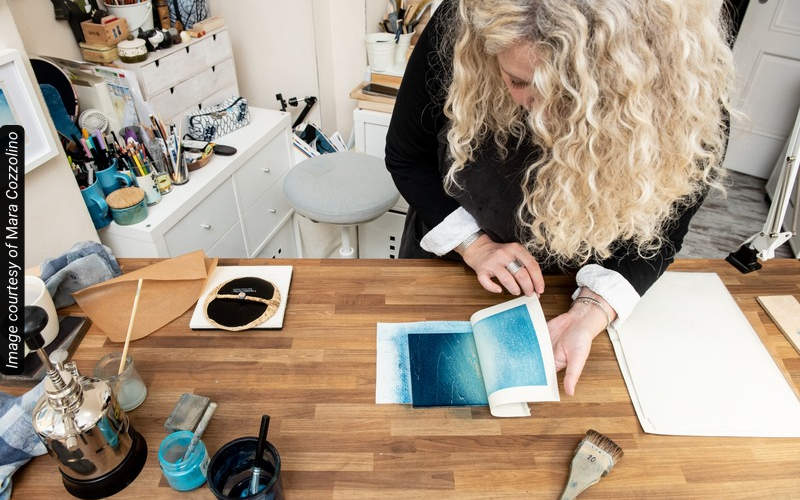
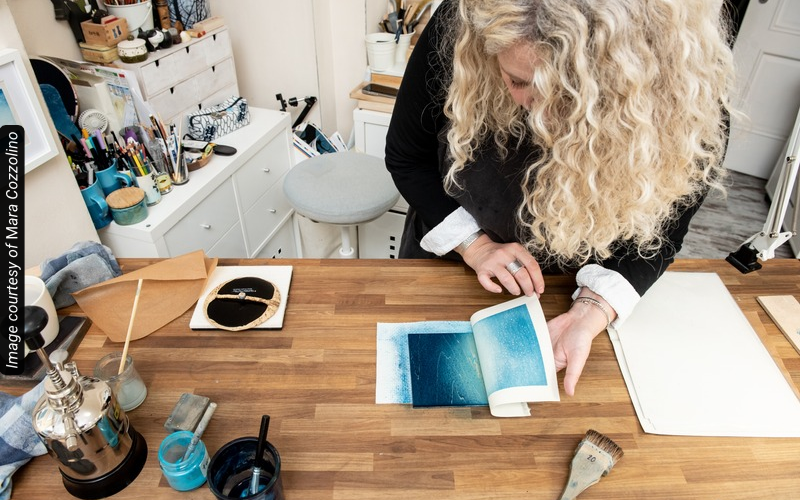
 Image courtesy of Mara Cozzolino.
When a collector asks you why the small painting on your website costs more than the larger one beside it, do you have a clear rationale for the price difference? Or is the honest answer that you just kind of like the smaller piece better?
Pricing can get personal: the price you put on your piece can feel like a judgment on your worth as an artist as much as an evaluation of the work itself. And sometimes, you don't even know where to start with setting a price.
Coherent pricing isn’t some mystery, though: it all starts with choosing a method and sticking to it.
Below you'll find three formulas that bring order to your prices, along with calculators that work out your rate for you. And read to the end to learn about the one pricing model you do not want to use, because most artists are relying on it without even realizing it.
Do Your Artwork Pricing Homework Before You Set Your Prices
Before you choose one of the formulas below, it’s a good idea to get a feel for where your work fits into your market. To get a realistic starting range:
Survey your peers. Look at what artists at a similar point in their careers, working in similar mediums and selling in similar markets, charge for comparable pieces. Artist websites, open studios, art fairs, and local gallery shows are all good places to gather numbers.
Ask galleries for their price sheets. If a gallery doesn't post prices publicly, send a short email asking for the price list for a current show. Most galleries are more than happy to share one.
Talk about pricing with fellow artists. Artists can be a little sensitive about money, and that's understandable. But someone's gotta start the conversation: the more you raise the subject with studio mates, critique groups, and mentors, the easier these conversations get for everyone.
Keep your findings in one place, noting each artist's medium, sizes, and prices. When you set your rate in the calculators below, you can check that your numbers land inside the range you found.
Method #1: Price Artwork by the Square Inch
This formula is the simplest of them all. Pricing your work by its size is a quick and easy way to build consistency into your portfolio’s price sheet. You multiply a piece's height by its width, then multiply that by a set price per square inch.
It works best for paintings, drawings, photography, and other two-dimensional work, where size is the clearest signal of value. If your rate is $2.5 per square inch, a 24 × 30 inch painting is 720 square inches so it comes out to $1,800, while a much bigger 30 × 36 inch painting is 1,080 square inches, so it’s priced at $2,700. Any collector can look at both and understand that the bigger piece costs more because it's bigger—simple as that.
Some Guidelines to Keep in Mind for Size-Based Artwork Pricing
Use the same rate per square inch for work in the same medium and series. Your oil paintings might get one rate while your works on paper get a lower one.
Size-based prices can get pretty steep on very large work, so if that 48 × 60 inch canvas comes out higher than your market will bear, set a slightly lower rate for oversized pieces and apply it consistently to that size range.
And lastly, the cost of framing, if you sell framed work, gets added on top of the size-based price so that your formula stays clean.
📐 Keep Every Price True to Your Formula
When prices are scattered across sticky notes, old emails, and your website, it's easy to forget whether that piece you priced in March used last year's rate or this year's.
With Artwork Archive, before you list a new 18 × 24 inch oil painting, you can pull up the rest of the series, see the prices you've already set, and confirm the new piece follows the rate you've decided on. It's peace of mind, no matter what formula you follow.
Method #2: Price Artwork by Your Time and Materials
This pricing model takes into account your material costs and how much time it takes to make a work into the final price. You set an hourly rate for all your work, track your hours on a piece, and add the cost of your materials to find the end price.
This method suits work where size can be difficult to calculate or doesn't tell the whole story, such as ceramics, jewelry, fiber art, sculpture, and commissions.
Say you’re wrapping up a hand-built ceramic vessel: you’ve decided that your hourly rate for ceramic work is $35, and the piece took 25 hours from wedging to final glaze: that’s $875. From tracking your material expenses, you know that clay, glaze, and firing cost you $70. So all together, the piece’s price will be $945.
Some things to keep in mind: Your hourly rate should reflect the value of your time, your experience, and your skill. An artist with 15 years of exhibitions behind them shouldn't charge the same rate as someone selling their first pieces.
Track your time honestly. Sketching, prep, and failed first attempts are all part of the work, so count them. And if a meticulous process pushes a piece far above what comparable artists charge, that's a signal that you need to revisit your rate or your process before you list it.
📋 Know What Every Artwork Really Costs to Make
Cost and labor pricing only works when your numbers are accurate. With expense tracking in Artwork Archive, you can log the $30 of clay and glaze the day you buy it. When the vessel comes out of the kiln, the cost is already on record, so you can price it in minutes and see at tax time exactly what your studio spent.
Method #3: Price Artwork by Size and Complexity
Some work doesn't fit neatly into a straightforward formula: the size of the piece matters, materials matter, but how do you account for a particularly involved and laborious process or especially complex materials?
This formula starts with a base price, adds a size-based rate, then adds a premium for that complexity. The base price covers what you need to make back from every piece, taking into account materials and overhead. The size rate keeps prices consistent and proportional across a series. And the complexity premium accounts for a piece that is particularly tricky to produce.
For example, you create a 16 × 20 inch encaustic painting with layered beeswax and embedded dried botanicals. Your base price might be $500. The size is 320 square inches multiplied by a $2 size rate, coming out to $640. But because embedding and layering the botanicals is so finicky and tricky, you add $300 for a complexity premium, bringing the total price to $1,440.
Use the Artwork Complexity Premium Thoughtfully
It’s easy to confuse a complexity premium with an “I really just love this piece” premium. Avoid that impulse! Apply a complexity premium thoughtfully for unusual materials, intensive detail, specialized processes, or other meaningful production demands. If you can't easily identify the material or process that requires the complexity premium, you're pricing by feeling, a habit we'll unpack at the end of this article.
📝 Set Multiple Premium Tiers Ahead of Time
Set two or three premium tiers ahead of time, such as $150, $300, and $500, and decide what process qualifies for each. Fixed tiers keep your premiums consistent.
You can note which premium you used for each piece in Artwork Archive's Piece Record—give it a try yourself →
The Artwork Pricing Method To Avoid At All Costs
Now for the pricing model you should like the plague. You’re probably already familiar with it, it’s how most artists price their work, even if they’ve never thought about it this way.
We call it Emotional Attachment Pricing, and it sets prices based on two main criteria:
- How much do you like this piece? The more you love it, the higher the price.
- How recently did you make it? A painting finished last week feels like the best thing you've ever created, so it gets a premium. A piece from three years ago gets marked down because the spark has faded.
But to a buyer, they’re looking at two paintings of the same size, medium, and series sitting side by side at $800 and $1,400. Nothing on the surface explains why they’re priced so differently, so the buyer wonders which price is closer to the real value of the work.
Emotional pricing also boxes you in over time, and wastes your energy. Every new piece becomes a fresh negotiation with yourself, and you can't raise your prices with confidence when you never knew what they were based on in the first place.
Play around with the calculator below and ask yourself, are some of these rationales familiar from your own practice?
Artwork pricing tool
Emotional Attachment Pricing Calculator
For when the real question is not what it cost to make, but what it would take to let it go.
Your emotionally adjusted price
You’re attached, it’s still fresh, and reasonable pricing has begun to leave the building.
Choose the Artwork Pricing Method That Fits Your Practice
The right formula depends on your medium, process, and the artwork itself. But as a general rule:
- Size-based pricing works best for paintings, drawings, photography, and prints. Watch out for prices that climb too fast on oversized work.
- Cost and labor pricing works best for ceramics, jewelry, fiber, sculpture, and commissions. Watch out for slow processes that drive costs up unnecessarily.
- Base + size + complexity pricing works best for mixed media, encaustic, and work with specialty materials or processes. Watch out for using premiums emotionally.
You don't have to use one method for everything. Plenty of artists price their canvases by the square inch and their commissions by the hour.
But the goal to shoot for is consistency within each category. Once you pick a method for a body of work, apply it to every piece. You'll save yourself a lot of headaches, and give yourself more room to maneuver, down the line.
Why Consistent Pricing Pays Off Over Time
When prices follow clear, logical rules, collectors leave your studio confident that they’re paying a fair price. When first-time buyers trust you, they’re more likely to become long-term collectors.
And when it comes time to raise your prices—because your CV is filling out, or interest is increasing substantially—having a clear formula keeps price increases worry-free. Instead of repricing every piece individually, you adjust one number, so moving your rate from $3 to $3.50 per square inch after a strong year lifts your entire body of work evenly.
Finally, predictable pricing lets you plan your income. You can set clear income goals for your entire art practice and see how many pieces it will take to reach them.
Know Exactly Why You Price Your Pieces the Way You Do With Artwork Archive
When prices live in a notebook, a spreadsheet, and your website all at once, it's easy for one piece in a series to drift out of line without you noticing.
In Artwork Archive, every Piece Record holds its dimensions, medium, series, and price in one place, along with all of your expenses and income. You can even add notes to yourself about which pricing method you used for that piece. Pull up your oil paintings from the coastal series and you can check in a minute that every piece follows your $3 rate, then share an up-to-date price list with a gallery before your next show. It takes the drama out of pricing, so you can focus on what you do best: making the work.
Want to try it for yourself? Organize your inventory and take control of your prices today with a free 14 day trial of Artwork Archive →