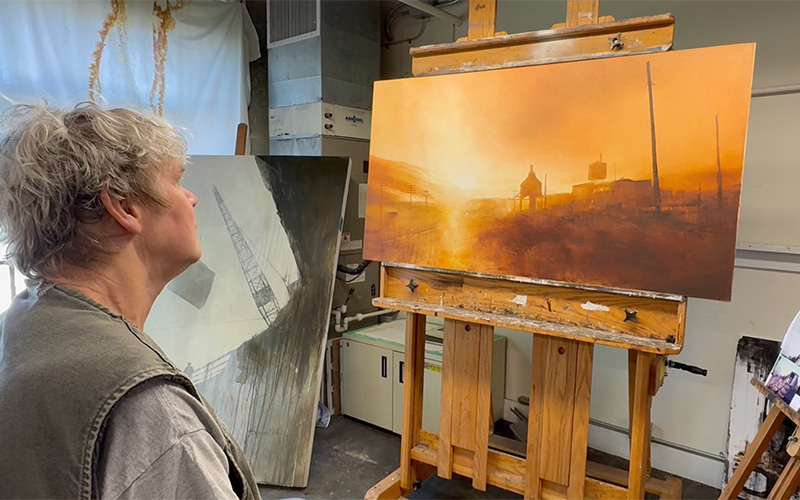
Take a first glance at Charlie Hunter’s canvases and you’ll see faded signs, decaying barns, and main streets past their prime.
But as his precise draftsmanship and unconventional painting techniques draw you in further, you’ll find that these scenes positively vibrate with a vitality that can only come from Charlie’s close and careful looking.
Because Charlie loves these places. Even if these scenes are the result of economic forces moving beyond these down-and-out towns, even if time has not been kind to these rail yards and country roads, these places still mean something to Charlie.
And a large part of that meaning comes from his decision to linger there, set up his easel, and spend an afternoon communing with a part of America that other people hurry past.
His subjects can be traced back to a small New Hampshire town where he spent his childhood. Walking home from school along the tracks of the Boston & Maine, the artist remembers reading the slogans painted on the boxcars as they rolled past. He went on to spend a stretch in the music business, where he designed tour posters for The Clash, REM, and the Jerry Garcia Band before turning to painting full-time. These days, you’ll find him honing his craft inside an old paper mill in Bellows Falls, Vermont.
“While an actual painting or drawing is a collection of light and dark marks, a representational artist has to be interested in the nominal subject matter,” Charlie explains of his love for America’s forgotten byways.
“The subject matter is the portal through which the creative act occurs.”
Want to see how Featured Artist Charlie Hunter’s upbringing led to his fascination with faded beauty, how long train rides fuel his practice, and how he has come to think about all the desk work that the artist’s life requires? Read on to see more of Charlie’s work and learn how he became the artist he is today.
How Charlie Discovered His Love of Painting
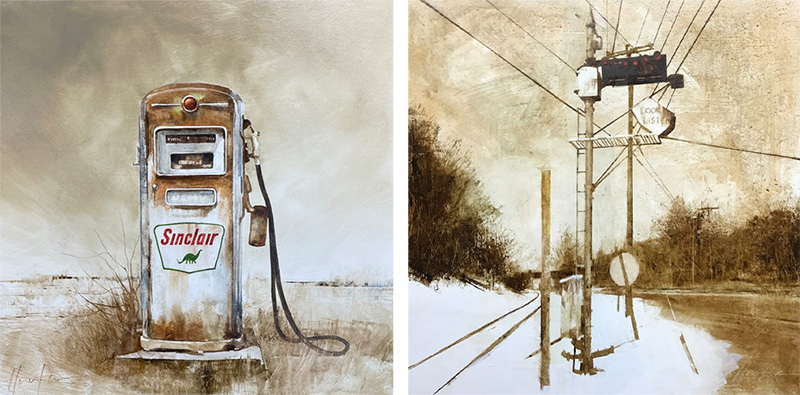 Charlie Hunter, SINCLAIR, Oil on panel, 20 x 20 in, and THE MECHANICAL FLAGMAN, Oil on canvas, 20 x 20 in.
Charlie was born in a small New Hampshire town with abandoned quarries and train tracks busy carrying people to bigger places.
“When they put a highway through our barns, my family returned to the house built by my great, great, great grandfather in Weathersfield Center, Vermont,” Charlie remembers. The highway was replacing the railway, but who knows how long that monument to humankind’s dynamism would last.
Being shuttled around by these forces outside his control—and seeing how easily yesterday’s progress became today’s ruins—were formative experiences for him. It led him to art, and to his signature ethos: “I like to paint what nature does to what man creates.”
In his paintings, you’ll find farm buildings put up in a hurry at the turn of the 20th century, old tractors from the ‘40s, steel girder bridges with rust beginning to show, gas stations graced with signs of once-proud companies—AMOCO, Sky Chief, Sinclair—since snapped up by multinational conglomerates. These sights from the century past seem old to us now, but in the long history of this land they come from the recent blip of living memory.
“I think there is a universal sorrow in seeing human endeavor slide into economic or social irrelevance,” he tells Artwork Archive. “I’m sure there were a lot of Neanderthals doing cave paintings mourning the disappearance of the woolly mammoth.”
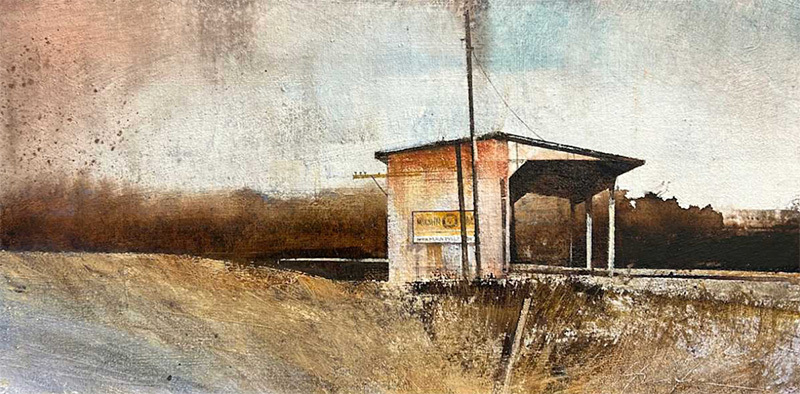 Charlie Hunter, HUDSON COAL, Oil on Muslin Panel, 8 x 16 in
Painting America’s Changing Landscape En Plein Air
Charlie renders these scenes in a muted palette, with splashes of barn red or the faded green of the plains in winter, colors that seem to spring from the ground at the places he chooses to make his art.“I am a big believer in the idea of ‘right objects,’ by which I mean subject matter that evokes an emotional response in the Artist,” he offers by way of explanation for his fascination with these out-of-the-way places.
“I’ve got to get excited about the subject matter; then there are a million ways into the battle.”
He’ll often paint en plein air, in places he reaches on his many long-distance rail journeys. These trips take him to spots that might once have been the heart of an area’s economic activity, but as the centrality of rail travel has given way to the car in this country, these places have faded as well.
He’ll sketch, paint, and then take the work back to his studio in an old paper mill on the banks of the Connecticut River in Vermont. He’s a prolific artist whose work shows in its expert handling how deep he has dived into his subject matter and his craft.
“And my smart-aleck answer to when one knows a piece is finished?” he says with a laugh and the craftsman’s knowledge of a job well done: “10 minutes after you should’ve stopped.”
Charlie’s Lesson for Musicians That Works for Artists, Too
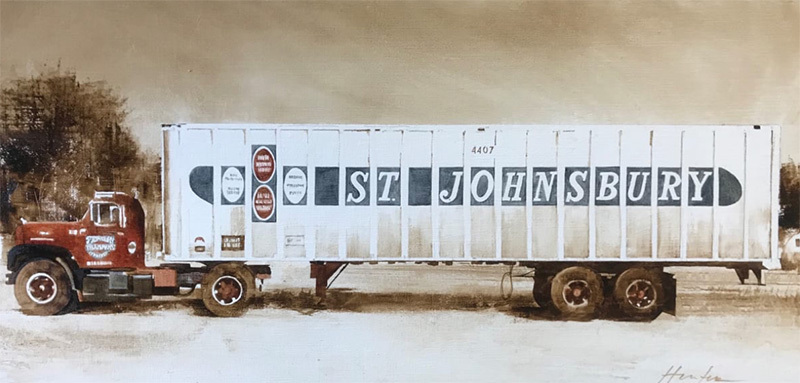 Charlie Hunter, ST. JOHNSBURY COMMISSION, Oil on muslin, mounted on panel, 12 x 24 in
In the 1990s, Charlie was a music manager for singer/songwriters.
“I always used to council my musicians to retain ownership of their master recordings, and not to write for the marketplace,” he shares.
Everybody in that scene was trying to write a hit single, something that would get them on the radio and get the royalties flowing in quickly. But Charlie had been around long enough to know that the musicians who stuck around, who continued to actually love their craft, were the ones who intentionally played the long game.
He’d tell his musicians: “Try to write something people are going to want to listen to in 30, 40, 50 years. Develop your own, distinctive, truthful voice, and deliver it as honestly as you can.”
That lesson is applicable to anyone who depends on their creativity to carry them through this life. “I try to do that with my work,” he muses. “I may or may not succeed, but I have not regretted that goal for a moment.”
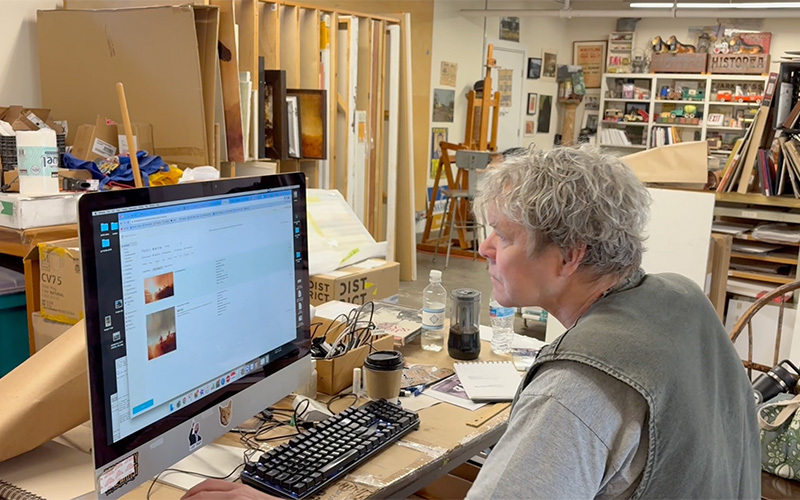 What Charlie calls the “deskwork” is a fact of life for working artists—but Artwork Archive has helped to lighten his load. Image courtesy of the artist.
How Charlie Runs His Art Studio With Artwork Archive
Sticking to his authentic artistic impulses began to bring Charlie success, and he realized he needed a better way to keep track of his inventory. He was painting up a storm, making trips by rail to the locations that excited him, and amassing a large backlog of pieces.
“The back end of the business is really important,” he admits, and he urges all artists to take these tasks seriously, even if they aren’t quite as exciting as the rest of the artist’s life: “You’ve got to keep track of inventory. You’ve got to know what you have at your studio and what is out at various galleries. Your pricing has to be consistent.”
He didn’t have the stomach for building a database from scratch—he knew it would be finicky and could potentially break on him, losing years worth of work down the line. So he started to ask his circle for their advice. That’s how an art consultant friend recommended he check out Artwork Archive. “That was really good advice,” he admits.
Artwork Archive has made it so much easier for him to run his art business: “I like all the ways that I can filter information. I find the Private Rooms feature extremely helpful. I am a big fan of how I can keep multiple images of works as they evolve.”
💡 Tool Spotlight: Artwork Archive Private Rooms
Featured Artist Charlie Hunter knows that being able to share his work seamlessly—and in a beautiful way—makes it so much easier for his collectors to appreciate his work.
Artwork Archive’s Private Rooms allow you to create exclusive digital galleries to share tailored selections of your art with clients, collectors, and galleries.
- Curate with Ease: Group specific artworks, include pricing or dimensions, and add personalized notes for a polished presentation.
- Streamline Collaboration: Skip the heavy email attachments. Send a direct, secure link to let buyers view your inventory effortlessly.
- Instant Professional Credibility: The sleek, thoughtfully designed layout is your high-end digital gallery, ensuring your curated collections make an unforgettable first impression.
Ready to cut down on your art business admin?
Try Artwork Archive free for 14 days and start using Private Rooms to share your work like a pro.
Progressing in his career as an artist has made him realize just how much admin there is in this gig, and how much easier all of those tasks have become with Artwork Archive. “A lot of my musician friends say they don’t get paid for playing music; they get paid for driving and lugging gear around,” he shares. “Similarly, it feels like us working artists don’t get paid for painting; we get paid for packing and shipping and keeping track of inventory. That’s where Artwork Archive comes in handy.”
Because ultimately, all of that packing and shipping and inventory tracking is to help you get back to what matters: making the work: “Having Artwork Archive at my fingertips has saved me untold hours of deskwork, and allowed me to spend that much more time on my artistic practice itself.”
Charlie’s Advice for Aspiring Artists
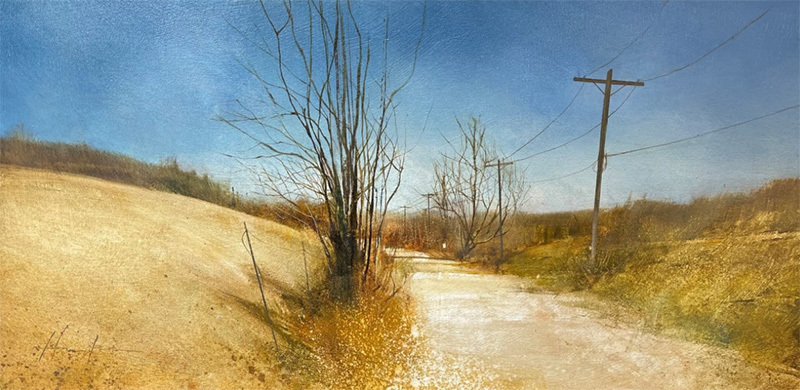 Charlie Hunter, WARWICK FURNACE ROAD, Oil on Muslin Panel, 16 x 32 in
Charlie has worn many hats over the years, and it’s only in the past couple decades that he’s been able to focus primarily on his painting.
He likes to keep all of this bounty in perspective, and to be pleased with what he’s been able to build out of his creative life.
“The Canadian singer/songwriter Fred Eaglesmith says, ‘When I was a kid all I wanted was somebody, anybody, to listen to my songs. Now, today, I’m not famous, but I can go almost anywhere in the world, and there are 100 people willing to pay 25 bucks to hear me sing my songs. Isn’t that enough?’” Charlie recalls. “I think that’s pretty great.”
Charlie’s advice for artists who are trying to find their footing in the contemporary art world is to tune out the noise and not worry about what everyone else is doing.
“Don’t spend time getting annoyed that Jeff Koons makes millions of dollars,” he urges. “‘Brand name’ artists are playing an entirely different game than people trying to do honest work.”
Because ultimately, it comes down to the time you spend to discover what drives your creative urges, and to carry those out to the best of your ability.
“Get good at what you do, and share it willingly, while figuring out a way to extract a living wage from your efforts,” he tells Artwork Archive.
Remember his advice for musicians: don’t chase after the radio hit. Instead, as much as you can, focus on building a career that lasts for decades.
“The great folk singer Utah Phillips used to say ‘make a living, not a killing,’” Charlie recounts. “I think that’s good advice.”
Charlie has spent a career learning to focus on what matters and letting go of what doesn’t. And messing around with finicky spreadsheets and lost piece records definitely doesn’t.
With Artwork Archive, you can make it easier to handle your art inventory, sales records, and all the desk work that goes into the artist life—so that you can spend more time focusing on the work only you can make. Try Artwork Archive free for 14 days.