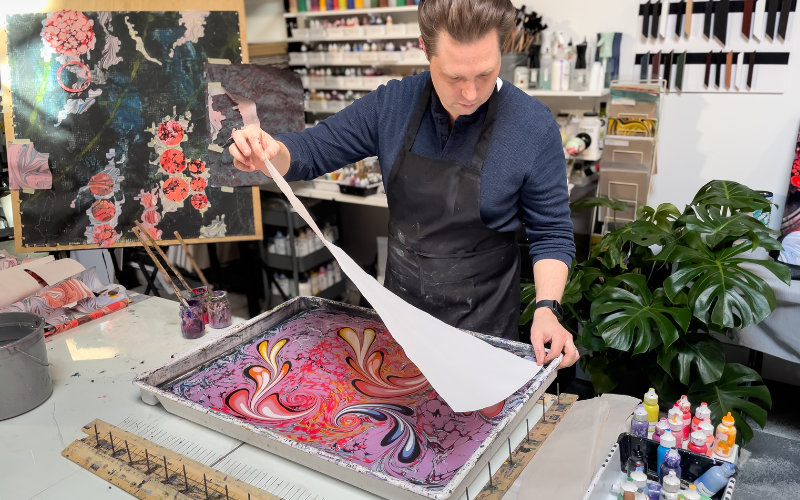
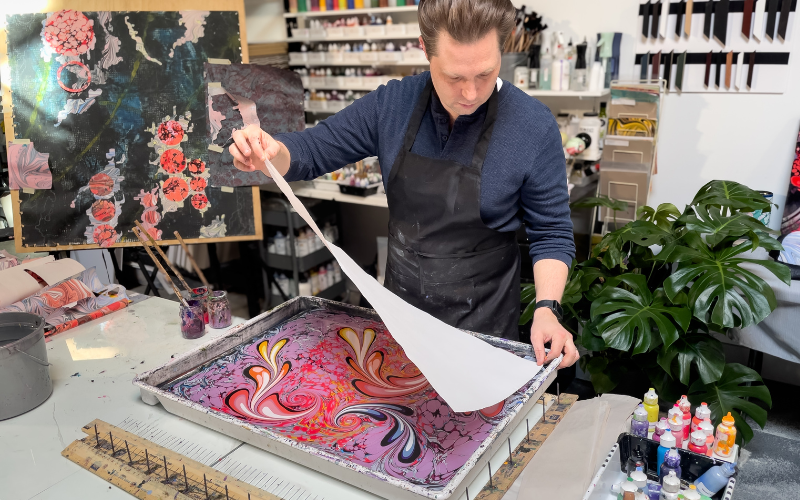
Featured Artist Keith Garubba lifts a freshly marbled sheet from the tray at Whistling Studios. Photo courtesy of the artist.
How Keith Garubba Uses Pattern and Symbolism in Printmaking
A printmaker, educator, and self-described ink-stained optimist based in Bethlehem, Pennsylvania, Featured Artist Keith Garubba makes work for deep-thinking daydreamers who like their art with a little mythology and a lot of soul. "Pattern is the language the soul learned first," says Garubba.
His work uses abstraction to charge familiar symbols with new meaning; pulling icons from their original context and restaging them until they vibrate with something new.
"I'm not interested in answers," he tells us. "I'm interested in the charged silence where a daydreamer stops, looks twice, and walks away uplifted, mind-shifted."
Now from Whistling Studios, the boutique teaching space he opened in 2024, Garubba has built an art practice that is technically rigorous, visually restless, and deeply attuned to meaning beneath the surface.
We got the chance to hear more about Keith Garubba's creative perspective, his technical process, and how he ran his art career entirely from a binder...until he found something better.
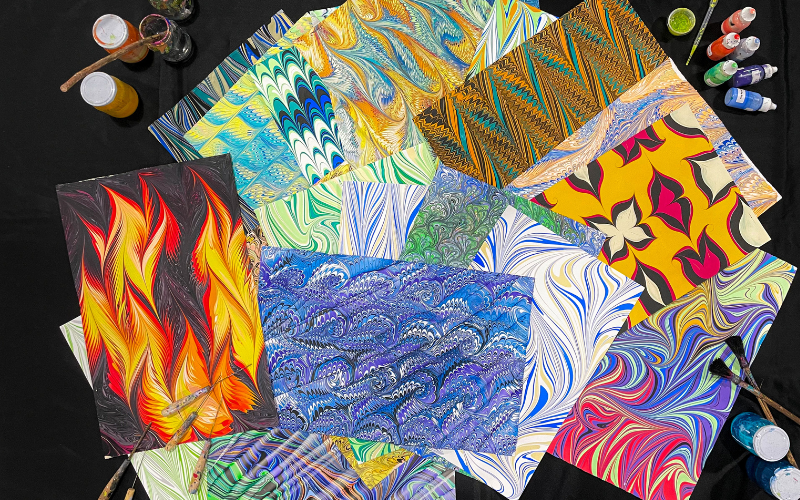
A spread of Keith Garubba's marbled paper works, each one a one-of-a-kind result of paint on water — no two ever quite the same. Photo courtesy of the artist.
Making Art Without Waiting for Inspiration
Keith Garubba doesn't wait for inspiration to start making. He makes art every day, letting materials and process lead until an idea catches up. "Whatever medium has my attention at the moment, I'll just get in and play," he explains, trusting that "the idea will enter the picture." And after years of working this way, he has little reason to doubt it: "They always do, so I'm never worried about that."
When an idea does form, it usually pulls him toward drawing first. He's inclined to "diagram, to test, to see something in its simplest construction" before deciding what it wants to become. Then comes the part he’s most drawn to, where the piece starts slipping out of its neat outline. He calls it "the glorious, messy middle, where things get pliable."
"The work gets chaotic sometimes, but the mind is quietly buzzing. I love it there."
There's no formula for stopping, either. Once a piece feels mostly resolved, Garubba pushes it out of bounds and "breaks" it. "Breaking it is essential. It's how you make novel solutions," he explains. "It puts me in a position where I need to actively figure out how to make it right again."
Once he finds his way back from the wreckage, he looks for what he calls "the pregnant stopping place." Not finished in any absolute sense. Just enough to leave alone. “Every piece in the world could be considered unfinished,” he reflects. "I'm just choosing the stopping place that feels most alive."
How Curiosity Shapes Keith Garubba’s Mixed-Media Art Practice
"Let curiosity guide you, the rest resolves itself." That philosophy has taken Keith Garubba across fused glass, silkscreen, and marbled paper, media that most artists would find daunting to learn, let alone master. But technical mastery isn't really what drives him. Instead, he's interested in the "magic moment" that happens at a specific point in each process: the kiln opening, the press running, the liquid marblework lifting onto paper. "I don't always want to feel in perfect command of what's happening," he says. "I like a mediated experience. Setting something up, and seeing how it comes out the other side. That's what it's all about."
But what he's really after every time? "That momentary magical collaboration with the unknown."
His confidence with new materials traces back to a single nudge from a professor, who encouraged him to apply for a research grant to work on a glass project he knew nothing about. "I had no idea what I was getting myself into," Garubba remembers. "He gave me an aspirational push, and I went for it." While that grant is how the artist developed his approach to silkscreened glass, it also taught him something he's carried ever since: "I can master anything I'm curious about and make it my own."
"It was the lesson that taught me to stop waiting for permission," he adds. "Let curiosity guide you, the rest resolves itself."
These days, which media he reaches for is part intention, part instinct, and part resource allocation. A smaller studio may call for modest, direct materials. A rare year with access to an incredible kiln might mean it’s time to let glass take the lead. “What you have at your fingertips helps determine which ideas you execute,” he puts plainly.
Right now, paper marbling is his world. And for someone drawn to slow, deliberate processes, it's offered him something unexpected, something he doesn't always give himself permission for: "insane levels of spontaneity."
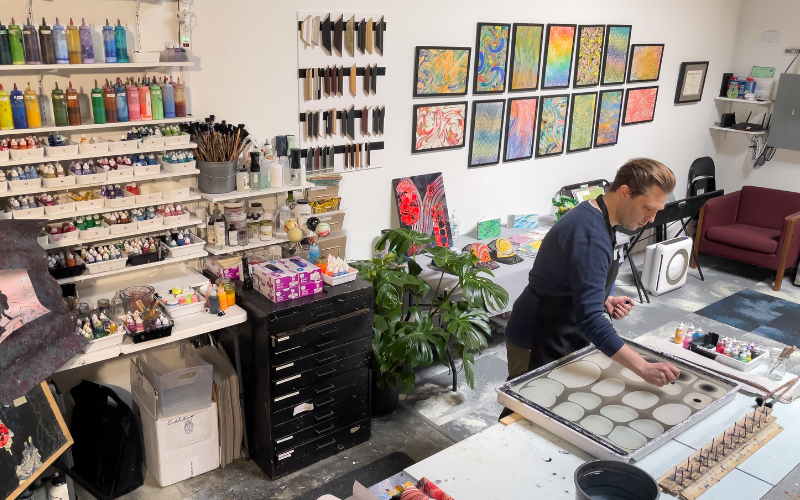
Keith Garubba at work surrounded by the tools, materials, and finished marbled works that fill his studio. Photo courtesy of the artist.
Building a Daily Studio Art Practice
Before Keith Garubba can settle into any medium, he has to move through the studio first. Literally. "I'm like Uncle Scrooge in his Worry Room, digging a trench in my wake," he laughs. Most days begin with several laps around the studio filled with looking, fidgeting, and, of course, daydreaming. "It's hard for me to attack my work without getting some of this nervous energy out."
He paces. A lot. Most days begin with several laps around the studio filled with looking, fidgeting, and of course, daydreaming. "I'm like Uncle Scrooge in his Worry Room, digging a trench in my wake," he laughs. "It's hard for me to attack my work without getting some of this nervous energy out."
For most of his career, his artwork was structured less as a daily practice and more as a series of projects. But with paper marbling, he finds a daily practice is much more possible. Something about the medium makes it easier to return to each day, and it's become its own kind of anchor. "I've found it very grounding," Garubba emphasizes. "It keeps me sharp and gives me a baseline for launching into the creative ideas that then become projects."
Blurring the Line Between Art and Science
"Paint drips are living things." At least, that's the premise behind one of Keith Garubba's most imaginative projects, Dr. Armbruster's Laboratory., a series that offers a vivid window into how the artist thinks about experimentation, storytelling, and the boundaries between art and science.
The series centers on Dr. Armbruster, who Garubba sees as "a character, an alter ego, an entomologist who has come to believe that paint drips are living things." With that premise in place, this body of work becomes a site for pseudo-experiments that explore how scientific research is creative, art is analytical, and all of it is more fluid than we generally pretend.
“There is definitely a bit of me in [Dr. Armbruster],” Garubba acknowledges. The character is even named after his maternal grandmother's surname. “He and I share a belief in a certain kind of magic, a quirky kind of believing that makes discovery possible.”
The project also gave narrative a more visible role than his work usually allows. “Most of my work has some bit of narrative in it, even if it is completely hidden,” he notes. "But in the Dr. Armbruster series, the narrative was much more explicit. It was the machine that drove the creation of the abstract visuals." It also showed him that any creative tool that leads you somewhere new is worth keeping. In this case, “a very strange story about a fictional research scientist” led him toward artworks he never would have made otherwise.
Dr. Armbruster's Laboratory stretched well beyond the wall. Garubba created large interactive installations with live actors playing scientists, guiding visitors through hands-on experiences with drips and running paint, wrapping the whole thing in what he describes as "a circus of pseudo-science." Those performers ended up reshaping the project entirely. Given their own directives and personalities, "they transformed the whole project and made it better," he says. "Part open-ended performance, part live painting, these artworks took on a really organic kind of life."
It made him realize that some of his most alive work came from simply letting go: "Give some piece of the art away and see what comes out the other end."
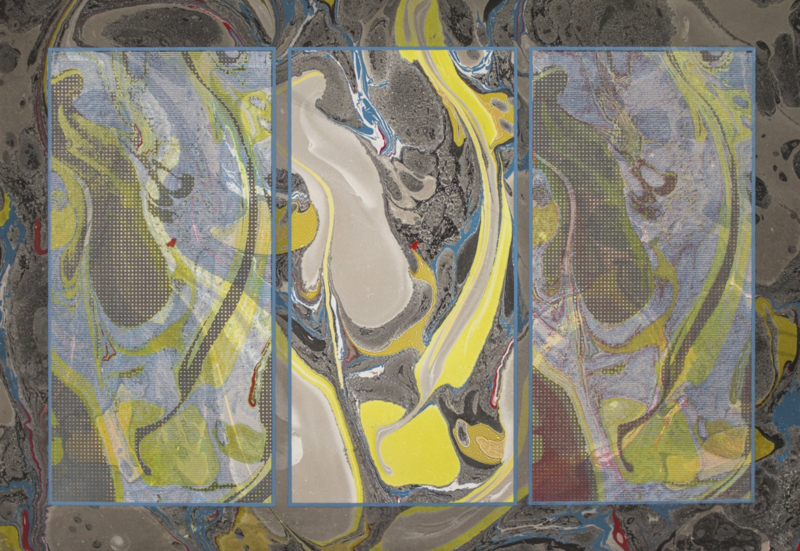
Keith Garubba, Simulation of a Drip Spawning 5, 15 x 22 in, from the artist's Dr. Armbruster's Laboratory collection
How Teaching Can Strengthen an Artist’s Creative Practice
"This chapter of my career feels like one of the most creatively alive I've experienced." Alongside his own fine art practice, Keith Garubba has found another source of creative energy: teaching. Having long drawn inspiration from working with students, he recently opened Whistling Studios, a boutique art studio where he teaches paper marbling, printmaking, and drawing.
"Teaching has become a central and deeply meaningful part of my artistic voice. It's not separate from my practice. It feeds it."
With that as the driving force, he built the space around what he thinks art should be, and it’s drawing in the kind of artists he feels connected to: "frankly, people I relate to." Watching his students move through the room, use the tools and systems he set up, and wrestle with ideas that may have started in one of his classes has been, in his words, “transformative.”
How to Build a Sustainable Art Career Without Burning Out
"The long bloom of an artist requires all seasons." It's a lesson Keith Garubba learned by first trying to do everything. Early in his career, he said yes to every show, every collaboration, and every fair he could manage. "Yes feels like you are opening up your world," he reflects. "But it's not. It's closing up your calendar." It took burning out a little before he could be honest with himself: he doesn't love a packed show schedule, collaborations aren't always his strength, and art fairs can drain him.
Your business identity needs to be as closely guarded as your art identity," he points out.
The career he actually loves looks a bit different than the one he originally imagined. "I love teaching. I love doing only a couple of art shows and a couple of fairs a year. And I love showing up online with my work. A career can be built on that. Less can be more."
The same honesty applies to the studio itself.
"The long bloom of an artist requires all seasons. Moderate your energies. You don't need to execute great ideas every time you enter the studio. Sometimes, it's ok to just enjoy the work. Sharpen the axe, read interesting things, foster curiosity. Trust that when the right circumstance comes, you'll make great art. But you don't need to be every virtuous version of an artist at all times. You can drift in and out of your practice. You can be mediocre for a while. Let the seasons play out. The true artist breathes into all of these seasons differently."
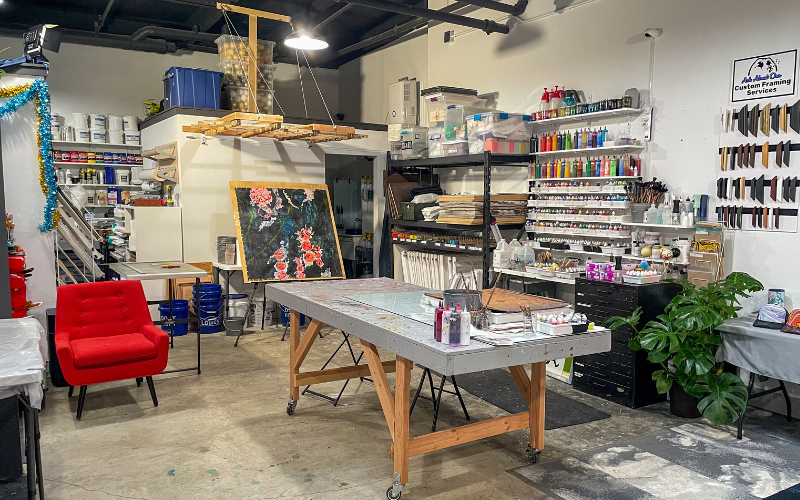
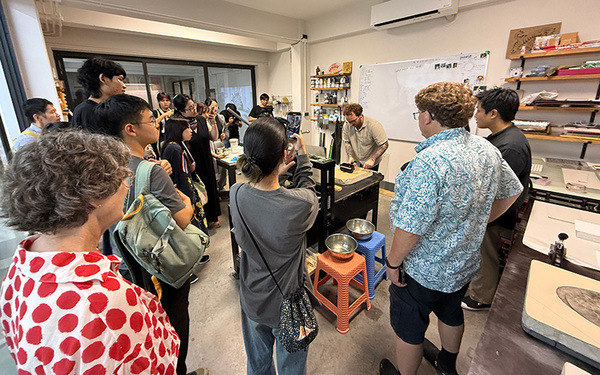
A look inside Whistling Studios, the Bethlehem, Pennsylvania space Garubba designed around what he believes art should be. Photo courtesy of the artist.
How Art Inventory Software Simplifies a Professional Art Practice
For an artist who once ran his entire career out of a binder, having every artwork record in one place is no small thing. For years, Keith Garubba managed his professional art practice by hand: big-picture strategy, artist statements, inventory records, and more, all created in word processors and PowerPoint and tucked into a binder he carried with him. It made him feel professional and "intimately involved with [his] art materials." For a while, it worked. Until it didn't. "It was clunky, and a nightmare to update. I outgrew it pretty quickly."
By the time he found Artwork Archive, he'd already encountered other inventory platforms through various art institutions. But what set it apart was simple: it was intuitively built, affordably priced, and a platform he could adopt early without outgrowing later.
Now, the reporting and exporting features are his most-used tools. At fairs, he organizes works like an exhibition, exports the inventory to print on-site, and attaches custom labels to the back of every piece. And when he needed a specific look for his wall tags that the standard export didn't cover, the Artwork Archive support team walked him through a workaround. "It was nice to know that when I needed something outside the box, someone was there to help," he tells us. The bigger thing, though, is simpler than any single feature.
"I have so much peace of mind knowing that everything about every piece lives in one place. For an artist who once ran his entire career out of a binder, that's no small thing."
A well-kept inventory does more than store artwork details:
Rather than rebuilding materials from scratch each time, Keith uses Artwork Archive to generate printable Inventory Reports and custom wall labels before an art fair. It saves time, keeps his presentation polished, and helps every piece stay organized on-site.
Learn more about the reports artists use for fairs, exhibitions, and inventory management here.
Or talk to our team about how to make your inventory work harder for you!
Why Your Art Career May Not Follow the Path You Planned
After nearly twenty years of making work, teaching, opening a studio, learning when to say yes and when to stop, and organizing an entire career's worth of inventory, the truest advice Keith Garubba can offer artists just starting out is to leave room for the unexpected. The artist you're becoming may not be the one you originally planned on.
"Be open to the idea that your artist life will take a different path than you imagine. It's the only guarantee."
Yes, your hopes and dreams matter. They're part of your story, they got you moving. But they were never a contract. "They aren't a promise you made to yourself," Garubba continues. "They are merely one side of yourself that spoke up once so you could start your journey."
What he leaves us with feels less like advice and more like permission: "The world needs artists. Specifically, the artist that you are becoming, not the one you promised yourself you'd become."
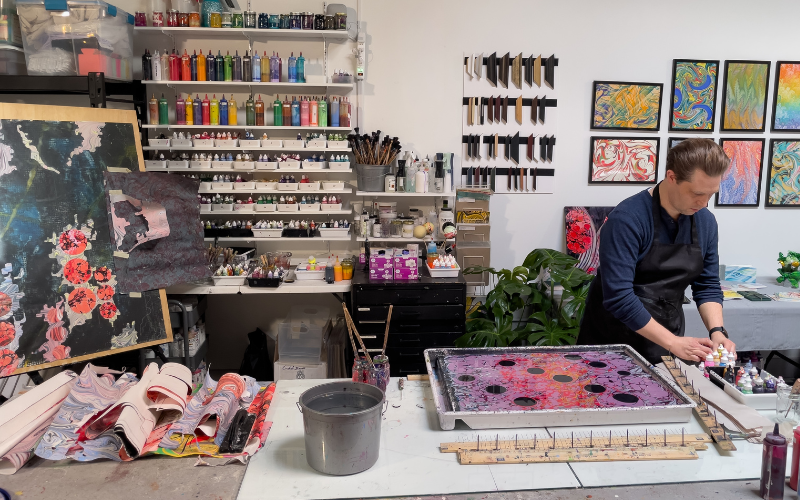
Keith Garubba prepares his marbling tray in his studio, with finished works lining the walls and rolled sheets from the day's practice piled nearby. Photo courtesy of the artist.
No matter what season of your art career you're in, getting your business side in order doesn’t need to feel overwhelming (and doesn't need to live in a binder). A bit of structure now can mean more time and headspace for the work you actually want to be doing.
Artwork Archive helps artists build an online portfolio, stay on top of their inventory, and create things like tear sheets and invoices in just a few clicks. Start a free trial and see how it fits into your own process.