Portraits That Explore the Complexity of Human Experience
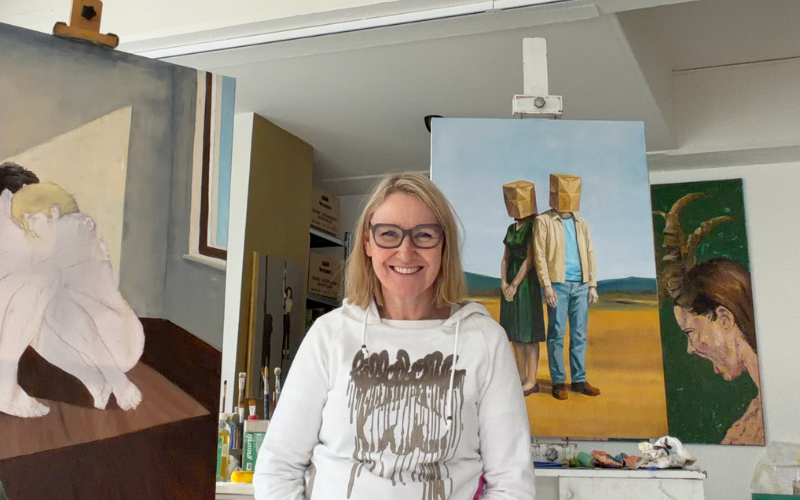
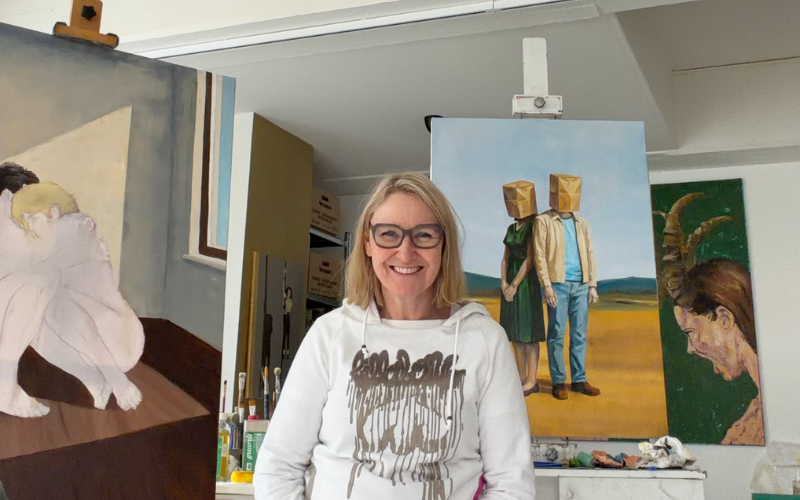
Featured Artist Sussi Hodel is interested in emotions that resist an easy description."My art creates a space for reflection, providing insights into human nature and the complexity of the emotional experience" she says.
The Swiss-Danish artist has spent her career painting the deep terrain of human experience, exploring the fears, vulnerabilities, and emotional complexity that can hold us captive. Her portraits are centered primarily on women, and the strength, intricacy, and sensitivity of the female essence runs as a thread through her practice. But her concerns are ultimately human ones.
Combining techniques from realism, pop art, and expressionism, she makes deliberate choices about color, light, and shadow to capture the various facets of individual personalities and transform a face into a full emotional landscape. Her creations are rooted in personal experiences and sensations, and viewers tend to find themselves in her paintings, establishing connections to their own emotional journey.
At the core of everything Sussi Hodel makes is a genuine respect for the people she portrays. Their sensitivity is treated as a form of intelligence. Their strength is never overstated. She simply looks at them clearly, and in doing so, invites the rest of us to do the same.
Artwork Archive had the chance to speak with Sussi Hodel about the emotions that resist easy description, the paper bag motif that stops people mid-step, and why recognition and marketing are not the same thing.
You can see more of her work on Discovery and learn more about her practice below.
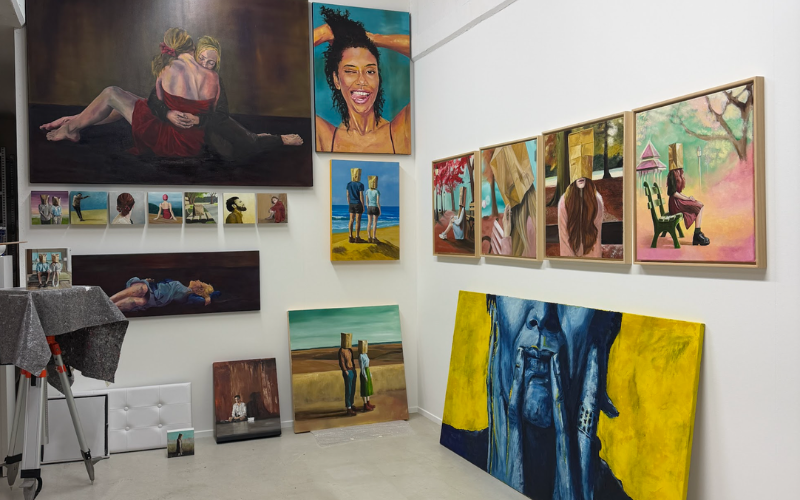
A view inside Sussi Hodel's studio with works filling her studio walla and floor. Photo courtesy of the artist
The Role of Color and Light in Emotional Portraiture
Sussi Hodel paints emotions most people recognize but have no easy word for.
Drawn to what sits underneath a composed face—vulnerability, longing, withdrawal, uncertainty, strength—she paints from feelings she knows personally, or from the moods she reads in the person in front of her.
"I am less interested in what is obvious than in what resonates beneath the surface."
Hodel usually knows what a painting will feel like before she knows what it will really look like. She begins with that feeling and sets out to capture it first in a sketch. The oil painting comes after, applied in layers over time, each application building on the last. Color, light, and shadow do the heavy work throughout the composition and, as the artist explains, do "not merely accompany the mood, but actively carry it."
She's patient with the process, and finds herself working toward a particular moment: "when the painting becomes more three-dimensional, starts to come to life, and the interplay of light and shadow begins to work." In other words, when the figure inside the canvas begins, somehow, to breathe.
Something surprising about her practice lies between how the paintings are perceived and how they're made. They look intuitive. They feel immediate. But they are, in fact, meticulously planned from the start: the model, the composition, the mood, almost nothing left to chance. Hodel describes the relationship between that level of control and the emotional openness it produces as the source of the work's tension. Anyone who has stood in front of one of her paintings and felt held there longer than expected will understand exactly what she means.
The Meaning Behind the Paper Bag in Her Portraits
An unmistakable marker throughout many of Hodel's pieces is the paper bag over her subjects' heads. It's the kind of image that stops people in their tracks.
She traced the motif to a personal desire for conscious withdrawal: the wish, in a world that's relentlessly demanding, to simply switch off. "In a loud, fast, and often overwhelming world, I find the idea of simply switching off, focusing on oneself, and not always having to be exposed very compelling," the artist shares. The bag, in her hands, is a temporary shelter. A small, deliberate act of self-preservation.
At the same time, the bag carries a second meaning. It captures what happens when people share physical space and still somehow fail to see each other. Hodel calls it "alone together," and describes the experience of being surrounded yet unseen. Both meanings live inside the paper bag at once, and she does not ask the viewer to choose between them, to decide whether the bag represents comfort or isolation. Instead, she leaves it open. It is, in that sense, exactly what her paintings are always doing: holding more than one true thing, and trusting the viewer to find their own way in.
The harder question — how work like this finds its audience in the first place — is one she has spent time learning to answer.
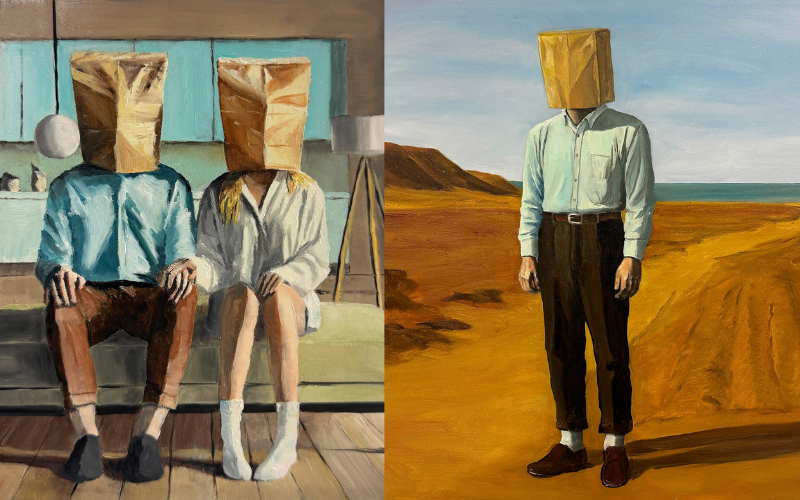
Sussi Hodel, & Hold My Hand, 2026, 20 x 20 x 5 cm & There is You, 2025, 80 x 80 x 4.5 cm
Why Making Great Art Isn’t Enough to Build a Career
People respond to Sussi Hodel's work, and they respond strongly. "And yet," the artist observes, "it took me a long time to understand why that resonance did not automatically translate into sales or visibility."
"Recognition and marketing are not the same thing," she explains. Strong reactions from viewers and the infrastructure that convert those reactions into a career turned out to be separate problems, requiring separate thinking.
Her relationship with the art world is honest: "I do question the art world at times because I don't consider everything that calls itself art to truly be art." Precisely because she holds that skepticism, she says, she had to figure out her own path to making the work visible and reaching the people it was actually meant to reach.
Making strong work is one part of the practice. Learning to speak about it, give it context, and present it with clarity is another. "Professionalism is not in conflict with art," she maintains. "It can support and protect it."
💡 Make Your Work Easy to Find and Easy to Take Seriously:
A well-maintained inventory with consistent documentation — titles, dimensions, materials, provenance, exhibition history — tells collectors and galleries that you treat the work with the seriousness it deserves.
Artwork Archive gives you the structure to keep that record complete and accessible, so when the right person asks about a piece, the answer is already there.
Managing Art Inventory as Your Practice Grows
As her body of work grew and her practice became more serious, informal tracking methods stopped being enough for Sussi Hodel. She wanted a system that could handle inventory, but also one that would let her organize work across different themes and share selected pieces with specific collectors before making them public.
"That, along with the platform's ease of use and user-friendly design, is what convinced me to work with Artwork Archive."
Currently, her go-to feature within the platform is the Private Rooms. Ahead of the upcoming ArtMUC Munich in May 2026, selected works are being organized by theme and shared with specific collectors before any public announcement. "For me," Hodel adds, "this creates a more thoughtful and professional way of presenting my work while also helping me stay organized behind the scenes." With Private Rooms, collectors get an intentional, VIP first look, a presentation as intentional as the work itself.
💡 Give Collectors Early Access Before You Go Public:
The Private Room lets you build a password-protected gallery for specific collectors, completely separate from your public profile. Use it to share a new body of work before it's announced, organize pieces by theme, or control who sees what and when.
→ Learn how to set up your own Private Room
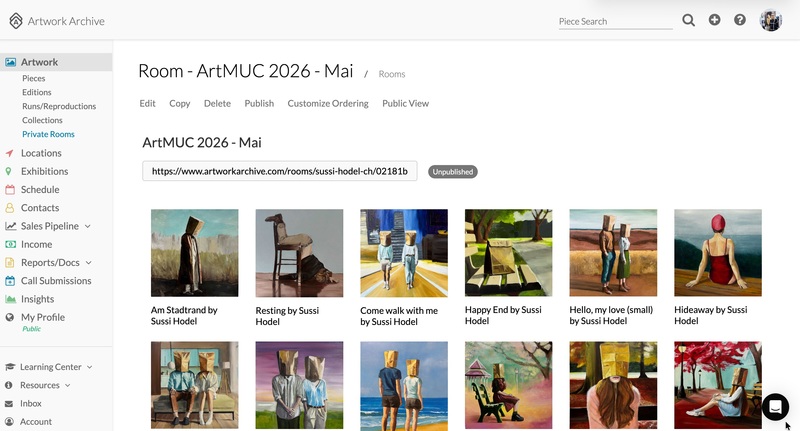
A look inside Hodel's Artwork Archive Private Room, built for ArtMUC Munich 2026. Screenshot courtesy of the artist.
Finding and Developing Your Artistic Voice
Sussi Hodel has one consistent piece of advice for artists still finding their footing: Do not orient yourself too quickly toward what you think might be received well. "Find your own visual language and your own personal themes. That's where long-term artistic strength and recognizability come from."
"Looking at other artists is useful for developing technique and sharpening your eye," Hodel continues, "but it's not a way to build an identity." Borrowed identities do not hold.
"If you only imitate, you remain interchangeable. If you have the courage to develop your own voice, you have the chance to create work that is truly distinctive and meaningful."
For this artist, that voice keeps returning to the same territory: the hidden emotions of the people she paints. The fears that resist rational explanation. The quiet strength that goes unannounced. The emotional complexity a portrait can hold when the painter is genuinely willing to look for it. The professional structure she has built around her art career is how she makes sure the work keeps getting made, and keeps getting seen.
No matter what season of your art career you're in, getting your business side in order doesn’t need to feel overwhelming. A bit of structure now can mean more time and headspace for the work you actually want to be doing.
Artwork Archive helps artists build an online portfolio, stay on top of their inventory, and create things like tear sheets and invoices in just a few clicks. Start a free trial and see how it fits into your own process.