Food is a vessel of history, down to the okra seed and the meaty flesh of the yam.
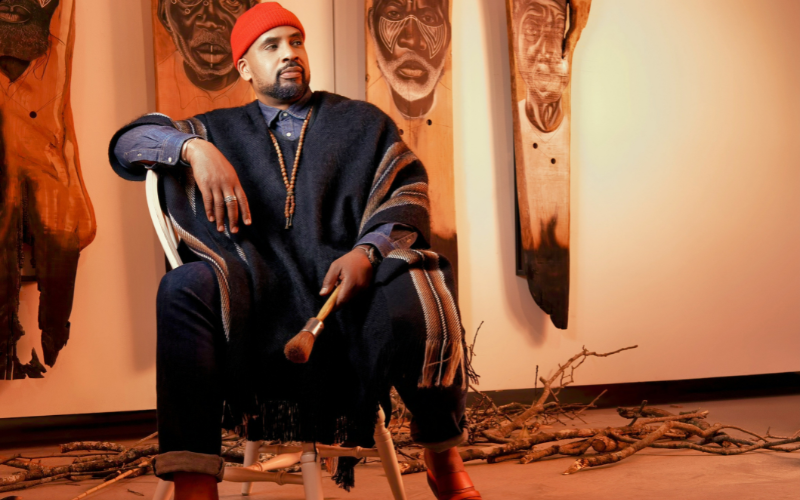
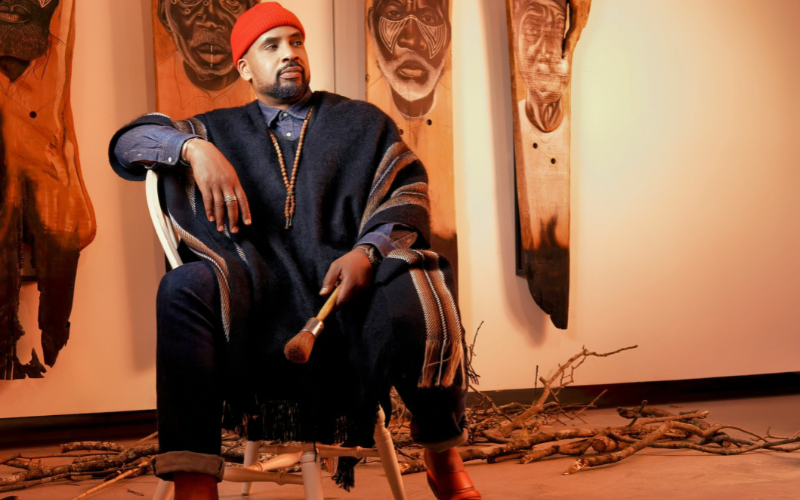
What does it mean for food to carry the movement and lineage of an entire people? Artwork Archive's Featured Artist Masud Olufani has been asking that question through sculpture, ceramics, metalwork, drawing, painting, and sound.
Olufani's work treats something as ordinary as a meal as an act that reaches beyond the body, into memory, ancestry, and spirit. His research follows the history of foods like tamarind, kola nuts, rice, and cassava, tracing their route from Africa to the Americas through the corridor of the trans-Atlantic slave trade. Those ingredients shaped the earliest diet of the "new world," a diet still being formed when they arrived.
For Olufani, that history becomes raw material, something to be shaped, cast, carved, and sounded out across every medium in his studio practice. Growing and eating food, in his work, becomes an alchemy, an act that satiates the body and the spirit at once. Nourishment carries a double meaning here: feeding what is corporeal, and feeding what reaches into other worlds entirely.
An okra seed. A piece of yam. Small and ordinary, and still carrying histories embedded inside them.
We sat down with Masud Olufani to trace that history back to its beginning, learn how objects take shape in his studio, and hear what he's learned about spirit, discipline, and building a life in art.
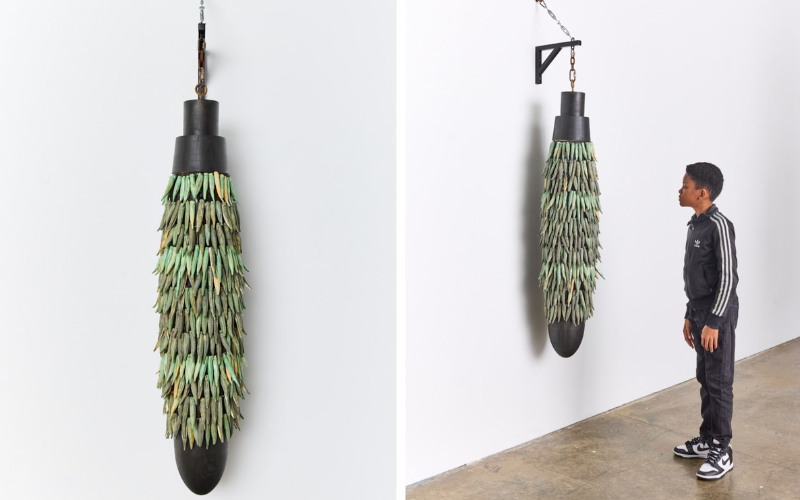
Masud Olufani, Okra Fly, 62 x 16 x 22 in, 2024. This work references the centrality of okra within the African diaspora and the ceremonial role of adornment as a social and a ritualized practice. To be fly in an African and an Afro-Atlantic context, is to be cool or pleasing in the way one adorns the body as well as in the qualities of the spirit.
How West African Foodways Shaped Masud Olufani’s Art
In 2022, Masud Olufani traveled through West Africa and spent time visiting local markets. At each one, he kept encountering some familiar things. Black-eyed peas, yams, rice, kola nuts, tamarind—the same staples that anchor Black Southern cuisine—all sat out on the tables in front of him. Only these ingredients were a long way from the American kitchens where he had first come to know them.
"The obvious connection intrigued me," he recalls, and standing among those market stalls got him thinking about what exactly food carries across time. "I began to think of food as a vessel of memory and meaning that endured the rupture of the trans-Atlantic slave trade," he explains, "becoming a modality of constructive resilience, cultural cohesion and reinvention."
The idea took hold and planted the seed of a body of work that now runs through everything he makes. In his hands, an okra seed or a handful of rice carries a record, physical evidence of what survived over time, and what it all means now.
A Multidisciplinary Art Practice Led by Intuition
Turning the exploration of food's history into physical objects calls for more than one set of tools, which is why Olufani refuses to settle into a single medium. "My studio practice is fluid in materiality and sources of inspiration," he notes. Working across ceramics, metal, wood, drawing, sound, and the food ingredients themselves, he moves between them according to how an idea first reaches him.
An idea can come from almost anywhere. He might read something that becomes a catalyst for a piece, or notice a compelling object abandoned at the side of the road. "Sometimes a vigorous conversation can generate an idea as well," he adds. Certain pieces come fully formed in his imagination, while others start with a loose direction that sharpens only as he works, and he makes a point of leaving that room open. "I try to nurture a space for intuition and improvisation," he says, "because that allows for the thrilling experience of discovery."
The room he leaves open for inspiration does not, however, make a piece any easier to build: "The process from conception to completion is rigorous, requiring a synergy of physical labor and imaginative exploration." He works each one all the way to its natural end. "For me the work is completed when I have reached the end of my dialogue with the object and there is only stillness."
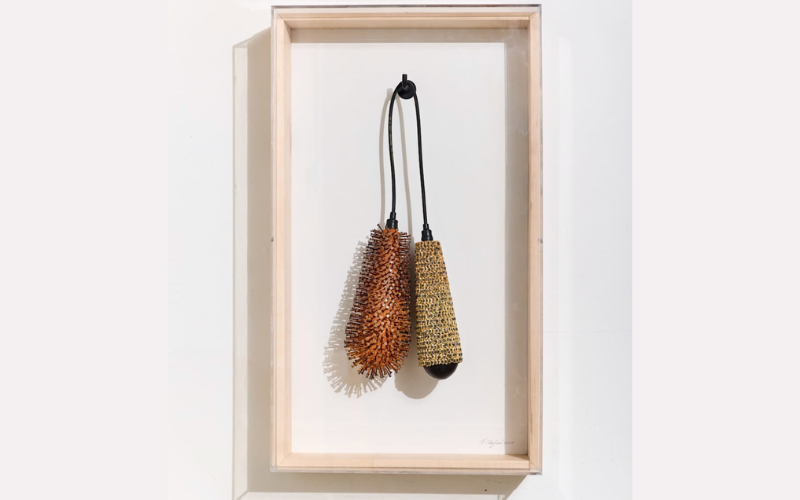
Masud Olufani, The Black Eyed Nkisi Nkondi, 34 x 20 x 6.5 in, 2024
Exploring Food and Spirituality Through Art
Nourishment, in his work, feeds more than the body. It carries a double meaning: sustaining both body and spirit. "My intent is to infuse all of my work with spirit," he tells us.
One recent piece, The Black Eyed Nkisi Nkondi, routes the connection between the physical and the spiritual through an unlikely conductor, an automotive coil. The piece joins two things the African diaspora carried across the ocean: the black-eyed pea, one of the staples he had found waiting for him in those West African markets, and the Nkisi Nkondi, a West African spiritual object used to protect against evil spirits.
Between them, Olufani set the coil as the intermediary, commenting on the intersectionality of the material and the spiritual; the corporeal and the incorporeal. "It points to two great legacies of the African diaspora," he describes, "There was something quite moving to me about the way this piece articulates the connection between the material and the non-material."
Tracing the Foodways of the African Diaspora Through Art
The Black Eyed Nkisi Nkondi is just one piece from a much larger investigation, and Olufani has no intention of stopping anytime soon. He plans to keep tracing the food staples of the African diaspora, "mining this rich and complex history for inspiration and then transforming that information into sculptural form."
The question in front of him now is "how food became a vehicle of communication and cultural expression among enslaved populations," and how the forced meeting of many tribal groups "produced a hybrid culinary tradition through forced migration, innovation, and improvisation."
An investigation this deep, exploratory, and open-ended only works if the day-to-day is built to sustain it, which is why this artist is so intentional about how his studio runs.
The System Behind Masud Olufani’s Professional Art Practice
The same rigor Olufani brings to creating his artwork, he brings to running his art career. "Approaching my studio practice with rigorous discipline and professional integrity generates an energy that naturally attracts opportunity." And in his eyes, every opportunity is another door to a new audience. "Success for me," the artist says, "is being able to produce the work and have it reach an ever-expanding audience."
However, reaching new audiences takes more than good artwork, and rigorous discipline and professional integrity are easier when everything lives in one place. "I needed to find a way to organize my practice and consolidate my information in one platform," Olufani remembers, "and Artwork Archive came highly recommended from a colleague who uses it regularly."
The platform trimmed what he called his "virtual paperwork" and gave him one home base for his entire art career. Inside his account, he tracks the provenance and location of every piece, and works the artist opportunity guides for grants, fellowships, and residencies that fit his scope. The professionalism he brings to the studio and the opportunities that grow his audience meet in the same system, each one making the other easier to sustain.
💡 How a Disciplined and Professional Practice Turns Into Real Opportunities:
Masud Olufani credits his reach to a disciplined, well-run studio practice, and Artwork Archive's opportunity guides are where that discipline turns into applications. Our team scours the internet to curate an ongoing list of artist grants, fellowships, open calls, and residencies, so you can spend less time searching, and more time applying.
The Importance of Follow-Up for Professional Artists
Despite the unrelenting professionalism he has now, not everything came naturally to Olufani. "Timely follow-up was something I had to learn and begin to practice as a discipline," he admits.
In a career built on studio visits, inquiries, and introductions via email, responsiveness is its own kind of work, and one that no one romanticizes. But Olufani came to treat it a bit differently: as a measure of character. For him, a returned call or message became a matter of respect, a small daily proof that he takes other people's time as seriously as his own. "It is so important to value other people's time as much as we do our own," he insists. "Being efficient and conscientious in responding to messages and phone calls is a key indicator of value."
It may sound like an unglamorous habit, which is exactly why it was a hard skill to learn. But treated as a discipline, and in light of this personal value, following up with others became just another part of his art practice, as important as time in the studio.
💡 Track Everything You've Sent, Down to the Last Invoice:
A growing practice means more people to stay in touch with, which also means more email threads to sort through. Or does it?
When you add a contact to Artwork Archive, the system starts a history of everything you've sent them. Every report, Private Room, and invoice is tracked right inside their contact record, so the next time you follow up, what you shared and when is already in front of you.
Masud Olufani’s Advice for Building a Successful Art Career
When talking to successful artists about what they'd tell others, you often hear some of the same things over and over: "put yourself out there", "don't be afraid of rejection," "make A LOT of artwork." All of it's true, and Olufani wouldn't argue with any of it. He starts somewhere else, though, with who you are before what you do. "I believe that one must have a strong moral framework as a foundation for a successful professional practice," he urges.
Kindness belongs on this list too, something that most career advice doesn't quite touch on.
For this artist, "kindness is a superpower that can attract sincere connections and pave the way for a successful career."
His advice for anyone starting out in this industry comes down to how you carry yourself with others. "Seek grounded, authentic professional relationships. People can smell inauthenticity, so make sure you move with integrity."
As he continues tracing the histories of the foods belonging to the African diaspora, turning things like a black-eyed pea and a kola nut into objects that carry spirit, Masud Olufani always comes back to the same thing. "If you are professional, kind, and you do good work, people will notice."
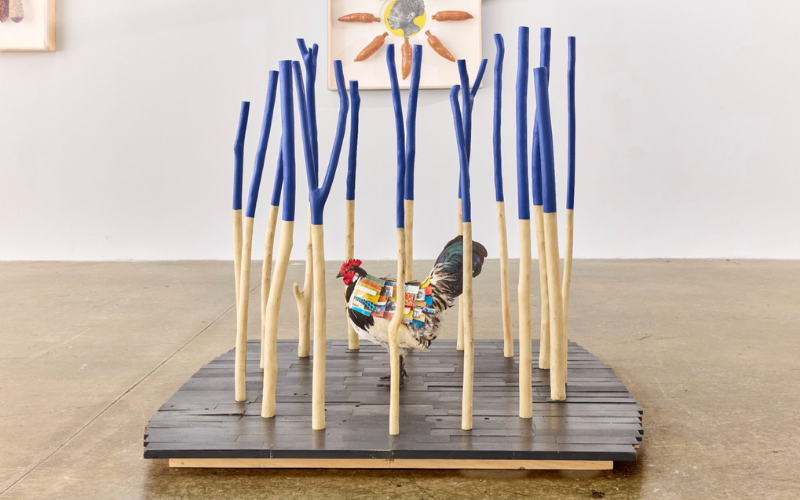
Masud Olufani, Can't Cage My Strut, 2024.
Being professional, prepared, and organized is part of what turns good artwork into a thriving art business. Artwork Archive gives you a head start on all three. Try it free for 14 days and build the career your work deserves.