Born in Morocco and raised between cultures and languages, Featured Artist Malika Sqalli has long experienced life in the "in-between."
That sense informs her photographic practice, where the concepts of home, culture, identity, and place are recurring themes. As an artist, she's driven by a propensity for optimism and hopefulness, qualities that resonate throughout her artwork. Drawing from a holistic personal worldview, she's most interested in the links between places, the similarities between people, the wisdom we share, and the mythologies that connect us.
Photography remains an important part of her practice (well-suited for her nomadic lifestyle), but Sqalli has increasingly pushed beyond the photograph frame. She moves between mediums, embroidering and painting onto her photographs, while also working with textiles and parachute material, experiments with tufting and weaving, and creates work that asks the viewers to experience an image through more than sight alone.
Her projects have explored everything from mountain identity and the effects of tourism on nature, to accessibility, the relationship between the body and its surroundings, and the connections between the physical and imagined worlds.
Artwork Archive got a chance to chat with Malika Sqalli about growing up between worlds, following materials wherever they lead, and the practical realities of building a life and career around making art.
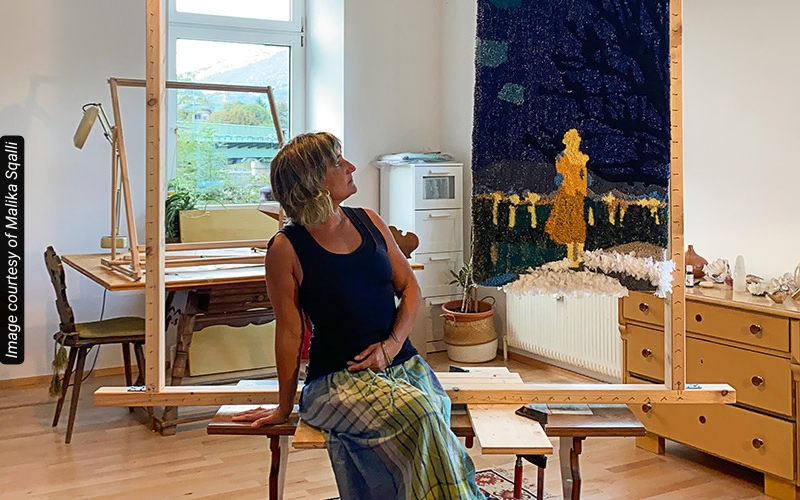
 A globe-trotting life shows up in Malika Sqalli's boundary-pushing work. (Photo courtesy of the artist)
How Growing Up Between Morocco, Austria, and France Shaped Malika Sqalli's Art
"There's a song by Matt Simons, Catch & Release, that has always resonated with me," Sqalli tells us. "The idea of catching and releasing feels very close to the way I have lived and, ultimately, to the way I work."
While growing up in Morocco, Sqalli attended a French school, traveled to Austria every summer, and moved to France as a teenager. There, she studied at the École des Beaux-Arts in Montpellier. That is until the school expelled her for being "too far outside the box."
Living in London and Los Angeles came later, and more recently the artist has divided her time between Austria and Morocco. So it's not too surprising that she went on to live a life filled with travel, moving across countries, languages, and cultures. "It felt like an obvious continuation," Sqalli reflects, "or perhaps simply the modus operandi in which I felt most comfortable."
Every place left something behind. "England defintely did. New Zealand did, even though I never actually lived there—I worked on several projects there and developed a very strong connection to the people and the land." Of course, she carries part of Morocco with her, yet she admits, "there are also parts of me that are absolutely not Moroccan." This has all led her to wonder if "to absorb something from a place, perhaps you also have to release something else."
The process of taking something in, letting something go, and carrying the remainder forward has become "a kind of compost from which the work grows." Traditional techniques tied to particular places, materials picked up along the way, different cultures and landscapes all feed into it. Mixing them "is a little like cooking with many different ingredients and spices rather than a single ingredient and no seasoning—but perhaps that's my Moroccan side speaking."
For a few years, Sqalli stayed in one place for longer than usual. She noticed that, unlike in cities, her sense of belonging grew stronger—not necessarily to the town itself, but to the lakes and mountains around her. "These were the places I walked around, climbed and swam in," she remembers. "I realized that in cities I had been missing that direct connection to the land and the elements." She has since moved again, and even after only a month, she can feel herself disconnecting from the landscape she left behind. "Strangely, my sense of belonging has already begun to move with me."
Much like the song that's always resonated with her, she's catching and releasing once more, "curious to see what work will emerge from the liminal space I find myself in now."
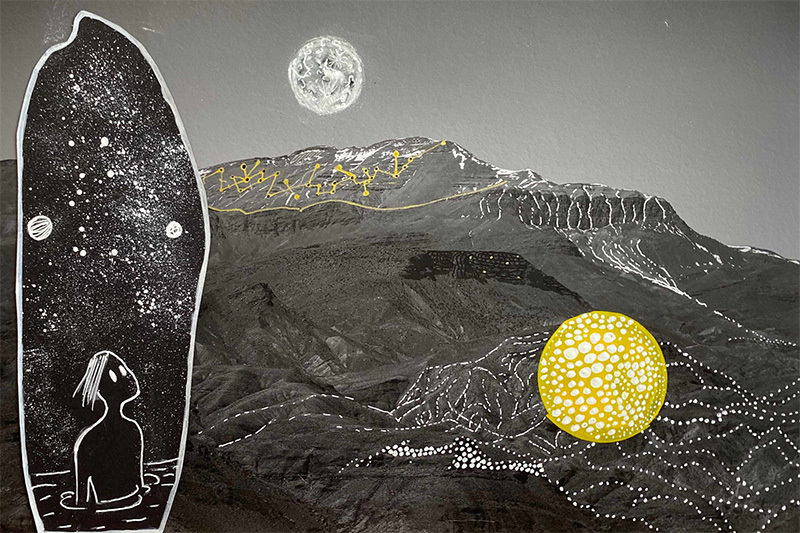 Malika Sqalli, A dream I had, collage, drawing, photograph on archival paper, 20 x 30 cm
How Malika Sqalli Turns Photographs Into Embroidered, Mixed-Media Artwork
For years, photography suited a life in motion, and became a natural fit for her nomadic life. A camera is easy to carry from one country to the next. But once she settled a little more, she eventually became saturated with two-dimensional imagery. "I began to ask myself: how can I make this different?"
She started stitching into her prints, she says, "to get out of the frame" and "to bring slowness back into my practice." She also wanted the work to turn tactile, to "speak to more than just the eye," and slow her hands into a more meditative motion.
Embroidery was already something familiar from her childhood. She had cross-stitched as a girl, and remembers it as "something I could lose myself in." Stitching into a photograph also changes what it is. "Photography can potentially be reproduced endlessly, but once I begin stitching into a print, that particular work becomes singluar," she explains.
Sqalli loves almost every part of her creative process, except for the end: "framing, backing, cutting the edges, and finishing everything off." Completing a piece carries a small sadness too, because she enjoys the making so much. "For me, making a work is a little like traveling or hiking," she tells us. "There are ups and downs, hills and flat stretches, unexpected turns and moments when you simply keep going."
A piece might begin as a sketch by hand and move onto the screen, where she works out colors and compositions in Photoshop before returning to the physical world. Sometimes, she prints an image and embroiders it, while other times, she sets up a loom to weave, or begins tufting. The materials, location, and even time of year can influence the direction of a work," she says. "So there's something very organic about the whole process. I have an intention, but also have to listen to what happens along the way."
The result of each piece is almost never what she first pictured, and, according to Sqalli, "that's part of the magic."
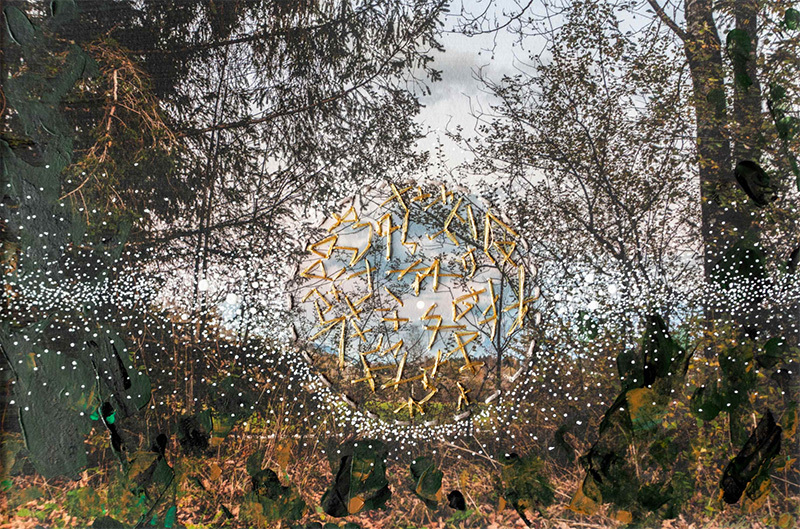 Malika Sqalli, Cosmology, Mixed Media, embroidery on fine art print, 30 x 20 cm
Coaching, Skydiving, and the Everyday Work Behind Malika Sqalli's Art Practice
Outside of her artist identity, Sqalli is a personal trainer, a kettlebell athlete, a holistic life coach, and a licensed skydiver/skydiving camerawomen. She's found each one of these identities all feed into and inform different parts of her art practice.
The training and coaching come from a genuine interest in the body and exploring how we can maximize our potential through health and wellbeing. "I remain in awe of what the human body can do in conjunction with the mind," she points out.
This same attention shows up in the art she wants to make, something "more tacticle and embodied," a way "to be more present in the body, and through that, perhaps more connected to intuition." The compulsion to create a piece of art is felt "in my gut and heart as much as my head," she shares. "It often feels like a call."
"I also draw considerably from my experiences as a skydiver," she says. Known in the air as Lady Yellow, Sqalli has even woven an emergency parachute canopy into a few of her pieces. For her, the fabric is a "call for a life lived by taking action."
There's no typical day in Sqalli's art practice. Some are long, obsessive runs of making. Others are dedicated to going to the mountains for reference photos. Some are filled with meeting new people and networking, and some consist entirely of administrative work. One thing holds true across all of them: "Somewhere in the background, my mind is always alert, waiting for an idea, or for that call to create."
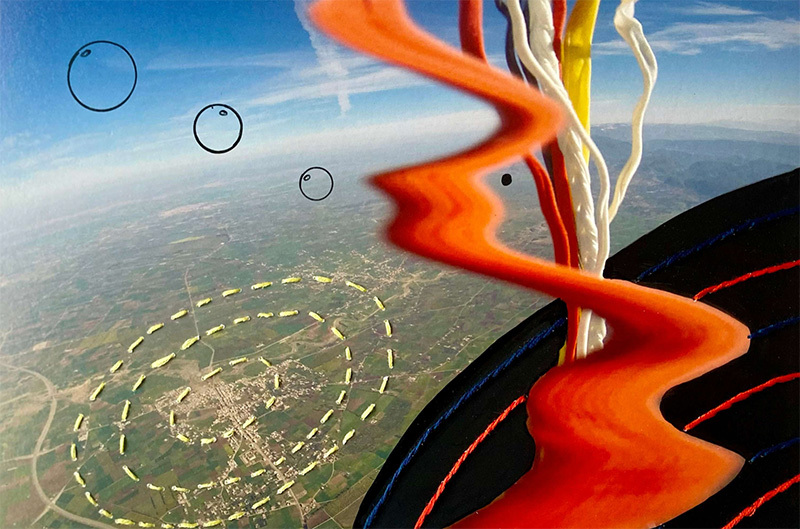 Malika Sqalli, Free falling, Photograph taken in freefall, Paint, embroidery, 20 x 30 cm
The Business of Being an Artist: Contracts, Admin, and Managing a Practice With Artwork Archive
"There's definitely far more administrative work involved with being an artist than I ever expected," Sqalli admits. "especially in the period leading up to an exhibition." As any professional artist knows, the making is only half of it. Behind every show lies paperwork, logistics, and a long list of small tasks that nobody really prepares you for.
Early in her career, she took an exhibition with a major art instutition with a large production budget. Despite her asking more than once, the institution never signed a contract.
"I was young and not confident enough to insist," she recalls. "In the end, I never received the full amount of the budget that had been promised and was left well out of pocket."
That experience changed the way she approached the business side of her practice, and taught her one of the most important art-business skills: "Agreements need to be clear, written down, and signed."
Since then, structure has become an integral part of managing her practice. "I chose Artwork Archive precisely because I'm not naturally very good at archiving," Sqalli says. "In fact, I can be quite chaotic. I was also dealing with health issues that affected my cognition, so I needed something that could give me structure."
Artwork Archive gives her somewhere to keep everything in one place: dimensions, prices, locations, sales, expenses, and any other information tied to her artwork. Now, archiving finished pieces has been folded into her creative process. "Psychologically, that creates a kind of endpoint for me," she describes. "The piece is finished, it has been recorded, and now I can move on to the next one. Without that moment, I would probably keep working on certain pieces forever."
"For someone who's naturally much more interested in making the work than cataloging it, that structure has been incredibly useful."
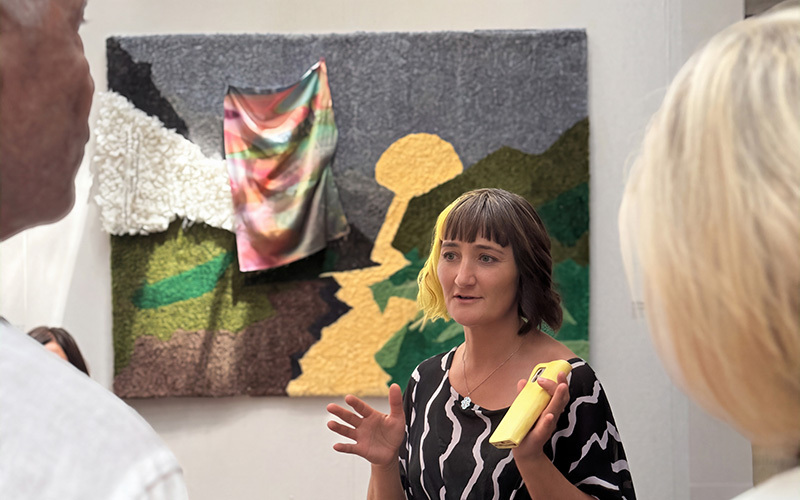
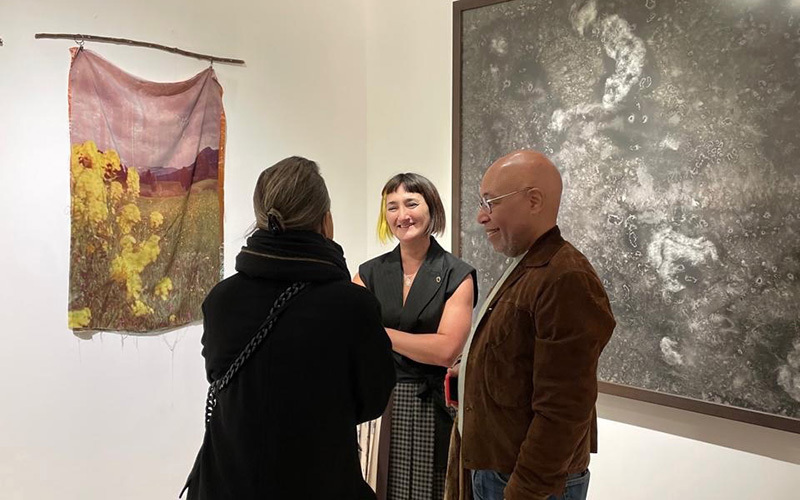 Learning how to keep track of her art business through Artwork Archive was especially valuable for Malika Sqalli. (Photo courtesy of the artist)
As An Artist, You Have to Just Keep Making, Keep Experimenting, Keep Paying Attention
Sqalli doesn't talk about building an art career as if there's a formula to follow. Instead, she keeps coming back to one simple idea: instinct. "Just do—make the work, test things, and practice, practice, practice," she urges. "You have to maintain a frequency that is tuned to curiosity."
Artwork Archive gives you one place to organize your art inventory, sales records, professional artwork images, and more so you can spend more time making your work. Try Artwork Archive free for 14 days.