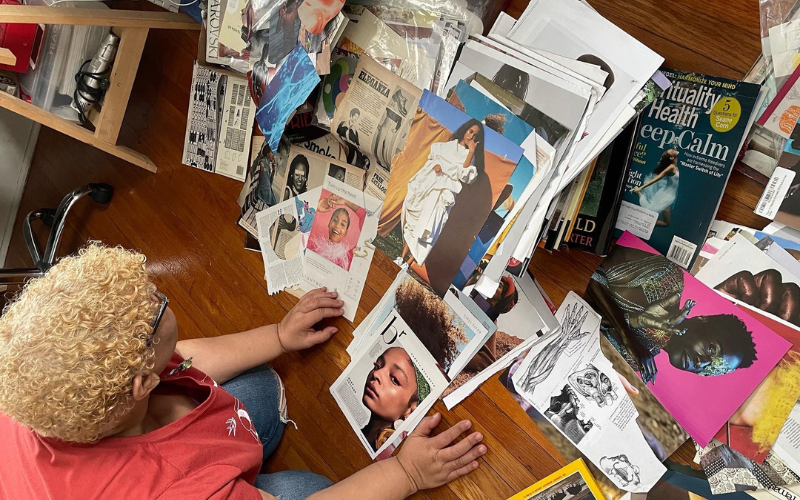
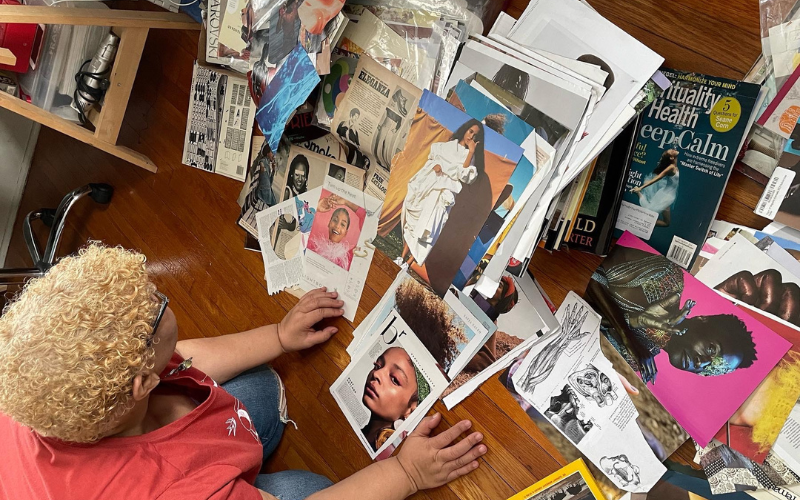
Indigene Theresa Gaskin sorts through magazine clippings and found source material, the raw fragments she layers into her collages. Image courtesy of the artist
"For me, collage is a form of archiving."
To archive something is to make a definitive claim that it matters, that its existence deserves to outlast the passage of time. Talk to anyone on the Artwork Archive team, and we'll tell you how important archiving is when it comes to protecting the history and legacy of your own art career. But for Featured Artist Indigene Theresa Gaskin, archiving goes well beyond the logistics and administrative tasks that make that possible. It's the heartbeat of her entire creative practice.
For over twenty-five years, the Bronx-born, Afro-Caribbean artist has treated analog collage as a form of archiving and a vessel for preservation. Gathering physical fragments of history, memory, and spirituality, Gaskin weaves ancestral legacy with contemporary imagination to center the Black experience, particularly the resilient, nuanced lives of Black women. In doing so, her work honors the stories that might otherwise be forgotten.
As she steps into the next chapter of a celebrated, international career, Indigene Theresa Gaskin is rethinking what it means to preserve an artist's legacy, and exactly how we carry stories forward for the next generation.
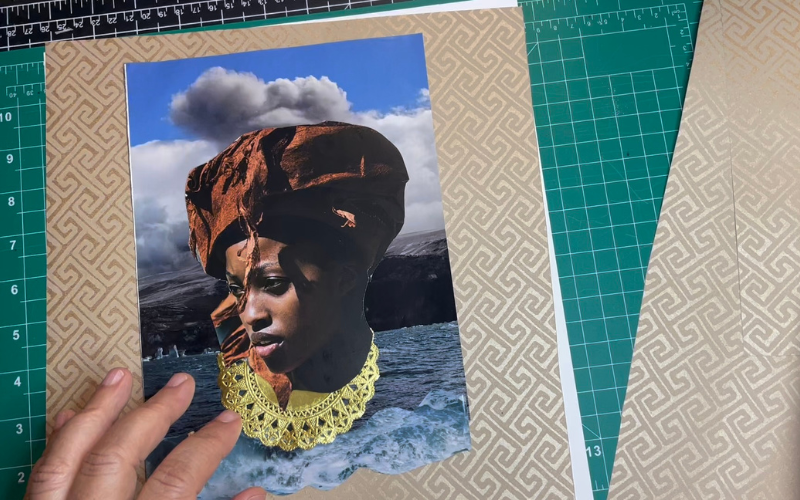
One of Gaskin's collages photographed on the cutting mat in her studio. Image courtesy of the artist
How Indigene Theresa Gaskin Builds Her Collages From Found Paper and Fragments
A vintage magazine clipping, a swatch of fabric, a band of color set aside months ago: Gaskin spreads her source material across her studio table and lets the fragments of history in front of her take lead. "I may have an idea or feeling in mind," she tells us, "but once I begin looking through my source material, the images often start speaking to me, suggesting where the piece wants to go." Through layering, cutting, and rearranging, each fragment is tested against the ones beside it until an unexpected connection surfaces.
As a self-taught artist, Gaskin discovered collage gave her a structure that conventional drawing never could. "I have always experienced the world in fragments, details, and stories rather than clean, organized layouts," she describes. "Because traditional drawing rules don't match how my mind naturally processes space, collage has become my home."
For her, a piece of fabric or vintage clipping "isn't just a visual shape, it's a word." She builds her art the way a writer builds a story, "layering pieces together to create deep, poetic connections." The fragments become a language of their own, each finished collage a full story.
“My favorite part is that moment of discovery when separate pieces come together and suddenly create a story I couldn’t have imagined at the beginning,” she reflects. When that breakthrough happens, "when everything feels like it belongs and there's nothing I want to add or take away," the fragments settle into their new home.
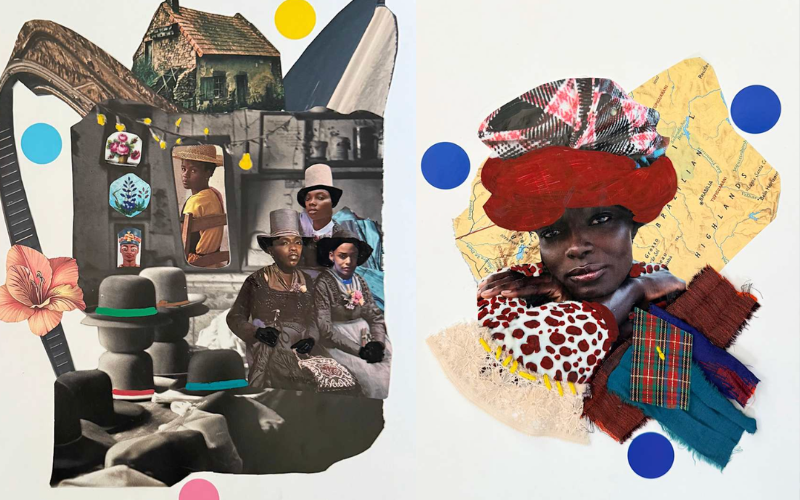
Indigene Theresa Gaskin, Hats of Heritage, 14 x 11 x 0.125 in | Carried By Many Roads, 12 x 9 x 0.5 in
Why Gaskin Treats Collage as a Form of Archiving
A weathered stone house anchors the top of the frame, with a string of round bulbs slung beneath it. Four Black women sit below in period dresses, their heads adorned with tall hats, while more hats are stacked nearby, banded with color. By her own description, Gaskin's Hats of Heritage "celebrates identity and cultural pride, using headwear as a cultural expression." Through a striking juxtaposition of historical and modern imagery, colorful accents, and domestic settings, the artwork reads as "both celebration and resilience within a community."
While specific focus on the head and headwear was highly intentional for Hats of Heritage, a broader fascination with the head frequently emerges across her work. Florals and colorful headwraps crown different figures, while Saturn-like halo rings circle another. The motif appears often, whether she planned for it or not. "Looking back at my work, I realize the head has become a beautiful way for me to tell stories about who we are and what we carry with us," she acknowledges.
Those stories have long sat at the center of Gaskin's practice, as she gathers fragments and images to make space for the lives of Black women; the stories that might otherwise disappear from the record. "For me, collage is a form of archiving," she says. And every clipping, scrap of fabric, and found image becomes part of that record.
Now, twenty-five years into her artistic journey, Gaskin is applying that same reverence to her own legacy. "I'm thinking more intentionally about preserving my own work and the stories behind it," she shares. Ultimately, she views her role as an artist as twofold: "I hope my legacy is not only the artwork itself, but the history, memory, and stories I've gathered and carried forward through my collages."
The Business Skills Every Working Artist Needs to Protect a Legacy
To carry stories forward for decades, an artist must eventually build a structure that survives the day-to-day grind. For Gaskin, protecting her art and guarding her legacy meant learning to protect the business around it.
"Stop waiting for permission to truly see yourself as an artist and a business owner," she points out. "That's the biggest mindset shift. You have to trust your voice, value your work, and understand that building a career takes patience, consistency, and persistence. There will be disappointments and doors that don’t open, but you have to keep creating and keep showing up. For me, it’s been about staying committed to the work while allowing the career to grow in its own time."
People love to picture artists locked away in their studios all day, blissfully ignoring the world to create in uninterrupted bliss. But "a real working day for me is rarely just making art," Gaskin admits. Instead, her time is split between the paper fragments on her studio table and the operational logistics behind the scenes. "There's usually a mix of emails, planning, organizing materials, photographing work, shipping, and other business that needs my attention," she explains. "And of course, ordinary life finds its way in too."
Talent alone cannot protect a legacy. It's one of the hardest lessons Gaskin learned. "Being a good artist isn't enough," she emphasizes. "You also have to understand the business side of your work." Early on, she admits that she didn't always pay enough attention to pricing, contracts, and making sure expectations were clearly communicated. "It taught me to value my work more seriously and to put everything in writing. But I learned that lesson through a few situations that cost me both time and money."
Today, she protects her creative time fiercely by "treating it as something that matters just like any other commitment and reminding myself that making the work has to remain at the center." Standing firm as a business owner means the loose agreements are gone. Now, Gaskin says, "I’m much more intentional about pricing, agreements, deadlines, and making sure I understand exactly what I’m committing to before I say yes."
💡Artwork Archive Tip: Store Documents Where You'll Actually Find Them
Gaskin learned to put pricing and agreements in writing after a few situations cost her time and money. With Additional Files, you can upload contracts, agreements, press coverage, and other supporting documents directly to the Piece, Location, or Contact record they relate to.
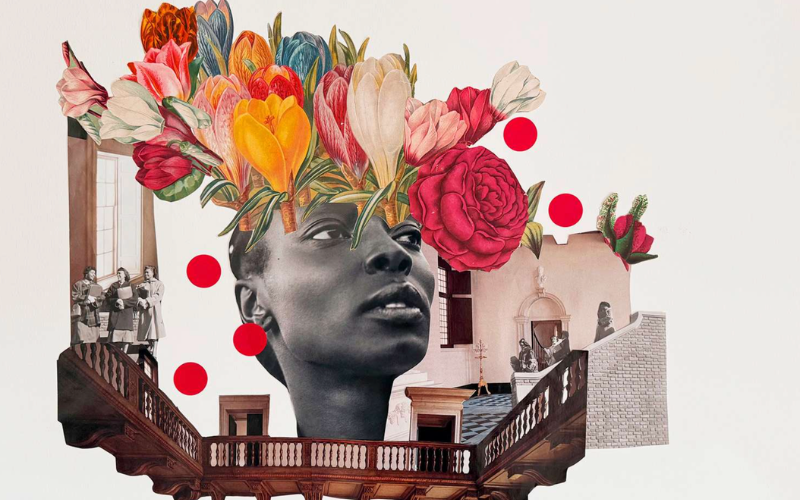
Indigene Theresa Gaskin, Broadening Your Horizons, 18 x 24 x 0.125 in.
How Indigene Theresa Gaskin Uses Artwork Archive to Preserve Her Own Legacy
Gaskin has spent her career turning scraps of history into pieces that preserve other people's histories. Somewhere along the way, her own body of work became its own kind of archive, one that inevitably came with its own kind of challenge. The same mind that thrives on processing the world in paper fragments started to get buried when those fragments began stretching across decades of inventory. For Gaskin, the hunt through studio drawers and desktop folders eventually reached a breaking point.
"I found myself searching through files and folders for images, titles, dates, dimensions, and exhibition information," she remembers. "I needed a better way to keep track of it all," a system capable of scaling alongside her career, which is why she chose Artwork Archive. "It gave me one place to organize my inventory and keep the important details of my work together, which has made managing my career much easier and more organized."
The artwork inventory tool quickly reshaped her daily workflow, saving her from the time-consuming administrative scavenger hunts. "With so many collages created over the years, having one place where I can see all the details is incredibly helpful," she notes. Operating with this level of organization transformed how she handles the business of art, too. "When I’m preparing for an exhibition, responding to a collector, or simply trying to remember when a piece was created, I can quickly find what I need."
Documentation became an active form of preservation; a way to organize scattered fragments into a narrative that finally made sense... much like her work itself. By anchoring her history in a secure system like Artwork Archive, Gaskin frees up her mental space so she can keep moving her practice forward, and keep telling stories. "It allows me to spend less time trying to locate information," she adds, "and more time creating."
💡 Artwork Archive Tip: Protect Your Provenance With a Certificate of Authenticity
Generate a Certificate of Authenticity (COA) for any work in your inventory, whether it's sold or still sitting in your studio. It documents what the work is and confirms it came from you as the creator, so proof of provenance is attached from the start instead of living in a folder you have to dig for later. When a piece does go to a collector or institution, the COA goes with it.
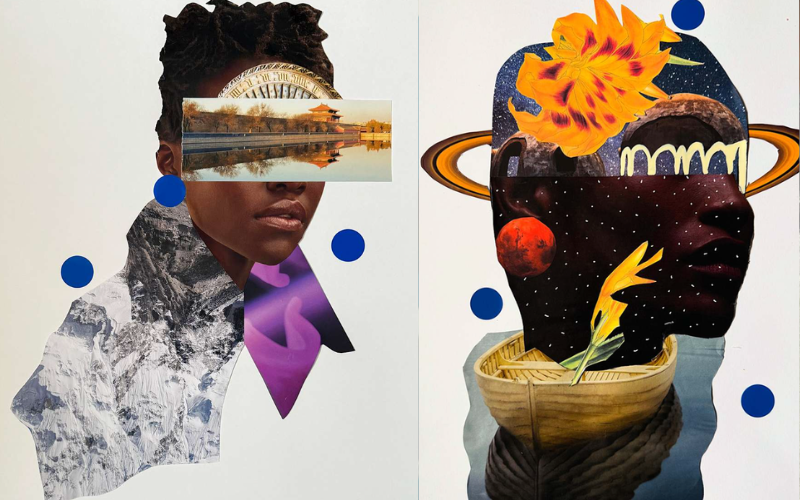
Indigene Theresa Gaskin, Topography of Thought, 17 x 14 x 0.125 in, Journey To Headspace, 17 x 14 x 0.125 in
Art Career Advice: Start Archiving Your Artwork From Day One
When most artists hear the word legacy, the first instinct is to look toward the future and wait. You assume you have to earn it first, that your history is only worth recording once you have a massive body of work, or a career that fits what the industry deems "worthy."
"Don’t get so caught up in what you think the art world wants that you lose sight of why you started creating in the first place," Gaskin warns. "My advice would be to stay true to your voice and give yourself permission to grow and evolve."
Respecting that internal voice as an artist means treating what you make as valuable from the moment it exists, without waiting for anyone else to confirm it. And doing so is a habit you can start sooner than you think. "If I could hand my younger self one thing, it would be a good system for documenting and organizing my work from day one," Gaskin urges. "Photograph every piece, record the title, date, dimensions, and where it went."
Logging those details from the start is how you decide your work matters, without needing the industry to give you permission. "Be patient," Gaskin adds. “Building an art career is a marathon, not a sprint, and every piece of the journey matters."
Recorded from the first piece, your art career becomes its own archive, its own legacy, and its own way of being carried forward.
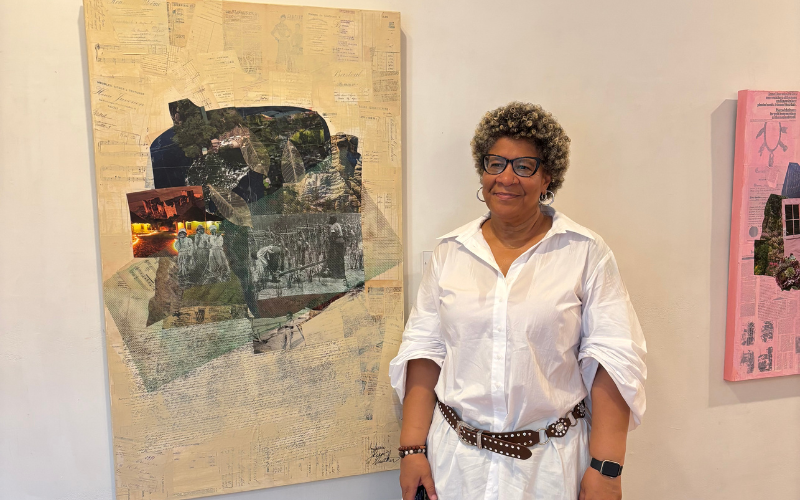
Indigene Theresa Gaskin with her work on view. Image courtesy of the artist