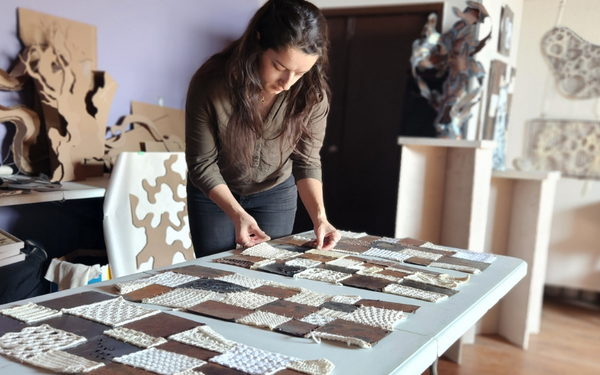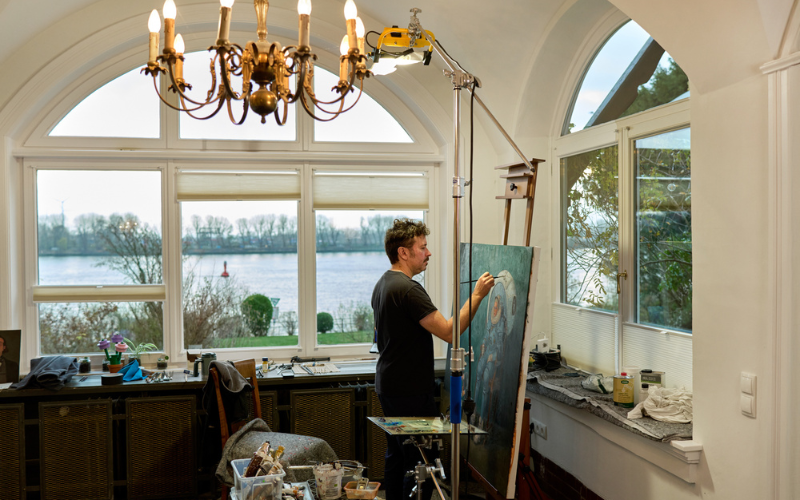
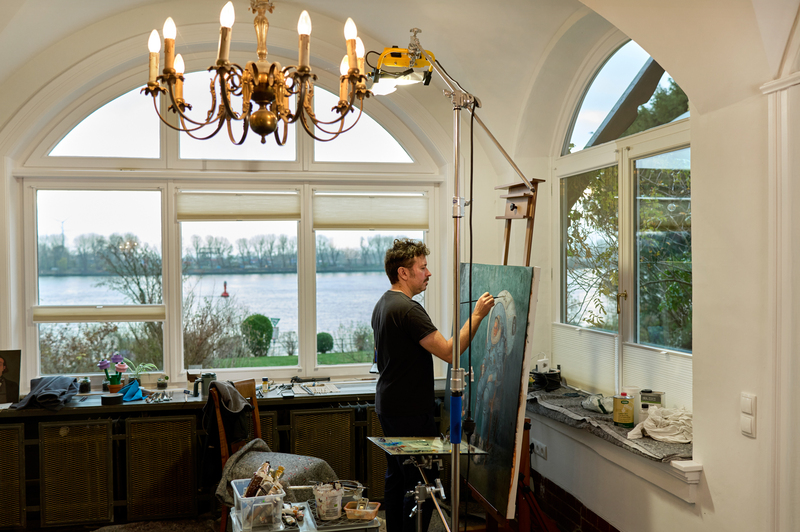
Casey McKee at work in his studio, a painting in progress on the easel. Photo courtesy of the artist.
Exploring Power and Social Structures Through Contemporary Painting
Featured Artist Casey McKee makes work about the systems we've all subconsciously agreed to stop questioning. "I try to push situations to an absurd level," says Mckee.
The American artist, now living in a small village in the German countryside, uses oil on canvas to explore subjects that are hiding in plain sight: the costuming of power, the mythology of success, the social contracts we inherit and rarely examine.
His paintings keep returning to places where authority and identity reveal themselves as constructed things, held together more by habit and repetition than by any deeper meaning. He approaches his subjects sideways, using humor and absurdity to expose the logic embedded in power structures, social hierarchies, and cultural norms.
Diagnosed with ASD as an adult, McKee has spoken about how a neurodivergent perspective gave him a particular kind of distance from received wisdom. Standing slightly outside of conventional thinking, he found himself drawn to a question most people never think to ask: whether the structures organizing everyday life make any sense at all. That question sits at the center of everything he makes.
Artwork Archive had the chance to speak with Casey McKee about satire as access, the inventory that once saved him from a gallery dispute, and what two decades of building a practice have taught him.
You can see more of his work on Discovery and learn more about his practice below.
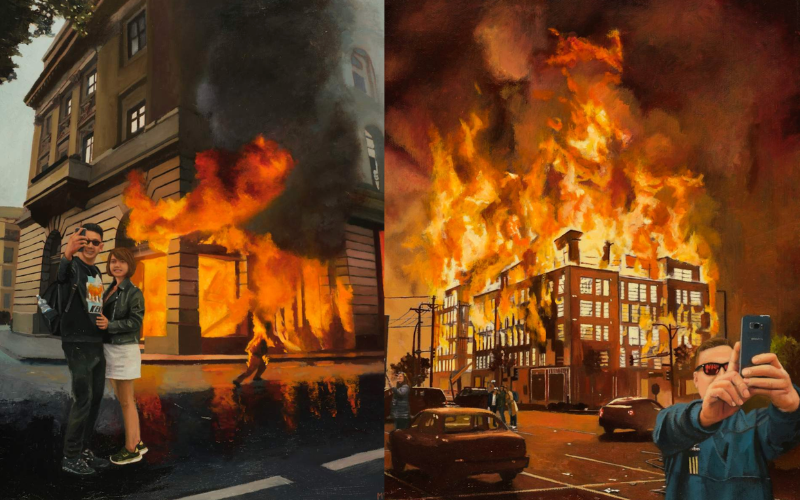
Casey McKee, You'll Own Nothing and Be Happy, 2025, 50 x 45 x 4 cm & Spectacle, 2025, 30 x 25 x 4 cm
Using Painting to Question Power and Social Norms
There's a David Foster Wallace commencement speech oil painter Casey McKee keeps coming back to. In it, two young fish are swimming along when an older fish passes by, says, "Morning, boys. How's the water?" and swims on. Eventually one young fish turns to the other and asks: "What the hell is water?" The point, as Wallace explains, is this:
The most obvious, important realities are often the hardest to see. That's more or less what McKee's been trying to do for the past two decades.
"Trying to see and to be able to point out 'the water' is incredibly difficult but important," the artist reflects. His paintings are attempts to do exactly that: to make visible the things that function precisely because no one notices them functioning. These themes, he continues, "emerged gradually out of a kind of friction I kept encountering, both personally and in observing the world around me." A growing preoccupation with who gets to define normal, who that definition serves, and who it pushes aside.
Businessmen in suits became a recurring figure in his work because they're almost too good a subject. The costume has barely changed in a century, still carrying its signals of seriousness and authority, "even though it has almost always been men in suits who have brought ruin and havoc to our lives and to the planet," he notes. Social hierarchies, expectations around productivity, the whole aesthetics of success: "what keeps pulling me back is how normalized these structures are, and how rarely they're questioned unless something disrupts them."
It's there, in that gap between the familiar and the examined, that his paintings begin. "Early on I found myself drawn to images and situations where something felt slightly off — where authority, identity, or social roles seemed constructed rather than fixed."
Why Satire in Art Makes Us Question the Familiar
Being diagnosed with ASD as an adult reframed something McKee had always sensed about himself. "I realized that being neurodivergent allowed me to stand slightly outside of conventional wisdom and to ask if this all makes sense," he observes. That slight displacement, the thing that had registered his whole life as friction, turned out to be exactly what his artwork needed.
Geography deepened that sense further. More than twenty years in Germany, time in China, and extensive travel beyond both, he's discovered "being outside the U.S. makes certain things I took for granted there feel more visible." Contradictions that might otherwise hum unnoticed in the background start to sharpen into something harder to ignore. "The U.S. increasingly reads to me as one of the most authoritarian countries in practice, even while it strongly presents itself as being about freedom and liberty," McKee points out. "That contradiction has really shaped how I think about power and how I translate it into my work."
Getting viewers to see what he sees is a different problem, and humor is his solution. "If something makes you laugh, even briefly, it lowers your guard," he explains. "You're already inside the work before you've decided how you feel about it."
McKee is most interested in that moment when the laughter begins to turn, and something more uncomfortable or ambiguous starts coming through. Push a situation far enough and the underlying logic (the thing that makes the behavior possible in the first place) becomes impossible to miss. "What might seem ridiculous at first often isn't that far removed from how things actually function."
"I try to push situations to an absurd level in order to make the 'water' more recognizable."
Working this way also creates space for interpretation, recognition, and the eventual realization that what looked like a joke is actually describing something that has been there all along. "Ideally, the work operates on two levels," he notes. "There's an immediate, accessible surface, and then a slower realization that what's being laughed at is tied to something structural and persistent."
The goal, the artist maintains, is never to deliver a verdict. "I'm not trying to provide answers as much as create spaces where those assumptions feel unstable. Where the viewer might recognize something familiar, but also feel that it doesn't quite hold together in the way they expect."
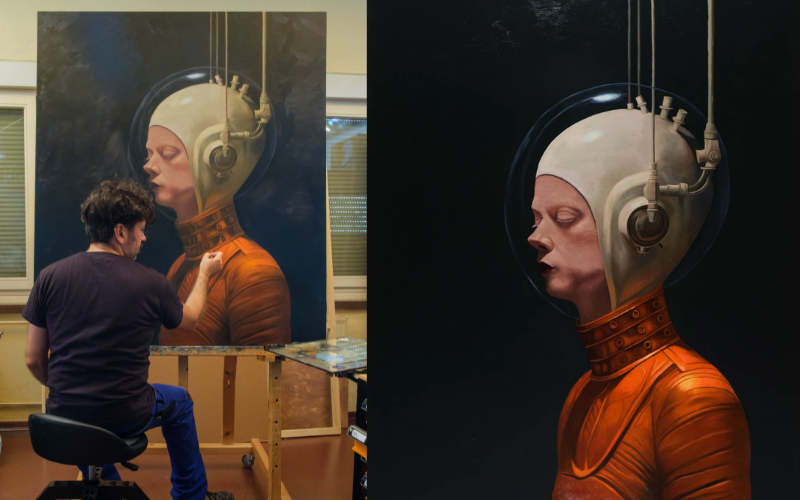
Casey McKee in his studio with a WIP. Pictured right, finished piece Data Harvest, 2025, 150 x 130 x 4 cm
The Creative Process Behind His Oil Paintings
The notebooks come before everything. Ideas that won't become paintings for years live there first, accumulating through extensive journaling until they're ready to be made. Several series circulate in the background at any given time, each waiting for the right moment to be developed.
"My process often starts a year or more before I begin working on the canvas," McKee adds. "I usually start with a loose idea, something I want to explore but that I'm not yet sure how it will take form."
Sometimes it starts as an image, sometimes a concept that hasn't found its shape yet. He sits with ideas for years, letting each one grow on its own terms. When it's ready, the process turns precise. A reference image assembled in Photoshop, drawn from his own photographs and from historical paintings found in books and museums he's visited. Then the canvas gridded, the drawing transferred, the oil paint applied until the work feels resolved. Each phase moves into the next without much attachment to any of them. "I don't have a favorite part," he admits. "I appreciate that the process involves variety so that I can move from one part to the next and keep it all fresh."
What Artists Need to Know About Building a Sustainable Career
Candor about what an art career looks like comes easily to this artist. "There is no such thing as 'making it,' Casey McKee says plainly. The path has ups and downs, and the sooner an artist understands that, the less likely they are to be undone by it.
Early on, his achievements felt like confirmation that a certain threshold had been crossed. A strong exhibition. A good year. "I made the mistake of thinking that certain successes or opportunities meant I had arrived," he remembers, "but then the next day comes and things are not really that different." Strong years don't guarantee the years that follow. A global recession arriving at exactly the wrong moment can change everything before there's been time to register it. "A lot is out of your control," McKee cautions. "In the end, it's less about reaching a final point and more about continuing to move forward through the fluctuations." His advice?
"Keep showing up. Day after day. Just keep going. There will be lots of rejections but they aren't personal."
The harder business lesson came from losing work to galleries that couldn't account for it. "Don't rely on galleries to keep track of your inventory," he warns. "You need to know exactly what is where and it needs to be clearly communicated." When pieces of his went missing, it was his own records he turned to. "It was only because I had my own inventory archive that I was able to know when the work was delivered to them and that it hadn't been returned."
Without that documentation, there would have been nothing to point to.
Using Location Tracking as Protection, Not Just Organization:
Artwork Archive's Location tracking lets you log exactly where each piece is at any given moment, whether on consignment, in a show, in transit, or at a collector's home, along with expected return dates.
If a gallery relationship sours or a piece goes unaccounted for, that record becomes your paper trail. Shipping details and consignment agreements can be attached directly to each artwork entry, keeping everything in one place.
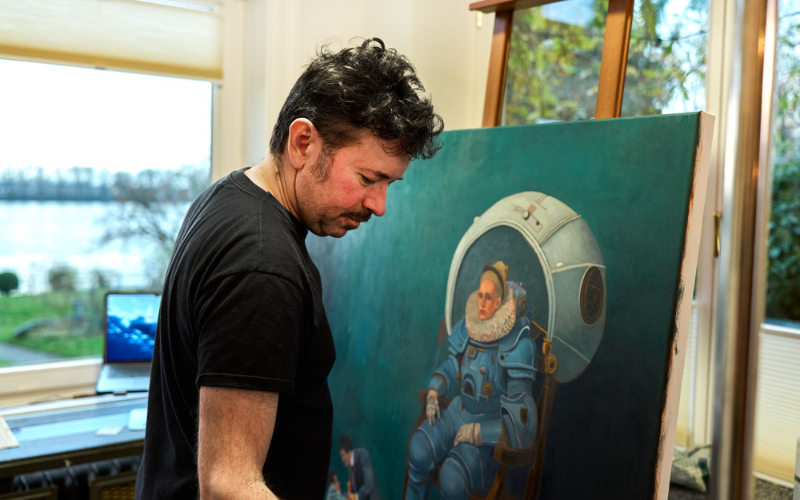
Casey McKee at work in his studio, a painting in progress on the easel. Photo courtesy of the artist.
Moving Beyond Spreadsheets for Art Inventory Management
Organization had always been a priority for Casey McKee. First by paper, then by spreadsheet. But then came the creeping realization that consistency was hard to maintain, and information that existed in theory was hard to use in practice. He discovered Artwork Archive last year.
"I was immediately drawn to the interface and how Artwork Archive allows me to track different types of information in one place. It's made managing my work much more efficient and cohesive."
What stands out most to him is the Exhibition tracking, specifically the ability to log not only shows he has participated in, but ones he has applied to across years, including works that were not accepted. "This is especially useful for recurring calls," he adds, "where I can refer back to previous submissions and see what I entered before." Location tracking rounds out a system that now stays on pace with the work, keeping tabs on where each piece is and when it's expected back.
Turn Art Rejections Into Better Exhibition Applications:
A lot of artists only track what work gets accepted. Rejections, on the other hand, are our forgotten history. Logged over time in Artwork Archive's Exhibitions feature, those nos start to tell a story: which works you keep sending out, which venues have seen the same piece twice, and which opportunities might be worth a second look with something different.
But these powerful patterns are only visible if you've been keeping track.
→ Start building your submission history
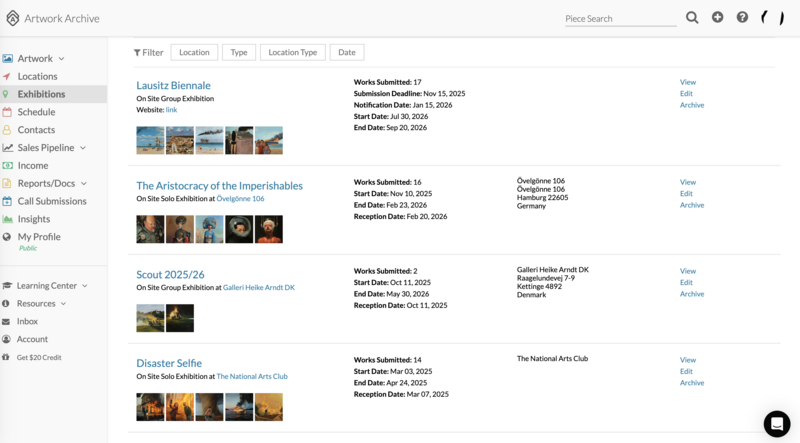
A look inside Casey McKee's Exhibition Records via Artwork Archive. Photo courtesy of the artist
Make the Art You Actually Want to See
"Be authentic. Make work that you genuinely love and find interesting, rather than trying to guess what others want to see."
For Casey McKee, that starts with knowing that social media performance and real-world resonance are not the same thing. What performs well on Instagram and what holds up in person are often completely different, and the work suffers when you stop being able to tell them apart.
His own paintings have always been about the things no one has thought to look at directly. The costume that hasn't changed in a century. The hierarchies so embedded they've become part of the air. Two decades in, the question that started it all is still the one driving the work: what the hell is water?
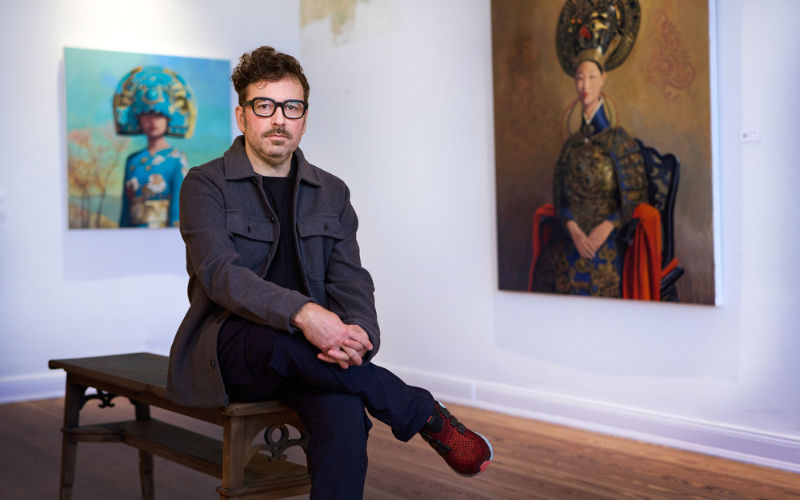
You can explore Casey McKee's work on Artwork Archive's Discovery.
No matter what season of your art career you're in, getting your business side in order doesn’t need to feel overwhelming (and doesn't need to live in a binder). A bit of structure now can mean more time and headspace for the work you actually want to be doing.
Artwork Archive helps artists build an online portfolio, stay on top of their inventory, and create things like tear sheets and invoices in just a few clicks. Start a free trial and see how it fits into your own process.