 Printmaker Ilana Dashe has turned a life of travel into serene prints.
“I can't know how my work will look until the last layer is applied. Once it is, that reveal completes both the piece and the process.”
For printmaker Ilana Dashe, every print is an act of faith. Working layer by layer, color by color, she won’t know if the piece succeeds until she lifts her final screen from the paper. It’s a process that requires patience, precision, and a willingness to trust that all those separate elements will come together in the end.
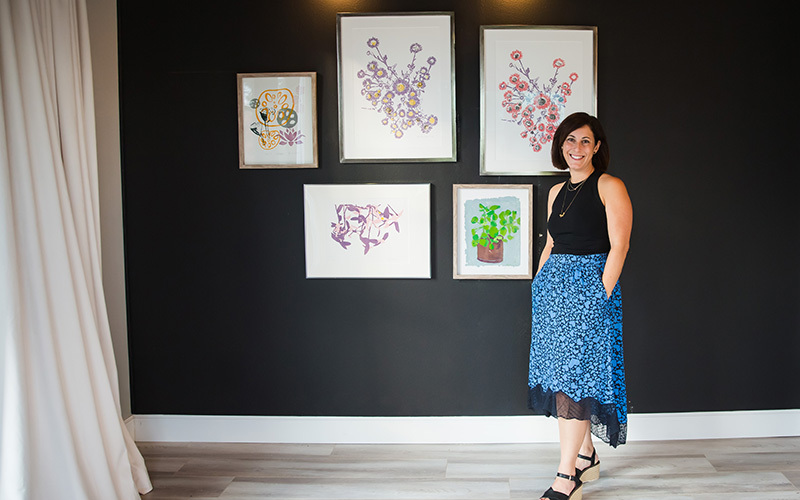
Based in North County, San Diego, the Colombian-American printmaker creates artwork with clean, modern aesthetics inspired by her personal history. She combines unusual color combinations to make familiar subjects feel fresh, she simplifies shapes that convey complex ideas, and limits her palettes to maximize the emotional impact of her work.
She tells Artwork Archive that her style emerged from an early love of midcentury modern design combined with a formative experience living in Japan and learning printmaking techniques from Tokyo’s artists.
Read on to see how Featured Artist Ilana Dashe’s design background shaped the way she thinks about her audience, how letting go of control strengthened her printmaking practice, and how one lost sale pushed her to get organized with tools that now save her hours every week.
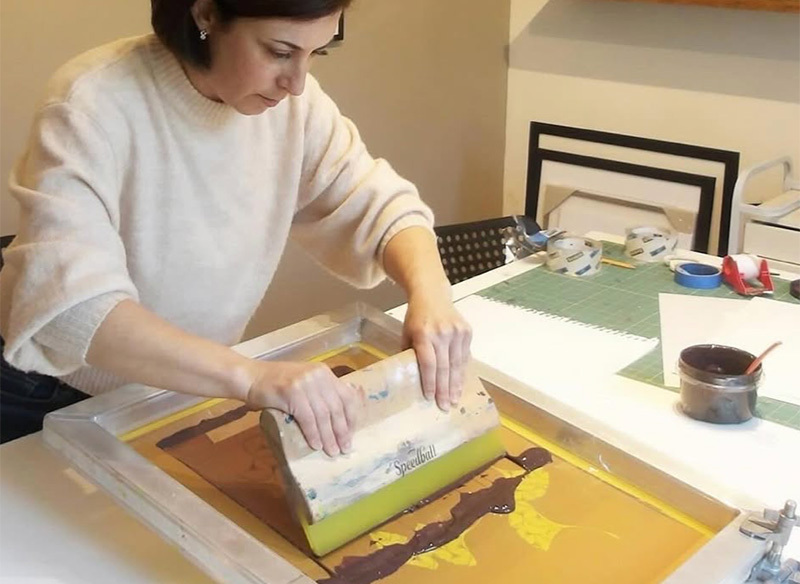 Pulling a print, what could be more fun?
How Ilana Brings Her Designs to Life
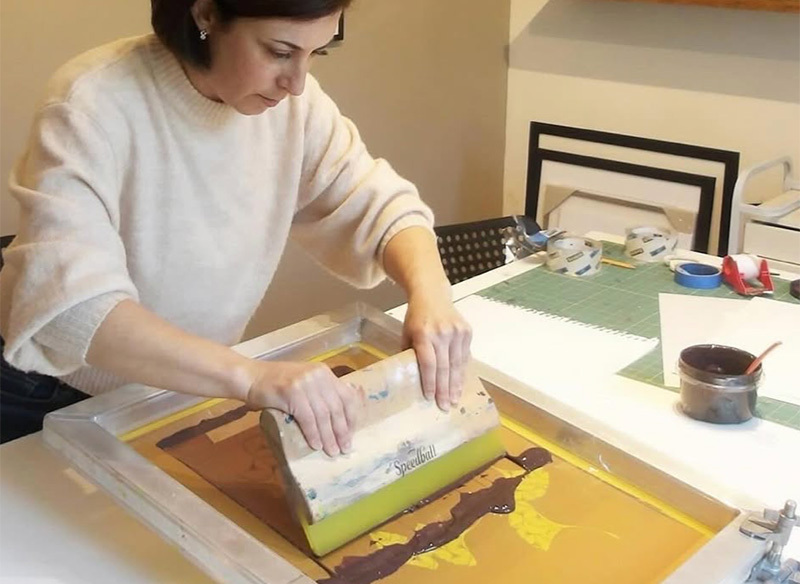
Ilana loves the printmaking process and has worked across many printmaking mediums, from lithography to monoprinting. But these days, serigraphy (more commonly called screen printing) is her technique of choice.
Her workflow for creating a serigraph involves a meticulous, multi-step process that transforms her drawings into layered prints.
“I begin with a hand drawing or large-scale laser print-out of my design,” she explains.
From there, she works with transparencies, UV exposure units, and photo-sensitive emulsions to create her designs on several different printing screens. Once one layer of her design is etched into a screen, she washes out the areas that will print ink so that the coating uncovers the bare screen in those spots.
Then she begins layering up the print, always working with one color at a time: “I hand mix screen printing inks to my desired colors, apply the ink to the screen, and hand print using a color-by-color layering process.”
Her favorite part of her art-making process is when that final screen has been inked, and she pulls it away from the paper, revealing the fully realized print. This part always brings a smile to her face: “Once the desired number of colors have been applied to the paper, my design is complete!”
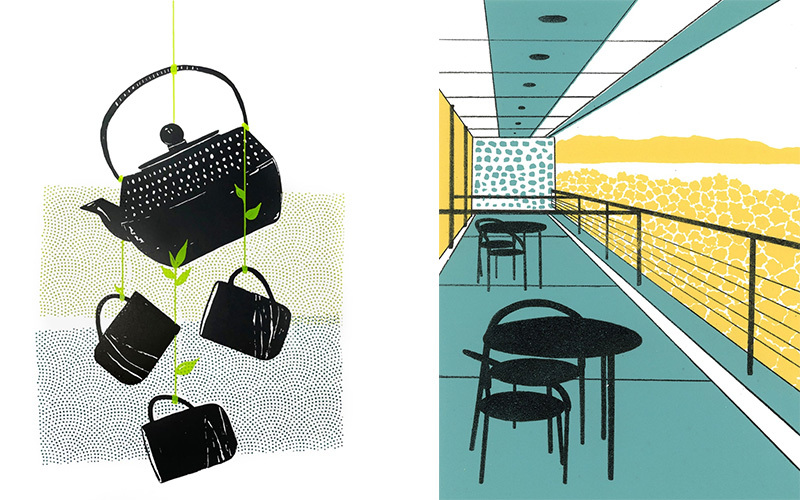 Ilana Dashe, Balance, Serigraph, 20 x 16 in, and Naoshima, Lithograph, 20 x 16 in
The Artists and Architects Who Shaped Ilana’s Vision
Even from an early age, Ilana knew what she liked. “As a young child and to this day, my favorite artist is Joan Miró,” she recalls. “I loved the surrealist style and the stories told in his work.”
“Miró worked in primary colors predominantly, and used simple, often organic shapes in his abstract compositions,” she elaborates. “I follow the same strategy, with a less-is-more approach combining hard edges with organic shapes.”
As she grew up, this early love of clear composition led her to pursue a career in design. She founded a design consulting firm called Avanti Creative and lived for five years in Geneva, Switzerland, pursuing this work. But, it was the city she lived in next that brought it all together for her.
“When I moved to Japan, I was taken aback by the architectural influence of many famous Japanese architects,” she remembers. “Particularly Tadeo Ando, and his extremely minimal constructions, mainly with concrete, to create spaces that are clean and stunning in design.”
Ando’s work really struck a chord with Ilana’s sensibility. “It was through Tadeo Ando's work and its contrast to the nature in Japan that my love for exploring the juxtaposition between the urban concrete setting and nature's beauty in my work,” she recalls.
“The contrast between inorganic and organic,” as she describes it, defines her visual vocabulary today. Her prints carry traces of both Miró’s playful surrealism and Ando’s purposeful minimalism, filtered through Ilana’s own experience of navigating foreign cultures and finding beauty in unexpected places.
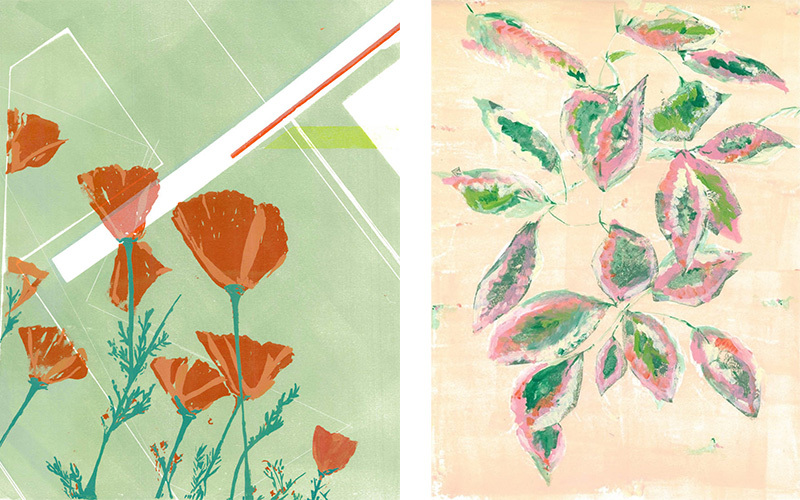 Ilana Dashe, Poppy - Renewal, Monoprint, and Pink Ficus, Monoprint with Acrylic Paint
Why Ilana Creates Art With the Viewer in Mind
Ilana’s background at her design consultancy and in corporate design and advertising gave her a unique perspective on the role of the audience in her art-making. Working in these fields where creativity coexists with budgets, deadlines, and deliverables, Ilana learned to marry artistry with a certain structure.
“Having a design background really motivates me to think of my audience,” she offers. “It’s wonderful to create, but I don't want my art to sit in my studio unseen.”
To make sure that her artwork meets the viewers it deserves, she thinks early in her process about ways to connect her work with her audience.
“In marketing and branding, you have to think about who you are speaking to,” she explains. “With my art—though my ‘why’ and my passions come through inherently—I often think about how people are going to connect with my work.”
She asks herself strategic questions as she’s making: “Will they be drawn to my color palette? Do they connect to my story of living abroad? Do they have a back-history with the ginkgo leaf, too?”
At the end of the day, allowing viewers a way into your art practice, whether that’s by sharing behind-the-scenes insights, telling a convincing story about why you make your work, or revealing how your personal history has shaped your art, is all just ways to get other people as excited about your art as you are.
“If there’s a connection, that connection leads to sales,” she says, “and sales mean my art moves, and allows mental and physical space for me to create more.”
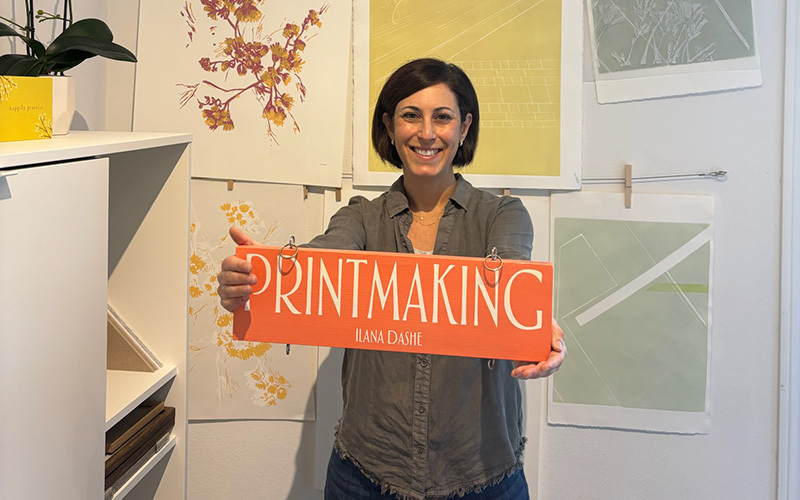 It's OK to lose a little control when it comes to artmaking.
How She Learned to Let Go and Trust the Art Process
Ilana tells Artwork Archive that one aspect of her personality might surprise people who encounter her calm prints: “I am very impatient.”
If a piece doesn’t turn out quite the way she planned it, she doesn’t fret. “I just move to the next one,” she shares. “No need to bury myself or get stuck in one work.”
Printmaking is all about creating multiples of a single image, but it’s rare that any two prints come out exactly the same. When it comes down to it, Ilana’s philosophy is to lean into this by enjoying the process and not worrying about the things she hadn’t foreseen.
This more loose approach to her work also influences how she approaches her art career. For her, the biggest shift as an artist came when she stopped trying to plan for every little possibility in the future.
“Stop trying to control everything,” she urges fellow artists. “As long as you're making moves toward your goals, the opportunities present themselves. The ones you least expect tend to arise, and the ones you planned don't often pan out the way you might have wanted.”
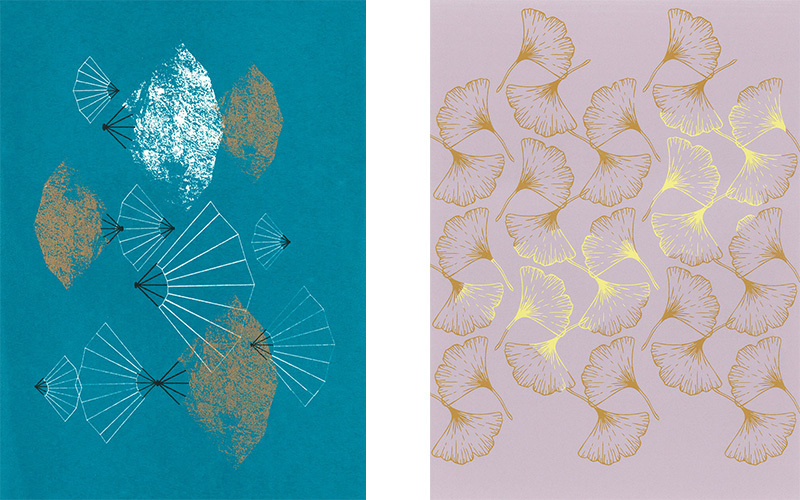 Ilana Dashe, Turquoise Fans, Serigraph, 10 x 8 in, and Ilana Dashe, Ginkgo Glimmer, Serigraph, 20 x 16 in
How Getting Organized Helped Ilana Protect Her Time for Making Art
In her creative practice, Ilana has learned to stay open to the unexpected. Every artist has to learn to find the magic in the serendipitous.
But as she’s progressed in her art career, she’s realized that a little order in her art business can go a long way.
The printmaker was accustomed to keeping track of her inventory and updating her website as pieces became available or sold. But that system started to break down as her business expanded.
“I actually lost a sale because it was marked available on my website, but when I went to find it, I realized it had already been sold,” she recounts with chagrin.
“I had way too many works to keep track of,” she remembers. “I sometimes didn't know where my work was, be it in a gallery or in my studio.”
That’s when she found an art inventory solution that has helped her organization immensely: “Artwork Archive saved me in having one place to mark where every piece is, and a way to track it when it is sold.”
The stakes were just too high for her to avoid investing in professional art business tools. “I learned the hard way that if I didn't get smart and organized on the administrative side, I'd never have time to make my actual art.”
TIP: You can manage art editions with Artwork Archive
Hey printmakers, photographers, and all artists creating multiples: did you know that it's easy to track your editions with Artwork Archive? Forget cumbersome spreadsheets and give Editions a try today.
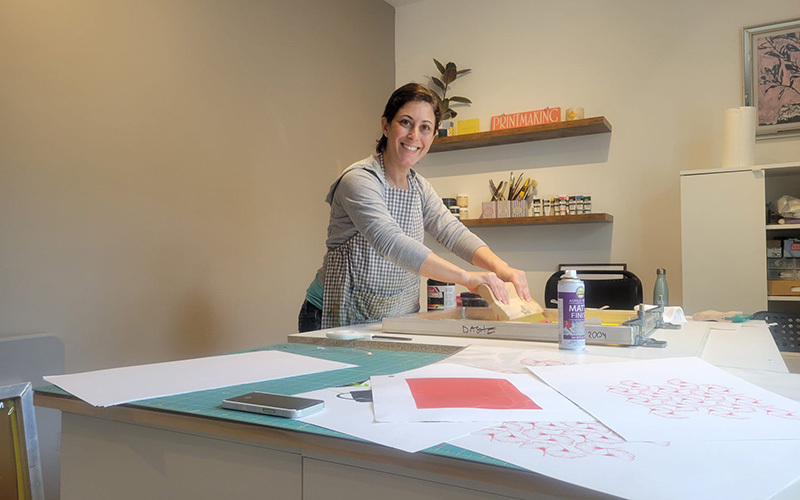
Lessons Ilana Learned About Documenting Her Artwork From the Start
Now that Ilana is running her art business through Artwork Archive, she wishes she’d made the jump sooner
“I have so many early works that I sold that I have no record of,” she says of her time before Artwork Archive, “and that really bothers me.”
But these days, “I sleep better at night knowing all my work is logged, documented, and accounted for. It saves me hours on ongoing management of prints.”
That’s why, if she had one piece of advice for artists building their careers today, it’s a simple one: “track your work from the start.”
That means taking pictures of every piece you’ve ever made, logging the creation date, and getting it into your inventory system. Even if you have no plans for it now, “if you have images of your work, you can later make them into prints or even develop later works from a piece that was sold.”
Ilana Dashe's path from corporate design consultant to printmaker shows how practical experience can evolve into creative strength. Her professional discipline, shaped by years of structure and problem-solving, now underpins her studio practice. Managing her inventory, finances, and audience isn’t separate from the art—it’s what gives her the focus and stability to keep experimenting, layering, and refining her prints.
No matter where you are in your art journey, getting your business side in order doesn't have to feel overwhelming. A bit of structure now can mean more time and headspace for the work you actually want to be doing.
Artwork Archive helps artists build an online portfolio, stay on top of their inventory, and create things like tear sheets and invoices in just a few clicks. Start a free trial and see how it fits into your own process.


![[GUIDE] The Best Artist Grants & Opportunities in September 2025](https://d1zdxptf8tk3f9.cloudfront.net/articles/2034/large/Nicky_Myny__-_September_Opp_Guide_Image.png?1749836260)
