 Featured Artist Crissy Arseneau has found that her art practice is a way to deepen her experience of her own life.
"Art is a way to keep me awakened to life.”
Featured Artist Crissy Arseneau’s watercolor creations grab your attention, and that’s by design. The Canadian artist uses hard-edged abstract shapes to draw viewers into a moment of contemplation, seeing how the hand-painted colors of her geometric compositions create something electric and other-worldly. Your eye travels along the lines, finding and losing edges, moving between reality and perception. An oasis of calm in a hectic world.
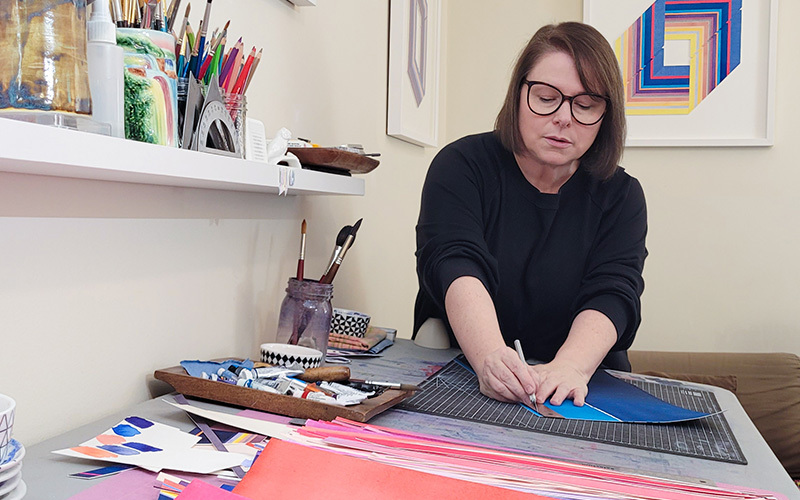
Beginning with washes of paint on watercolor paper, Crissy slices and forms bands of color into precise shapes that seem to float in space. For her, the deep focus that her artwork requires allows her to be more present, and more connected, when she’s not in the studio.
"When someone is drawn to my work,” Crissy explains, “I hope they feel a similar experience of sustained focus that is stimulating and calming at once.”
Read on to learn how Crissy Arseneau balances the organic chaos of watercolor paint with the precision of her hand-cut creations, why she believes art is the ultimate antidote to distraction, and how she found the simple tools that keep her art business running so she can focus on her creativity.
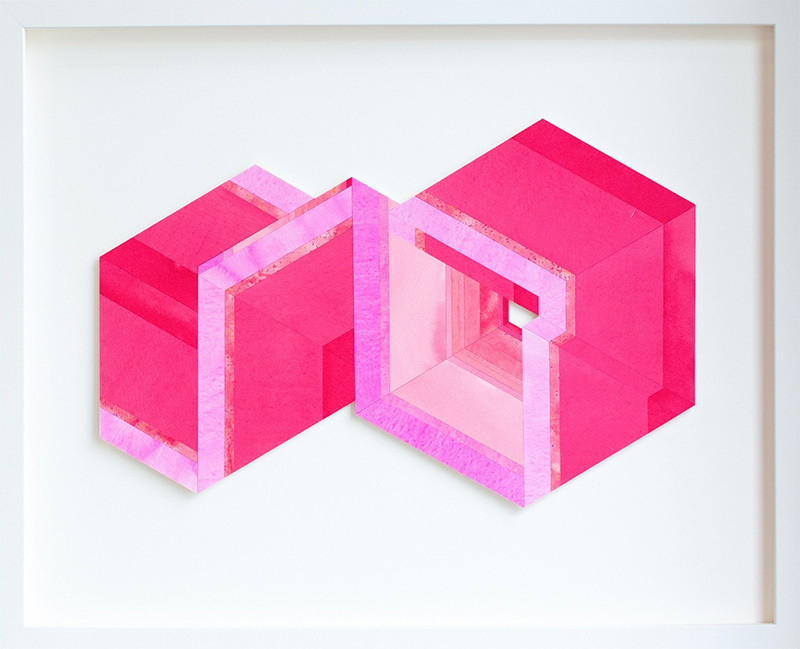 Crissy Arseneau, It's Time to Come Together, watercolor, cotton paper, 10.25 x 15 in
How Crissy Creates Order Out of Chaos in Her Artworks
Crissy’s practice is built on a fascinating contradiction.
She says she’s the kind of person who likes to find order in chaos, and strives for precision whenever possible. And you can certainly see that in the expertly cut and arranged pieces that grace her Public Profile.
But she also uses watercolor paint as the base of her artworks, a medium that famously has a mind of its own once it gets put down on paper, pooling in some areas, thinning out in others.
“It moves and changes as it dries, settling in ways I may not have intended,” Crissy tells Artwork Archive. And she loves that.
“It doesn't always do what I want,” she shares, “which is something that’s helpful for us as humans, in our current ‘for you’ climate, to be reminded of.”
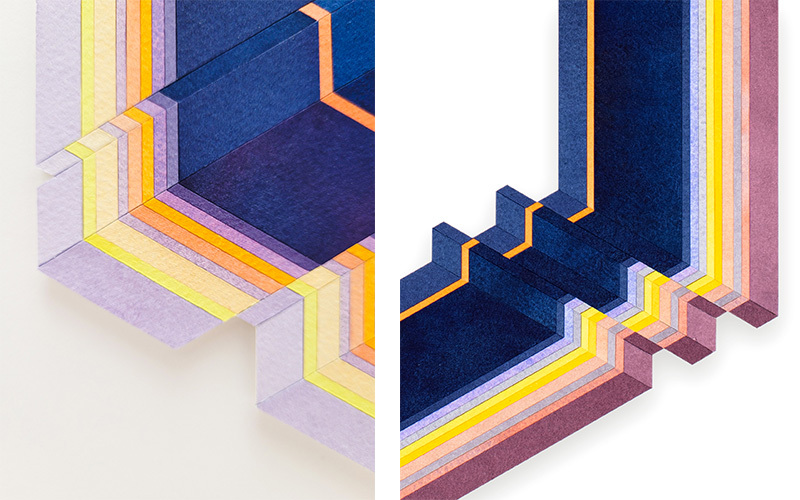 Details from two of Crissy's pieces.
As a first step, she lays down transparent washes of watercolor onto sheets of paper. This is one of her favorite parts of the process, and she carefully considers “the application of the paint to achieve smooth or variegated visual texture and tonal variety.”
Once the sheets are dried, she precisely cuts, arranges, and bonds the painted paper into crisp polychromatic bands and angular shapes. She knows a piece is working when “the liveliness of the paint on the paper meeting the crispness of its cut edges” starts to create a rhythm and a feeling of volume.
The resulting piece is a “low relief” form that physically sits off the surface of the paper, hovering in space like a geometric hallucination.
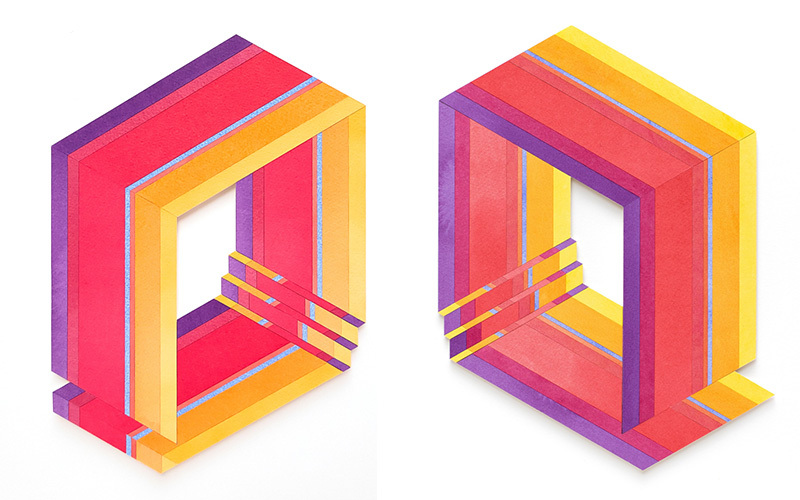 Crissy Arseneau, To The Other Side, watercolor, cotton paper, 11 x 8 in, and We'll Leave the T.V. and the Radio Behind, watercolor, cotton paper, 10.5 x 8 in
How Crissy Uses Her Art to Deepen Her Attention
Because of the care that Crissy puts into each creation, and the methodical layering of the paper into eye-absorbing arrangements, these are pieces that reward a longer look.
According to Crissy, that grew naturally out of a need she was feeling from living in a short-attention-span world.
“Particularly in the past few years, my attention has absolutely been divided,” she admits. Luckily, she has found a way of working that forces her to pay attention.
“When I feel the discomfort of not being sure how I want to move forward on something, the urge to reach for the pacifier of screens (or snacks!) can kick in,” she explains. But her way of working doesn’t allow for that.
“If I’m not present, I make errors,” she shares. “But more importantly, it stops me from experiencing the pleasure that making can bring.”
In a culture where difficult feelings can be swiped away, it’s helpful to have something that demands your full attention. In fact, sitting with those feelings is sometimes the only way to truly deal with them. “I want to feel the challenges and enjoy resolving them (or having to be okay with perhaps not resolving them),” she offers.
When viewers encounter her work, she hopes they can gift themselves the same level of presence. “When they look closely and spend time with a piece, it can be a way of zooming in with purpose. I hope they are curious and delighted, not just about the work but about their reaction to it, and that it makes them more likely to seek out and recognize those feelings when they are out in the world, too.”
According to Crissy, this has already happened to her: “Just yesterday, I stood just off a busy street to watch the sky as the sun set, seeing the light and colors change, the clouds move, the birds taking in the last of the day.” Art is her way of staying alive, staying in touch with these moments of quiet beauty.
 As Crissy started showing her work more, she knew she needed a better way to run her art business.
When Crissy Knew it Was Time to Move Beyond Spreadsheets
As Crissy’s career progressed, and her work began appearing in more exhibitions and finding its way into collectors’ homes, she hit a wall with her studio organization.
“I have to say, I do love a spreadsheet!” she admits. And when she was first starting out as an artist, it was a natural way to organize her work.
But scaling up was a challenge: “It didn’t take long to realize the limitations: it was difficult to include everything I wanted to record and to sort data with attached images, too easy to write over information, and just not super useful for the way I needed to retrieve details.”
For an artist so inclined to creating order in her artworks, her fragmented art business systems seemed like a problem she just had to face.
“Artwork Archive was recommended to me by other artists,” she recalls, “and it was an instant game changer!”
The benefits were immediate: Artwork Archive, for Crissy, "offers a central place for all the details of each piece and there are dozens of ways to sort the data. It’s ideal for me to organize pieces for an upcoming show, or put together collections of past work to use as reference for new pieces. It’s easy to send people a curated collection of work that fits their taste or project objectives.”
Collectors are also able to visit her Artwork Archive Public Profile and see which works are available, or see past pieces that might spark their interest in a commission.
The best part is that as her practice grows, she’s able to find the tool she needs to solve any new issue that arises. “It has so many features I don’t yet regularly use but that are there for me to draw on when the time is right. Let’s just say, I’m a fan!”
 Crissy Arseneau, As the Miles They Disappear, watercolor, cotton paper, 6.5 x 7.25 in
How Crissy Uses Artwork Archive to Power Her Art Business
Now that Crissy has moved her inventory over to Artwork Archive, she can manage her entire professional life through one central hub.
As she completes one of her colorful creations, she can take a snapshot with her phone and add that placeholder image to her Artwork Archive inventory. This can help her when coming up with titles, and once she gets it professionally photographed, it’s simple to find the piece and update its imagery, along with all of the dimensions, media, creation date, and more. She can even use the Notes function to record personal reflections: “I also add private notes for myself so I have them for reference when I’m later writing about the work.”
When a piece goes out to an exhibition, or sells to a collector, or gets consigned to a gallery, Crissy logs this in the for each piece so that she can easily find which pieces are floating around outside her studio: “It’s impossible to rely on memory alone—I love that I can outsource the recall to Artwork Archive!”
Don't Lose Track of Your Art!
With Artwork Archive's Location tool, you can log when your art is in an exhibition, out on loan, or in a collector's home. When it comes time to pick up your art, you'll have a clear record of which pieces you're looking for.
And like all Artwork Archive data, this is easily exportable so you can stay in control of your data.
 Crissy uses Locations to track her artworks' movements in the world.
With this easy organization has come a new confidence when dealing with potential collectors. She uses Artwork Archive’s Private Rooms to share curated selections of her works with clients, or to get a start on organizing a new body of work. And her Public Profile is a drop-dead simple way for her to keep her collectors updated on the new work she’s making.
By recording information at every step of her practice, she’s making sure that her professional history and her artistic legacy is documented and accessible to her at a moment’s notice.
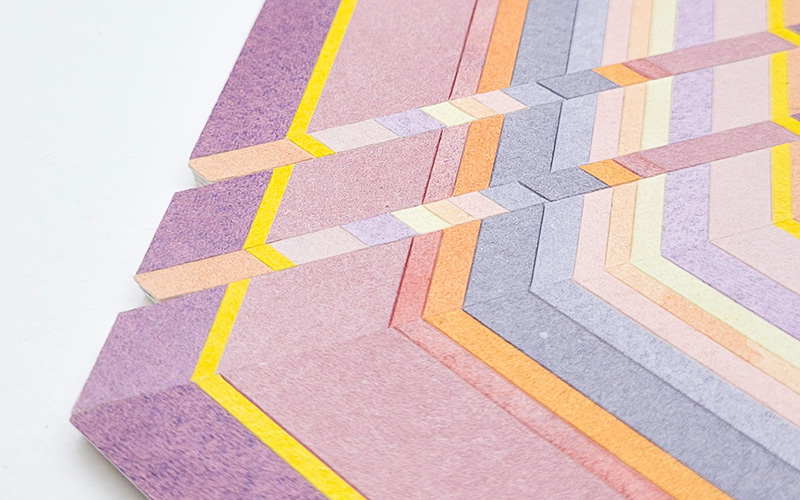 Detail from Crissy Arseneau, The Air Was Full of Sound, watercolor, cotton paper, 14.5 x 8.75 in
Crissy's Advice to All Artists
Crissy enjoys the calm focus that goes into creating her artworks, but she also recognizes that the studio can be a solitary place. That’s why she urges artists who are just starting out to prioritize building up their community as much as possible.
Being a professional artist is as much about sharing ideas, overcoming obstacles together, and celebrating victories with peers as it is about the hours you spend by yourself in your studio: “You can share opportunities with each other, and sometimes create them together for yourselves.”
“When you go to an exhibition, you’ll know people there so you’re more likely to go out and support your peers and local galleries (and they will also support you when you have something happening),” she advises, creating a virtuous cycle that will keep you hooked on the art-making process.
A community is a support network, but it’s also just plain fun to hang out with like-minded people: “If you feel a mutual spark with another artist, whether online or in-person, fan that flame!”
Beyond community, she emphasizes the need to cultivate a healthy balance of self-belief and humility. Take pride in your work, but also remain open to a lifetime of growing and learning: “Allow art to be a tool for self reflection.”
And remember that even a misstep can begin you down a path worth exploring. “A piece that didn't meet the mark overall may have a little something wonderful in it that is the seed for your new series,” she shares, “and a less-than-optimal experience may hold a lesson that makes the next one extraordinary.”
Her last word of advice is a practical one: take the time to get organized now. Even if you haven’t produced a large body of work yet, your future self will thank you for starting professional systems today.
“Do yourself a favor and create a simple system that works with your rhythms to keep track of things,” she urges, “so your year end is less of a chore and hopefully more of a celebration of the year’s accomplishments.”
By using tools designed for professional artists, like Artwork Archive, you can provide a healthy foundation for your art career to grow from. And as Crissy has found, it will allow you to keep enough mental space to stay “awakened to life” and energized by your own creative journey.
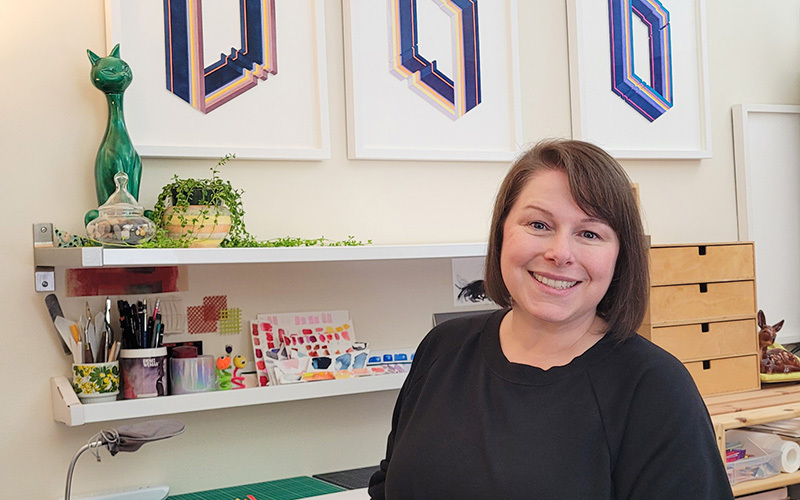 Now that Crissy can rely on Artwork Archive's simple organizational tools, she's free to spend more time on what really matters: her artwork.
Ready to trade your spreadsheets for a system that grows with you? Take Crissy’s advice and you can save hours of time and present your work with the polish it deserves. Start your 14-day free trial of Artwork Archive today.