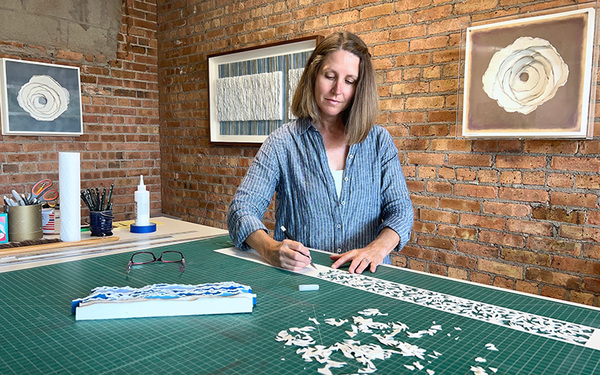
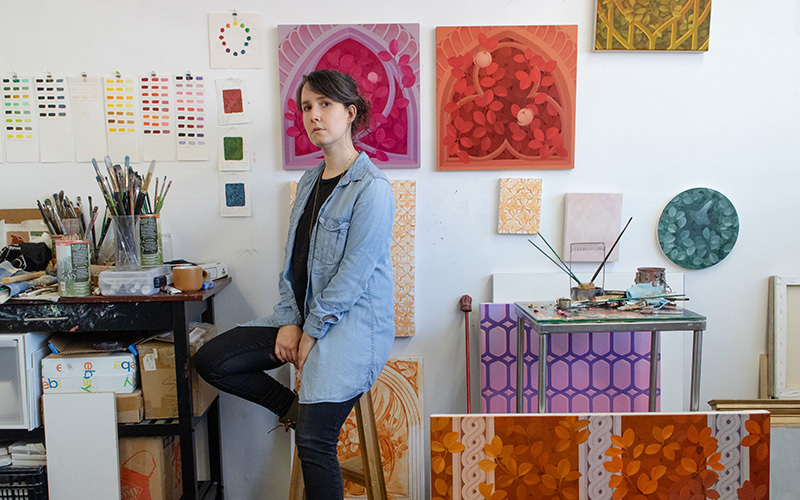
 Lucía Rodríguez Pérez creates something otherworldly out of the everyday forms she finds around her.
"Something I had to learn early on was that before anyone else sees you as a professional artist, you need to present yourself as one. That means making art and understanding your own practice as professionally as possible, even at the beginning when you don’t yet have an audience."
In Featured Artist Lucía Rodríguez Pérez's paintings, ivy crawls across stone columns, ornate marble trellises dissolve into foliage, and light bends through spaces that feel both familiar and otherworldly.
Originally from Chile and now based in New York, Lucía constructs her softly colored paintings out of a photographic visual library that she is always adding to on her long walks through the city.
"I think of my work as dreamscapes, portals into a dreamlike place that resembles our own but is not quite realistic," she tells Artwork Archive. "In the construction of these spaces, color is fundamental, as it defines the atmosphere and creates an image that is at once seductive and eerie."
Read on to learn the inspiration behind Featured Artist Lucía Rodríguez Pérez's painted portals in which architecture and nature coexist in perfect tension, plus the art career lessons she wants all artists to learn.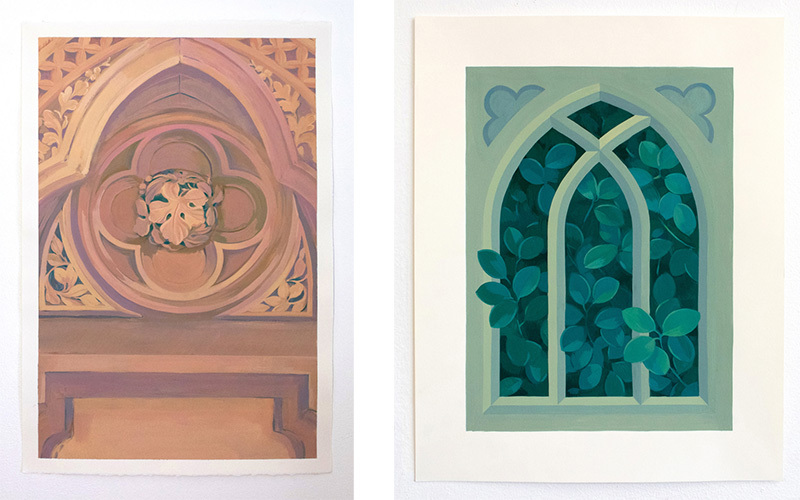 Lucía Rodríguez Pérez, Untitled (neogothic chapel, niche study), 2025, gouache on paper, and Untitled (window), 2024, gouache on paper.
Lucía Draws Artistic Inspiration From City Walks
Close observation is at the heart of Lucía’s practice. The calm scenes that she brings to life on her canvases are the result of deeply looking at the world around her, and seeing the underlying patterns that shape the urban environment.
“My interest in the relationship between architectural elements and nature started when I was a student,” she recalls, “walking around Santiago on my way home or to school and noticing how many houses used fences covered in ivy as a way to create a barrier between their homes and public space, for security and privacy.”
Plants serving as fences, or as havens, or as glimpses of nature in a man-made landscape struck a chord with her. “As I began exploring this relationship in my art, I started paying even closer attention to the city’s environment,” she shares.
When she moved to New York City a decade ago to continue growing her art career, she found herself drawn to the layers of time embedded in the very fabric of the city itself: “I immediately noticed the abundance of architectural and ornamental details coexisting in the city as a product of decades and centuries of different styles and intentions.”
Sometimes it will take a long incubation period before something she sees in the world makes its way into her art, but as she walks through the city, she’s always looking out for details that catch her eye.
“I actually find myself constantly taking pictures around the city (or any other place I visit), collecting visual elements that I find interesting and later incorporating them into my work. This is a fundamental part of my practice.”
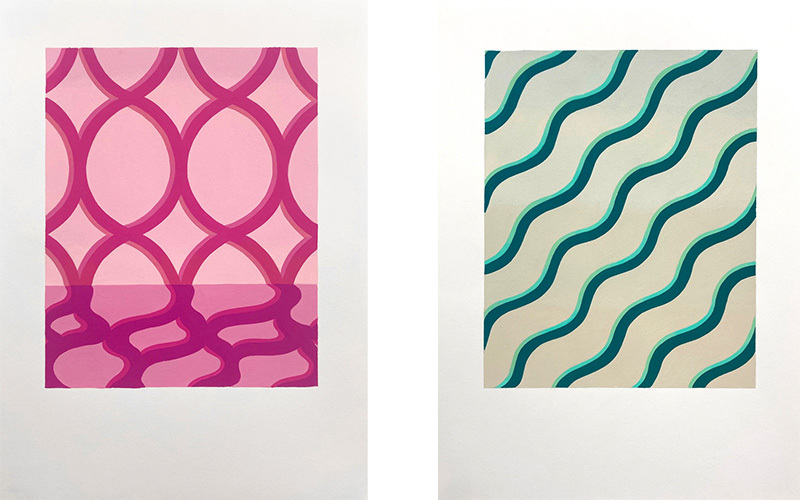 Lucía Rodríguez Pérez, Untitled (rose fence), 2023, gouache on paper, and Untitled (teal waves), 2023, gouache on paper.
How Lucía Conjures Her Dreamscapes Out of Paint
Despite her interest in the concrete realities of the city around her, when Lucía sits down to create a piece, she’s drawing on feeling more than anything else.
“My process usually starts with a vague idea of the piece I want to make, and my goal during the process is to find the visual elements—such as composition, color, patterns, etc.—that will convey a certain feeling I have for what I want to create,” she tells Artwork Archive.
“I usually do small sketches first to decide on the main composition and elements,” a kind of research that helps her work out ideas on the paper. “I look through my own visual library to find references for architectural elements, ornamental details, and foliage to incorporate into my work.”
Once she gets started, she’ll use those sketches and studies as a roadmap to guide her through the final painting, but there’s always room for more exploration along the way.
“My favorite part of the process is when the color palette falls into place and the sense of light starts working,” she reflects. “At that point, I can focus on subtle variations to create a sense of light across different surfaces and spend time refining the details I want to define more clearly.”
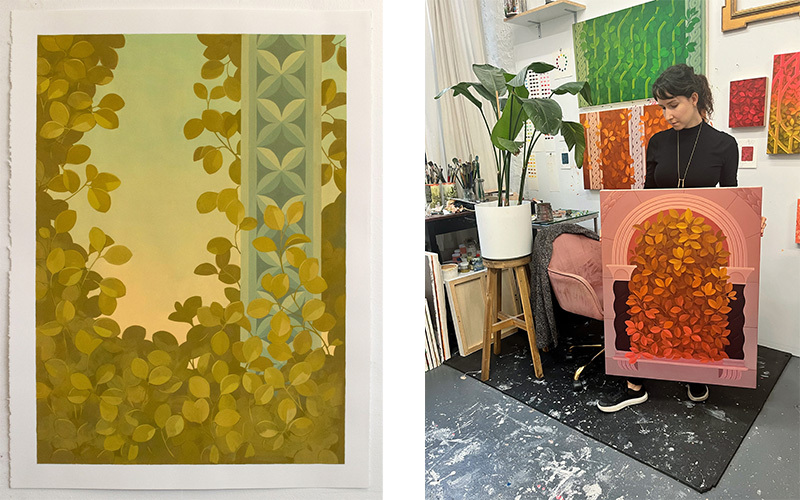
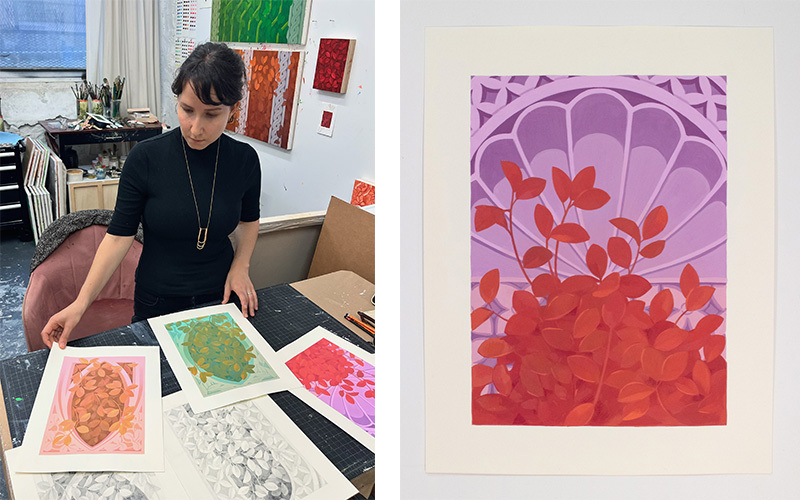 Lucía in her studio, and Untitled (on my way to the holy well III), 2024, gouache on paper.
To Be an Artist, You Have to Make a Statement
Like all artists, Lucía went through a long period of trying to find her authentic voice, trying to boil down her art practice to its essentials. When you’re a student, she thinks that artists should keep an open mind: explore different techniques that interest you and allow yourself to fail so that you can learn more about your medium.
“But at a certain point, it becomes essential to recognize what tools you have, what truly interests you, and how you can use your skills to make a statement through your work,” she advises.
“Being an artist means making a statement,” she says. “Say something you believe in, something that means something to you, and in doing so, you will find your audience.”
When you’re wishy-washy with your art, dabbling in a couple different areas and failing to bring projects to conclusion, the people around you might be encouraging, but they won’t be able to offer much in the way of genuine feedback.
When you take a stand with your work, it will invite the world to engage with your work as serious, principled, and open to authentic responses. All of that can only help you grow as an artist.
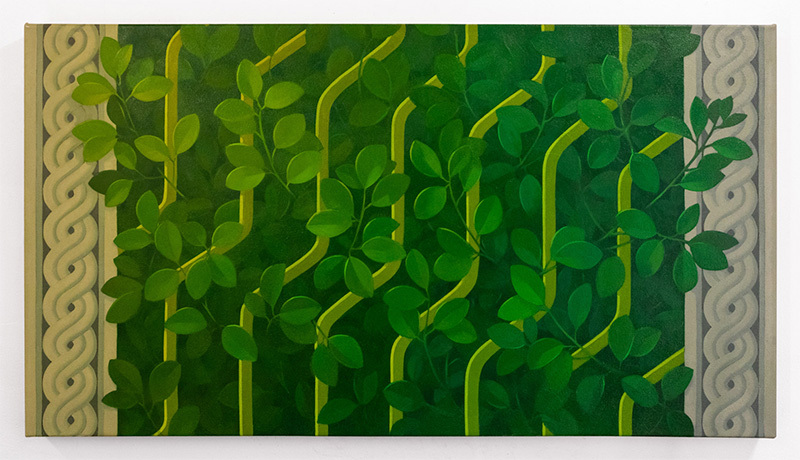 Lucía Rodríguez Pérez, Untitled (garden gate I), 2024, oil on canvas, 22 x 40 x 1.5 in
Make Art Business Admin a Regular Part of Your Studio Practice
Once you’ve found the statement you want to make with your work, you’re well on your way to finding satisfaction through your art. But if you want to find success as a working artist as well, it helps to develop habits of professionalism that will empower you for the rest of your art career.
“Something I had to incorporate into my studio practice was accepting that part of my time would be dedicated to managing my practice,” Lucía recounts.
“Keeping inventory, documenting, and applying for opportunities takes time, and it’s time that has to be dedicated consistently,” she offers. “I still struggle with this sometimes, but it can be very rewarding to see the professional progress that comes from viewing the studio practice as bigger than just drawing or painting.
These days, she invests time not only in making her art, but in ensuring that her art finds its audience. She urges every artist to make time for these practice-supporting tasks: “Look for opportunities, apply, keep an inventory, and present yourself as a professional in every way.”
Because ultimately, the goal is to keep doing what you love: “Investing the time and effort into the business side helps the work go out into the world and allows the practice to sustain itself.”
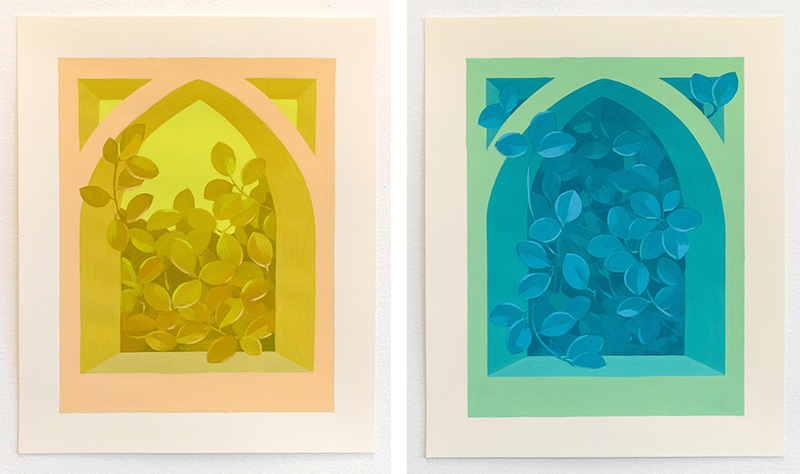 Lucía Rodríguez Pérez, Untitled (niche II), 2024, gouache on paper, and Untitled (niche III), 2024, gouache on paper.
How Lucía Uses Artwork Archive to Run Her Art Business
One way that Lucía ensures she doesn’t spend any more time than she has to on her art business admin is by making it as easy as possible to get all of that work done.
Early in her career, inventorying her work, collecting images, prices, sales, contacts, and all the other details that goes along with a busy artist’s life felt more difficult than it needed to be.
“Over the years I tried to make spreadsheets to keep track of artwork but it always felt difficult to manage and inefficient,” she remembers. “And it is really easy to lose track of pieces or feel like you don’t have enough.”
As she became more confident in her work, she knew she needed to find a better way of running her studio.
“When I wanted to prioritize my art practice and become really professional I knew that big part of taking that step was to have work I could show and share,” she says. “So I decided to do some research and see what services for art inventory were out there.”
Once she found Artwork Archive, it felt like a perfect fit for her needs. “It was a clean design, easy to use, and affordable. And with the different membership levels, I was able to test it first and upgrade whenever my practice advanced and I needed it.”
"One of the features I like the most is being able to create PDF portfolio files for specific projects or clients," she offers. "The platform allows me to easily go through my inventory, find and select specific pieces that I can put together into a PDF file that includes an image an all technical details so I can send them via email or share online."
The end result? "This saves me a ton of time and makes it easy for the gallery or collector to look through the artwork I have available for show or sale."
Looking back, she’s surprised what a change Artwork Archive has brought to her career, in organization, professionalism, and simple peace of mind: “I have been using it for years and the fact that I always keep it up to date is the proof that is the perfect system for me, as it is fully incorporated into my studio practice.”
Artist Reports That Work For You
When Lucía needs to let her gallery or a potential collector know which art she currently has available, she can quickly select the pieces she wants to include and generate a professional PDF report to share in minutes. Learn how Artwork Archive's Reports can simplify your art business admin, then give them a try with a 14-day free trial today.
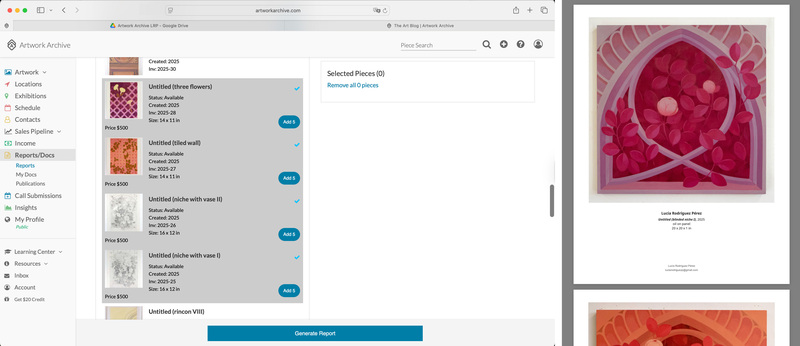 Professional inventory PDFs are a breeze with Artwork Archive's Reports.
If You’re an Artist, You Need to Take Yourself Seriously
Throughout the years of her practice, Lucía has followed a few simple rules: take her own art seriously, and invest the time and energy needed to make it live up to her own standards. Her advice to any artist trying to find their way through the art world is to do the same.
“Something I had to learn early on was that before anyone else sees you as a professional artist, you need to present yourself as one,” she advises. “That means making art and understanding your own practice as professionally as possible, even at the beginning when you don’t yet have an audience.”
It’s a lot of work, but if you really want to be an artist, it’s all worth it in the end.
“You need to make the work first, which requires investing a great deal of time, money, and energy in your studio, even when no one is watching,” she admits.
But, “if you take yourself seriously and make the effort to understand how you and your practice are perceived from an external point of view, you are on the right track to getting the support and attention that will allow your practice to grow.”
For an artist looking to build an art career that keeps them inspired, and is sustainable for the long-term, Lucía Rodríguez Pérez offers a valuable example: the same qualities that serve artistic development—patience, attention to detail, a systematic approach, and a willingness to invest time and energy—also support professional growth. The dream and the discipline aren't opposites but partners in creating work that matters and a career that endures.
 Lucía Rodríguez Pérez, Untitled (sunrise in green), 2025, gouache on paper, 30 x 22 in.
Ready to bring professional organization to your artistic practice like Lucía Rodríguez Pérez? Artwork Archive helps artists manage inventory, create custom portfolios, and present their work professionally—so you can spend less time searching through files and more time creating the work that defines your vision. Start a free 14-day trial today and discover how the right tools can support your artistic journey.