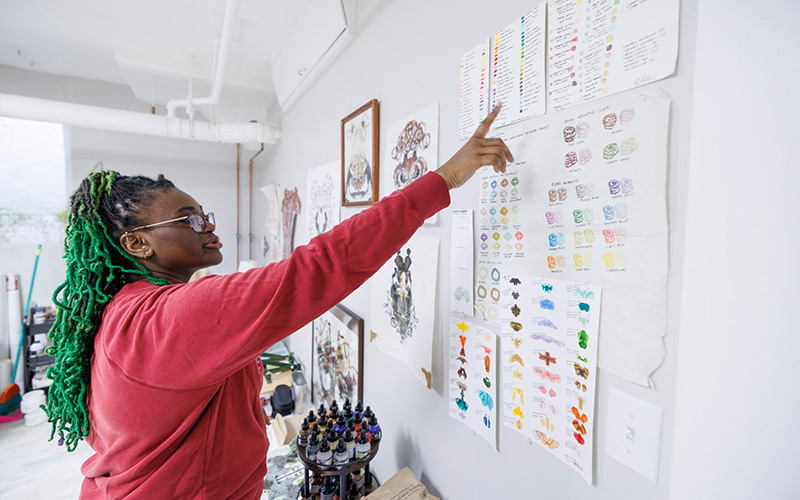
 Featured Artist Alana Walters has turned her fascination with self care and mental health into entrancing artworks. (Image courtesy of AnAPhotography)
“Working with an inkblot test is the perfect start to any project I’m doing; it gives me a randomized image that I can make into anything.”
What do you see in these images? Fascinated with psychology, Featured Artist Alana Walters has transformed the inkblots of traditional Rorschach tests into a tool for exploring self care and mental health within Black communities.
Starting with the symmetry of an inkblot shape, the Philadelphia-based artist adds linocuts of hair braids and other shapes, filling in the gaps or accentuating the outlines of the inkblot, and finishing with fiber or embroidery.
Want to see how Alana Walters turns these psychological tests into compelling commentary on mental health and collective healing? Read on to find out.
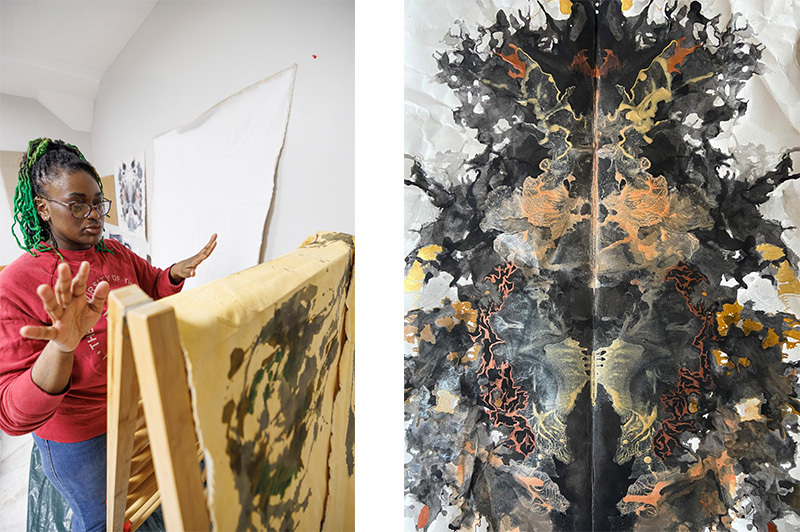 Alana Walters in her Philadelphia studio (image courtesy of AnAPhotography), and Meta, 2024, Acrylic & India Ink and Watercolor on Paper, 27.5 x 20.25 x 0.5 in.
How Alana Turns Mental Health and Puzzles Into Beguiling Artworks
When Alana was growing up, she loved using her mind to figure out solutions.
“There was always something about puzzles, board games, and solving mysteries in movies that took my mind off of my own negative ideations,” she tells Artwork Archive.
Mental health has always been important to her, so when she got to college, she started making art that combined a researcher’s interest in the mind with an artist’s dedication to process. In one early work, she made watercolors based on the brain scans of patients undergoing a study for mental illness.
Researching mental illness with scientific methods has yielded some life-changing treatments, but Alana was interested in the fact that the more we find out about the mind, the more enigmatic it can seem in its workings. An extremely technically advanced image of someone’s brain is a scientific miracle, but can it really illuminate the mysteries of the mind?
So she turned to an older form of mental health diagnosis, one that leaves open much room for interpretation: the inkblot test.
This diagnostic test, developed by the Swiss psychiatrist Hermann Rorschach in the early twentieth century, prompts a patient to express what they see in the ambiguous shapes of a symmetrical inkblot on paper.
Alana takes the basic technique of the inkblot form and elaborates on it with printmaking techniques, fiber embellishments, and other marks to make them her own.
Working with an inkblot as a starting point scratches the same itch that puzzles did for her when she was younger: “it gives me a randomized image that I can make into anything,” she explains. “Approaching my work as a puzzle that I have to solve or mystery I have to work through creates that same sense of peace.”
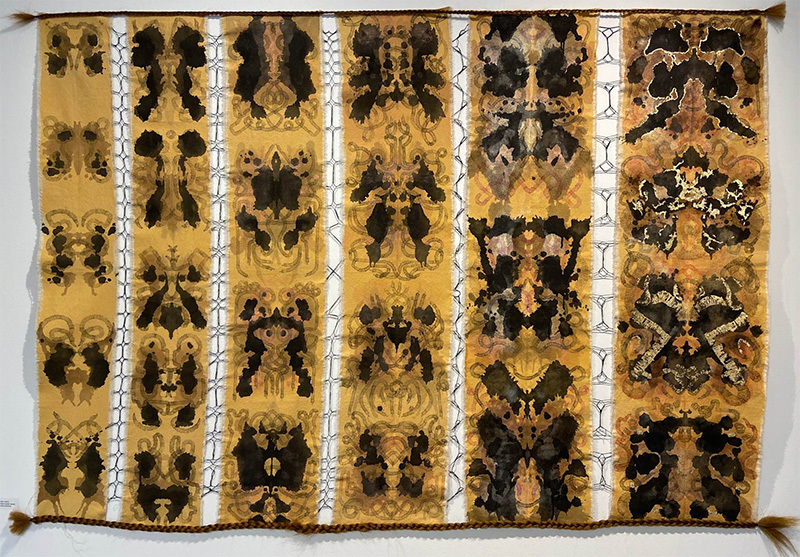 Alana Walters, There’s Levels To This…, 2022, Acrylic Paint, Ink, Black Rubber Bands, Relief Print, Gold Flakes and Hair on Canvas, 64 x 96 x 1 in.
How Hairstyles and Tetris Blocks Inspire Alana’s Artworks
Alana’s process starts simply, with her creating layered inkblots with acrylic ink.
“These pieces can stop at three layers or go to ten depending on my mood,” she shares, “but once I have that base, the options are limitless in terms of what I can do with the silhouettes.”
She takes photos of those silhouettes and brings them into the program Procreate, where she keeps a full archive of all the inkblot shapes she has made. This allows her to easily layer a new shape onto the piece she’s currently working on, to see how an addition will change the direction a piece is heading in.
She then starts adding ink using the custom linocut stamps that she has created. The linocut shapes are inspired by Black hairstyles, particularly braided and cornrowed styles. “The lines, thick and thin, that traveled throughout the scalp to create these beautiful works of hair art is what my linocuts are structurally derived from,” she explains.
To create these stamps, she cuts a printmaking linoleum sheet into connecting shapes, “reminiscent of Tetris blocks.” That way, the pieces connect together when she lays them down on her artworks, creating a flowing, shifting, interlocking arrangement.
From there, she might add layers of fiber, embroidery, paint, or other printmaking into one image until it starts to click for her: “I like to say most of my artwork is never truly complete because if I develop a new skill (currently learning how to pleat), it may end up being added to an already existing piece, no matter how old it is.”
“Ultimately,” Alana offers, “my art aims to foster dialogue about mental health, particularly within Black communities.” She believes a piece is successful if it allows the viewer’s mind "to quiet and focus on something other than the hardships they are facing.”
“In a roundabout way,” she says, “what I get from creating my work is what I want someone to feel when viewing it.”
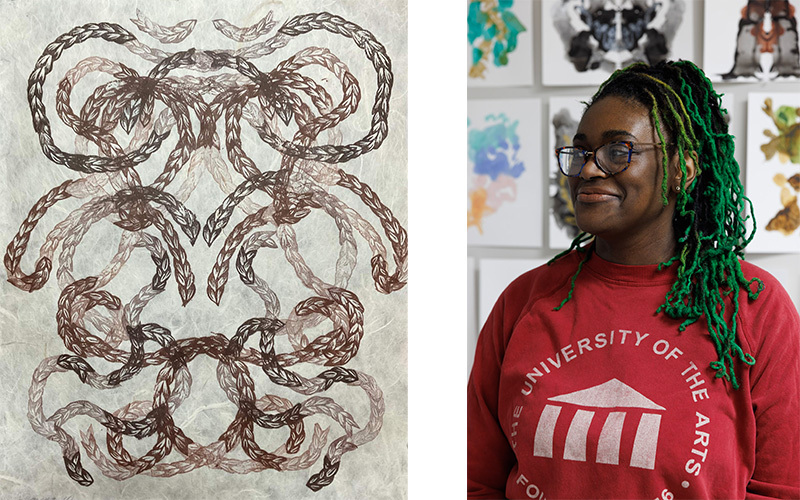 Alana Walters, Not Too Tight, 2024, Relief Printing on Mulberry Paper, 14 x 11 in (photo of the artist courtesy of AnAPhotography)
Why Alana Uses Artwork Archive to Manage Her Art Business
Alana really discovered her artistic voice in college, and she started working with the psychology-inspired methods that she uses today during the last year or so of her art degree. She also got some good advice from a trusted mentor: “I had an amazing teacher in college, Mrs. Michele Kishita, who taught a Professional Practices class” she remembers, “and she introduced us to Artwork Archive.”
At the time, Alana was just starting out in her career, but in the coming years, as she amassed a larger inventory and started being featured in several exhibitions at the same time, she came to a realization: “I needed to really start organizing my art.”
She pulled up her notes from Professor Kishita’s class and remembered all the features that had excited her about Artwork Archive at the time. She started an account, and has never looked back.
Now she uses Artwork Archive regularly to keep her art organized, share her art with galleries and collectors, and most importantly for her, keep her exhibition schedule on track.
“One of my favorite features of Artwork Archive is probably the Exhibition feature,” she says. “It allows you to track certain details about the show like the dates, location, and curators, and lists which pieces of yours were shown.”
Never Forget a Deadline Again
With Artwork Archive's Reminders, you can see your exhibition, art competition and other important dates in one place, add custom to-do's to follow up with important clients, and receive email reminders as deadlines approach.
Best of all, it integrates seamlessly with iCal, GCal, and Outlook, so your calendars will always be in sync. Give all these features a try with a free 14-day trial.
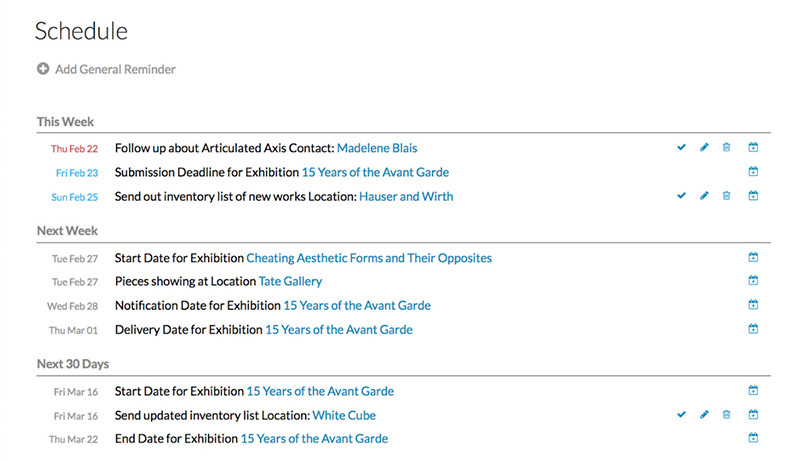 Alana Walters uses Artwork Archive's Schedule feature to track her deadlines and to-do's.
Because she has a busy schedule, having the drop-off and pick-up dates for each show is, in her words “a life saver.” The email reminders keep her on schedule, and ensures that she never leaves any of her work behind.
“Tracking the location in which certain pieces were shown allows for me to not show a piece twice in the same space,” she shares. And she’s gathering valuable information about how her work fares in art markets outside of Philadelphia: “When artwork of mine is sold at an away exhibition, it also gives me insight into that art community and what work succeeds in certain areas of the country.”
It’s seemingly small insights like this that add up to a sustainable art practice and a career pursuing the puzzles she loves.
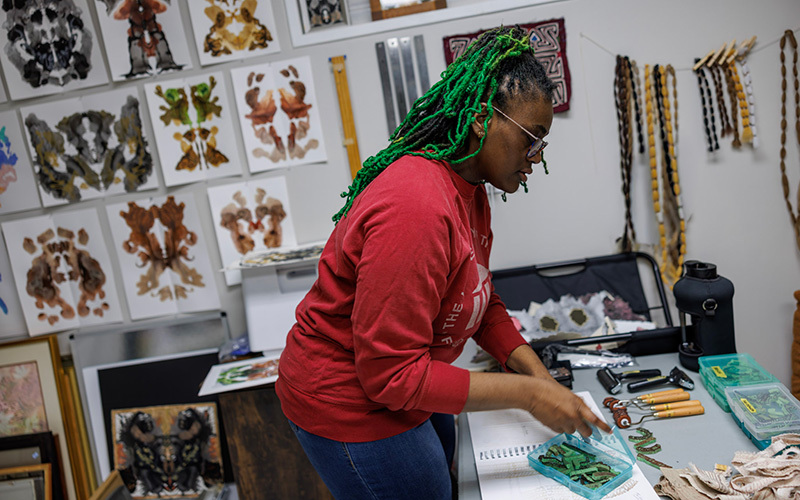 Alana Walters now uses Artwork Archive to track her exhibitions, organize her art inventory, and share her artwork with galleries and collectors. (Image courtesy of AnAPhotography)
Alana’s Advice for Artists: Price Your Work Ambitiously
Like so many artists, when Alana was right out of college, she didn’t have a clear pricing strategy for her art. “In the beginning, I would work on pieces that would take months,” she recalls, “and because I was an emerging artist and felt I would never sell work at a higher price point, I lowballed myself.”
After a few years of doing this and feeling like she couldn’t advance in her art career, she sat down and drew up a price chart for every type of work that she creates. She still sticks with that chart to this day, updating it as materials and other costs rise but staying true to the same original formula.
According to Alana, being honest with yourself about how much time your art takes, and being brave enough to value it accordingly, is one of the most important shifts an artist can make in their practice.
Another lesson she has learned over the years is that applying for new opportunities is not only important to get her name out there, it’s important to help her continue growing as an artist.
“In the art world, if you don’t put yourself out there, you can become stagnant,” she advises. “Betting on yourself and your career involves applying to shows and residencies, marketing yourself, and connecting with your local arts communities.”
Even as you’re building your career, though, “always remember that your work is your own and do not feel pressured to create work that compromises your vision,” she urges. If you can do that, you’ll have cracked the puzzle of a rewarding, sustainable art career.
No matter where you are in your art journey, getting your business side in order doesn’t have to feel overwhelming. A bit of structure now can mean more time and headspace for the work you actually want to be doing.
Artwork Archive helps artists build an online portfolio, stay on top of their inventory, and create things like tear sheets and invoices in just a few clicks. Start a free trial and see how it fits into your own process.