
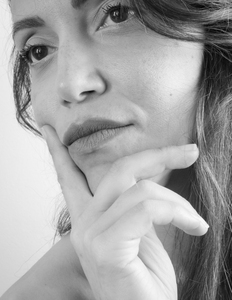
Kerenor was born in 1980, in a hospital famously known as “Le Bois d’Amour”, in a town infamous for the wartime Deportations, Drancy. She spent her childhood near Paris in the department of Seine-Saint-Denis, in the small town of Livry-Gargan.
In 1998, she successfully auditioned for the avant-garde prep school, "Classe d'Approfondissement en Arts Plastiques" (CPES-CAAP PICASSO). This school was founded by the painter-artist and teacher, Charles Galissot, who became her first Art mentor and inspired her commitment to Art and becoming an artist. This year was a formative period for Kerenor that would set the direction of her education.
Kerenor successfully auditioned for several fine art schools throughout France and chose the "Ecole Nationale Supérieure d'Arts de Paris-Cergy" (ENSAPC), the avant-garde school. Her decision was influenced by the school's huge dance studio and facilities for avant-garde improvisation techniques taught by renowned dancers and choreographers.
She moved to the cultural centre of Paris to study Art and lived in an 18m square studio in the 18th arrondissement of Paris, Lamark Caulincourt, near the FEMIS. Kerenor became a frequent visitor to this renowned cinema school for lectures and screenings.
Her body of work, at this time, was in drawing, painting, and sculpture of the human figure. She began writing to annotate the study of the connection between the thinking process and the creative expression of the human form. This developed into a study of dance as an artistic expression using photography and cinematic film techniques to capture drama and the aesthetics of movement.
Kerenor graduated in 2003 with a Master 1, and in 2006 with a Master 2, both awarded with high distinction.
Following this Kerenor considered several paths. Jean-Claude Connessa invited her to enter the post-graduate cinema school Le FRESNOY; she auditioned for a singing and music conservatoire or continue her drama education. Finally, she successfully auditioned and was accepted by Trinity Laban Contemporary Dance school in London for the postgraduate MFA in Dance Studies.
She graduated from Trinity Laban in 2009 awarded the Simone Michell prize for outstanding achievement in choreography. Kerenor followed a career as an international choreographer.
Her movement research and artistic path science were always part of her artistic research, and in 2011, she enrolled in the British Rolfing Academy and graduated in 2014. Giovanni Fellicioni has been her Rolfing mentor since 2007. Kerenor started to use Rolfing principles and techniques in her choreographic process. Giovanni recommended her to look at the work of Russell Maliphant, who is also a Rolfing practitioner. In 2009, he presented
What makes us body as matters and spirit. She was already using writing in her painting as an element of connecting the body with the mind. (Read more)
She auditioned with a body of work of huge painting representing the body in motion, the palimpsest of the mind (writing on painting as a background landscape, using clay, plaster on canvas sometimes as she wanted to express the density of the body on a frail support. And presented some sculptures, a series of feet, and a big installation made of the material of a broken roof she recuperated.
The
Her career as a dreamer started quite early. She was surrounded by four older half-brother from the first marriage of her mum who had to find her way to keep on when her husband left her for another woman while being 8months pregnant of the 4th child. She is the first child, and unique daughter, of her second marriage. She was a miracle for her mum. Unfortunately, her dad who at that time was an ingenious chef in the control and repair of aviation motors, lost his mind when she was 2 years old. From that breaking point, her life changed radically. All the education she could have had dropped into the care of the dad who need till now constant care.
From very early age she questioned what is the mind. As a child she didn’t know such word, but she wanted to understand what’s inside the body. She became a meticulous observer. Not just the human being mouvement and thought, but of all of her surrounding including herself.
This is a very important element to understand her artistic work as well as her extended research around different fields.
She found ressources very early on in her dreamland that was not a fantasy but a playground where she could act with her imagination to build, nurture her true desires extracted from the chaos she was born into.
The complexity of her story can’t be unwinded in a short biography page but she has started to make an artistic work on it in 2000 when she was a first year student at l’ENSAPC. It is called “Gestes de Famille”. A study of grand-father photographs she managed to save after his death. She started to look carefully the details of hands touching things, embraces, love gesture, gaze, human connection, objects that was always present in this part of her family. Her work has grown into the research of what makes us singular in a complex embedded story. There is the story that we know. But she found that there is more clues to who we are in the shadows of the narrative we are telling almost as a fixation of our identity. The analysis of these pictures opened her min to a total new world of the grand-father she never really met as a photographer. She discovered his passion for photography and his fantastic point of view in capturing gestures, or a situation. This work started as a desire to honor this family treasure as the heritage she had left.
She did some pictures of the emptying house to bring a dialogue and keep a trace of that place of memory that she didn’t want to disappear. Of course this was not conscious when she did all of that. I is only 25 years after letting this work in boxes, that she reopened her past. Like a way to let the past mature itself, memory refresh, story dissolve, narrative renew, interpretation too, and meaning can still grow.
People die often with their thoughts. These pictures give a little bit of glimpse into the mind of her dad story. What is the heritage of the silent part do we hold on when it is not our life path to follow? She wanted to become free from all dogma and family patterns. That’s why this work is hugely important. It is in progress since she started two years ago to work on this project.
Powered by Artwork Archive