



- W. H. Grindley & Co.
- Columbia, Rd. 30 May 1882
- Earthenware
- 10.25 x 10.25 in (26.04 x 26.04 cm)
-
Not For Sale
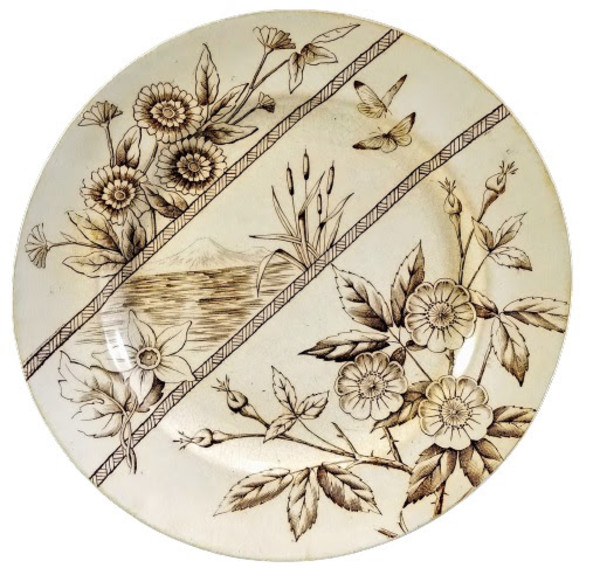
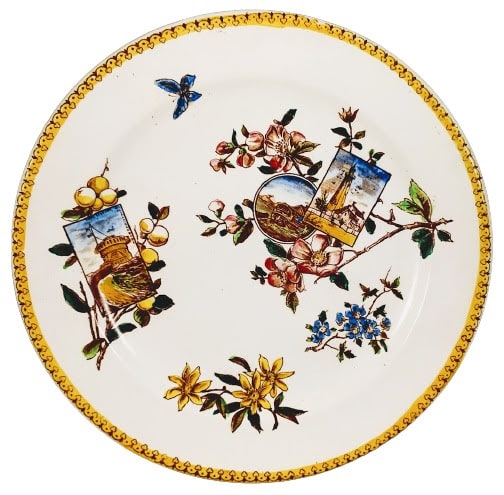
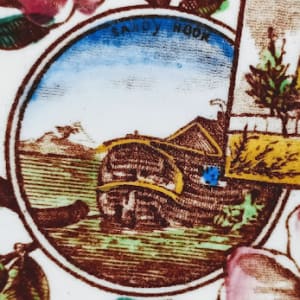
Plate, 10.25 inches diameter. Brown transfer with polychrome clobbering. No maker's mark, but this pattern has been documented as W. H. Grindley & Co.'s "Columbia," registered on 30 May 1882. The three cartouches feature images of places. The large rectangular cartouche on the left features an image of York Redoubt on Halifax Harbor. A redoubt is a fort and the word means “place of retreat.” York Redoubt is a fort situated on a bluff overlooking the entrance to Halifax Harbour at Ferguson's Cove, Nova Scotia, Canada, originally constructed in 1793. The small rectangular cartouche and the round cartouche feature images of Sandy Hook and Sandy Hook Lighthouse in New Jersey, USA. Sandy Hook is a barrier spit in Middletown Township, Monmouth County, New Jersey. The barrier spit is approximately 6 miles in length and about 1 mile wide and is located at the north end of the Jersey Shore. It encloses the southern entrance of Lower New York Bay south of New York City, protecting it from the open waters of the Atlantic Ocean to the east. The Dutch called the area "Sant Hoek," meaning "spit of land." First lit on June 11, 1764, the Sandy Hook Lighthouse is the oldest surviving lighthouse in what is now the United States. Financed by a lottery, it was built by the Colony of New York to keep ships safe as they passed by Sandy Hook on their way to and from New York Harbor. During the American Revolution, its thick walls protected it from cannonball fire from the Continental Army. The British captured the lighthouse in 1776 and held it through the end of the war in 1783. The lighthouse itself was fortified during the War of 1812, when the short-lived Fort Gates was built here. The Lighthouse Keeper's Quarters, built in 1883, is the fifth such quarters built on this site.
W. H. Grindley & Co. was founded at the Newfield Pottery in 1880 by William Harry Grindley (principal partner) and Mr. Turner (the '& Co.') They produced Earthenware and Ironstone China - particularly for the Canadian, United States, South American and Australian markets. In 1891 the company moved to the Woodfield Pottery, Woodland Street, Tunstall.
- Subject Matter: Aesthetic (Cartouche)
- Collections: Aesthetic Transferware, W. H. Grindley & Co.