
Kanyer Art Collection
The Kanyer Art Collection and Historical Archive of Collage owned by Doug and Laurie Kanyer
Message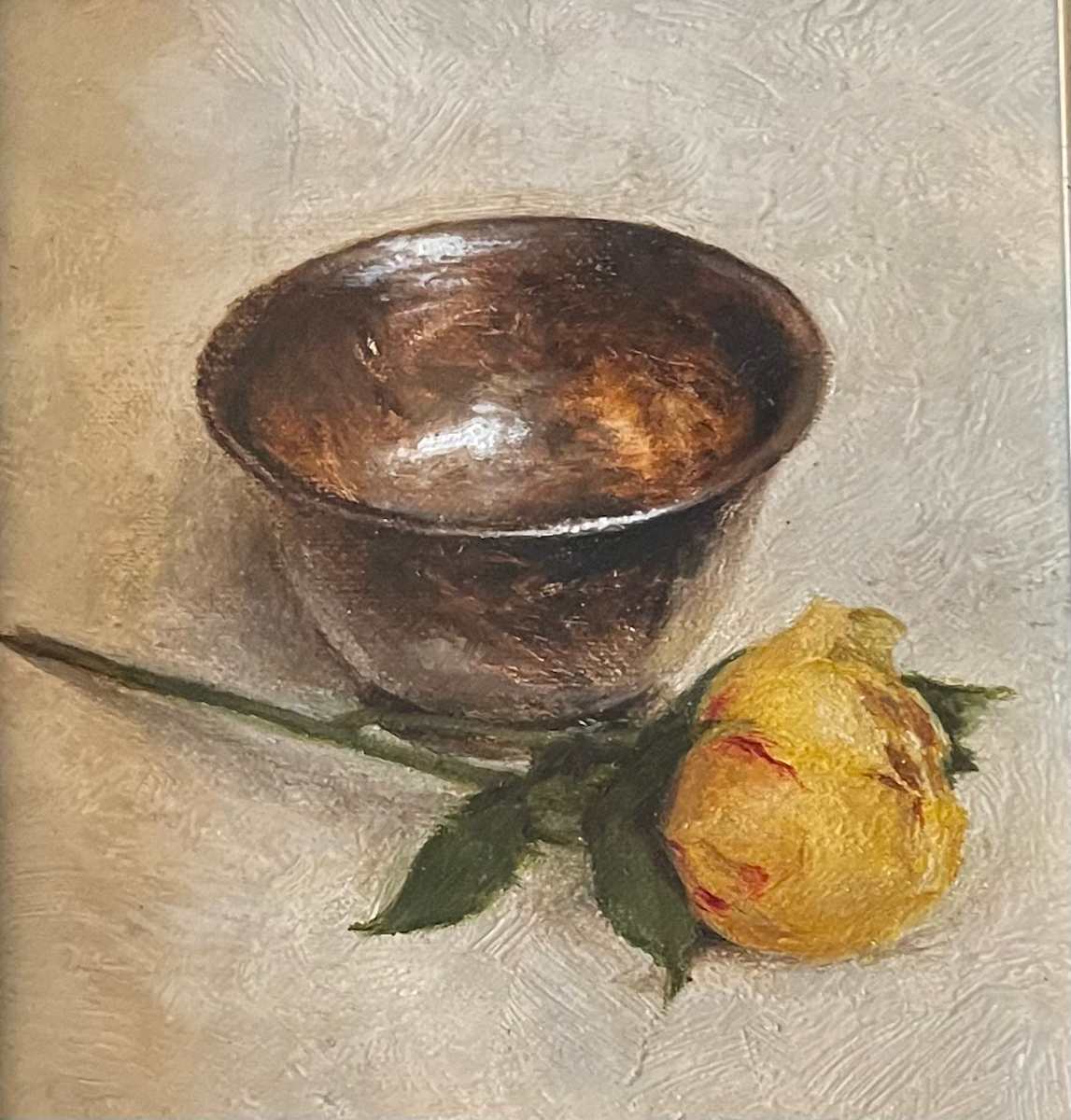
Bev Byrnes is a studio artist in Seattle, Washington. Her creative process is grounded in an exploration of direct perception arising from the collapse of assumed subject/object relationships. As boundaries between subject and object dissolve the phenomena of Presence becomes amplified. It is this Presence which directly guides and shapes the direction of the work. She can be reached at bevabyrnes@ gmail.com.
Article by Pat Muir, Yakima Herald July 2015
A still-life painting of a blouse on a hook has no right to be
compelling.
But there’s Seattle artist Bev Byrnes’ painting of a blouse on a
hook, and here we are compelled. The painting doesn’t “say”
anything — well, anything except “Blouse,” its plainly stated title—
and still it demands attention and consideration. Part of that is the
apparent effort and Byrnes’ mastery of technique. The oil painting
easily could be mistaken for a photograph, such is her precision
and attention to detail.
But a bigger part of the work’s appeal, and a key to all of the work
that Byrnes will exhibit in the Yakima Light Project show “Light and
Stillness” that opens this evening, is that the more you look at it,
the more you realize it captures things a photograph never could.
Byrnes, a 50-year-old Yakima native, imbues her work with a
quality of light that doesn’t actually occur in the real world. Or if it
does, it’s fleeting, there for an instant and gone before you can
even name it. That she’s able to create that quality, to seemingly
capture light itself, in still lifes is what makes “Blouse” compelling.
There’s meaning in the painting, inasmuch as it may mean
something specific to any person who sees it, but the only quoteunquote message in it is its own aesthetic quality.
“I’m not a conceptual painter,” Byrnes said in an interview late last
month. “I’m drawn to what I find beautiful.”
Her work, along with that of Vashon Island painter Erin Schulz,
makes up the exhibit, which will hang at the Yakima Valley
Museum through Sept. 30. Like Byrnes, Schulz is a Yakima native
who paints still lifes.
Their paintings are strictly literal. If there is a philosophical or
symbolic meaning to them at all, it has to do with notions of direct
perception and representation. Yet, owing largely to how each of
them creates and uses light, there is enough depth to the work to
hold a viewer’s eye long enough for careful consideration.
The style is ideal for the Yakima Light Project’s mission, said
Yesenia Hunter, director of the light project. She didn’t select the
artists for this show — that was up to previous director Laurie
Kanyer — but Hunter was immediately taken with the work.
“I came in as director with work already set before me,” Hunter
said. “Once I contacted Bev and talked with her and then saw
some of her work, I was thrilled.”
In addition to both artists having grown up in Yakima, with an
understanding of the way the area’s abundant sunlight colors life,
Byrnes’ work actually includes pieces of the Yakima Valley and
other places she’s visited. Literal pieces — she makes her own oil
paints, using pigments from materials she grinds by hand.
“It means much more to work with material you’ve made with your
own hands,” Byrnes said.
That includes rocks, sulfur, corroded metal, mercury — anything
from which she can draw color and texture. And the fact that she
makes the paint herself means she can manipulate and customize
those elements to suit very specific needs. Hand-ground
pigments, for instance, have a different texture than uniformly
ground pigments when they’re added to oil.
“It’s a whole different feel,” Byrnes said. “I do think there’s a glow
to it. There’s something different about it.”
To Andy Granitto, the museum’s curator of exhibits, that level of
artist participation at every step of the process is intriguing.
“In the old days, that was a whole skill people learned,” Granitto
said of Byrnes’ paint-making. “It can provide depth and luminosity.”
The museum is hosting this Light Project exhibit because the Light
Project Gallery lost its home in The Seasons Performance Hall
last month when The Seasons’ board voted to end the partnership
amid financial uncertainty. Kanyer and Hunter have pledged to
keep the project’s mission going and are working to find homes for
future shows.
“If you think about light, you never know where light is going to
show up,” Kanyer said.