
The process of bronze casting is truly fascinating — and quite involved. It all begins with a sketch of the proposed artwork, followed by the creation of an armature, which serves as the internal support structure for the sculpture. Once the armature is complete, the original clay sculpture is built over it.
When the sculpture is finished, a silicone mold is carefully applied over the clay. For more intricate pieces, multiple molds may be required to capture every detail. A plaster or fiberglass “mother mold” is then created to reinforce the silicone. Once both are cured, the mold is opened, and the clay original is removed. The silicone and plaster molds are then reassembled, forming a perfect cavity of the sculpture’s shape.
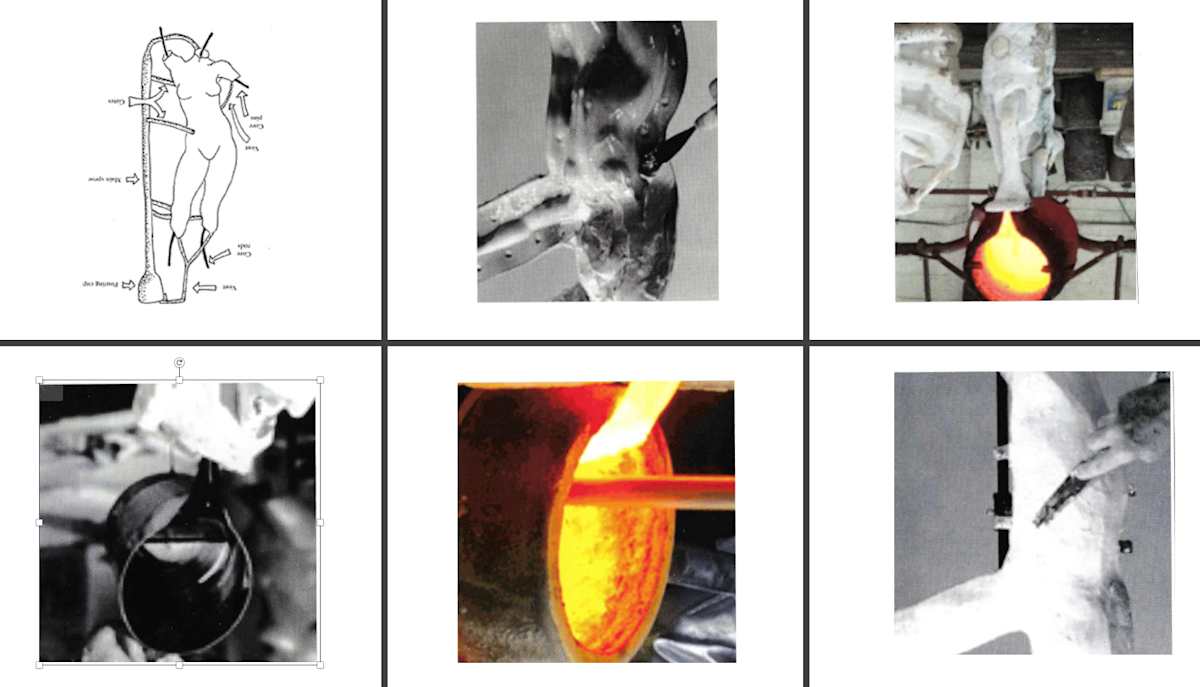
Next, melted wax is poured into the mold to create a hollow wax replica of the piece. When the wax hardens, it’s removed and meticulously inspected to eliminate any imperfections. Wax sprues and gates are added — these act as channels that will later guide the molten bronze and allow air to escape during casting.
The wax model is then repeatedly dipped into a ceramic slurry and coated with silica sand to build a hard ceramic shell — a process that takes about two weeks, as each layer must dry before the next is applied. Once complete, the wax is melted out, leaving behind a hollow ceramic mold ready for the bronze.
The bronze, heated to roughly 2,200°F, is poured into the ceramic shell. After cooling, the shell is carefully broken away to reveal the raw bronze sculpture inside. The piece then undergoes sandblasting, welding, and polishing to refine its final form.
The last stage is the patina — the coloring applied through controlled oxidation using heat and various chemicals to achieve the desired tone and finish. A clear protective coating is added, and the sculpture is finally ready to find its new home.
From start to finish, the entire process can take anywhere from three to six months, depending on the complexity of the piece.
- Collections: advertising