
- Bovey Tracey Pottery Co.
- Richmond, c. 1880
- Earthenware
- 11.5 in (29.21 cm)
-
Not For Sale
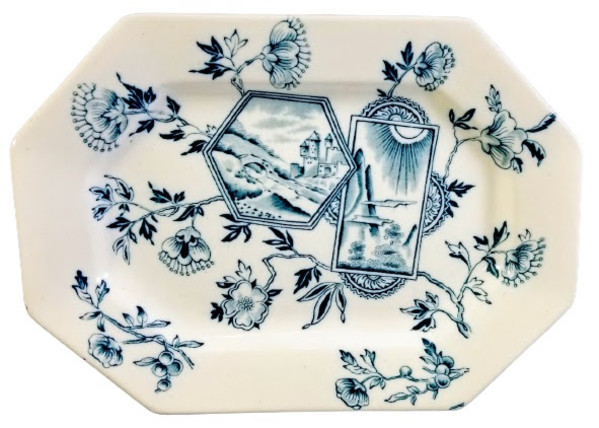
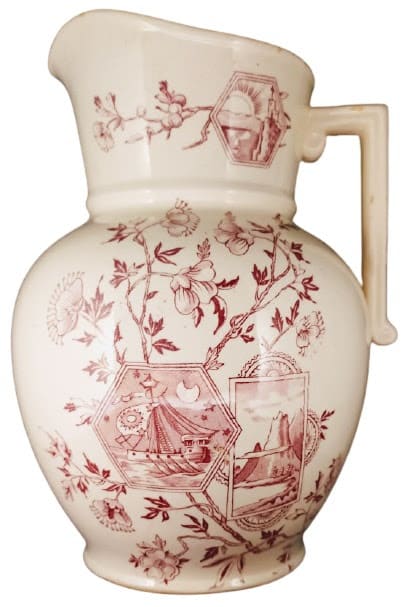
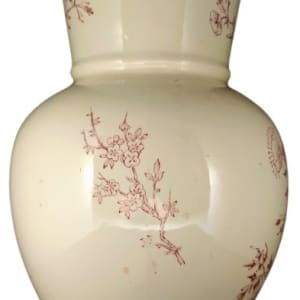
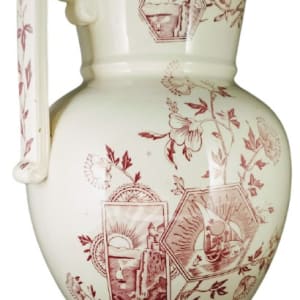
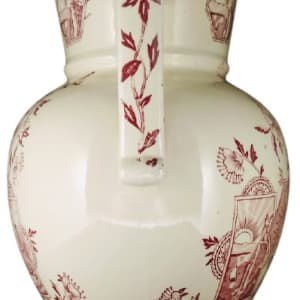
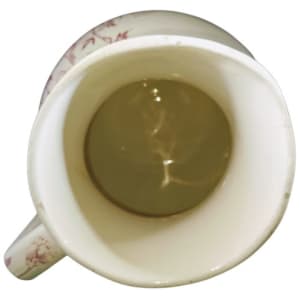
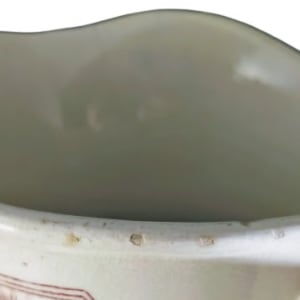
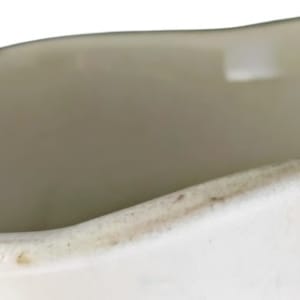
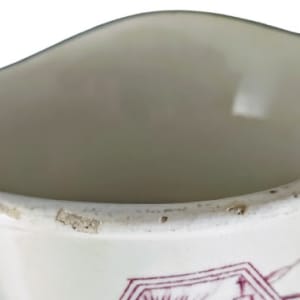
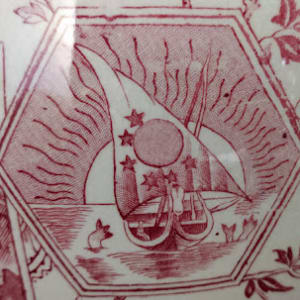
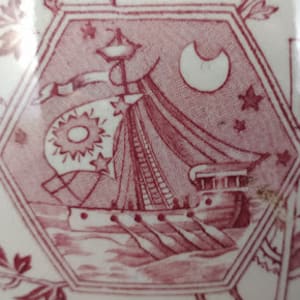
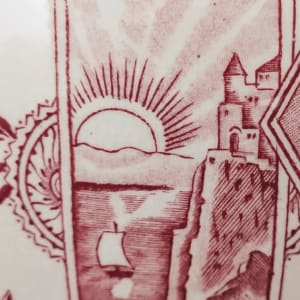
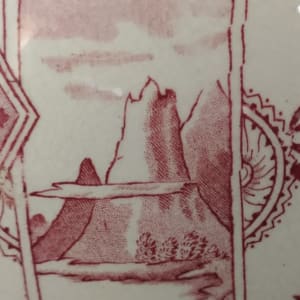
Pitcher, 11.5 inches tall. Red transfer. Maker is the Bovey Tracey Pottery Co. This fantastical pattern features a collection of cartouches laid over woody branches with small leaves and stylized flowers. One one side a hexagonal cartouche features a galley ship with sun and stars decorating the sail and a trailing pennant sailing under a moonlit sky. It sits next to a vertical rectangular cartouche bordered by half circles infilled with geometric designs and featuring three tall mountains next to a body of water with low-hanging clouds. The other side of the pitcher features a hexagonal cartouche depicting a Viking-style ship with a sail decorated by moon and stars and a setting sun in the background. Three tails of presumably whales can be seen breaching on either side of the ship. This cartouche is paired with another vertical rectangular cartouche bordered by decorated half circles featuring a castle perched on the edge of a tall cliff, overlooking the sea with a sailboat and the sun on the horizon in the background. The border consists of two motifs on either side: a hexagonal cartouche with the castle on cliff scene superimposed over a small flowering branch. The front of the pitcher is decorated with a branch of stylized flowers and the handle is decorated with a trailing vine of leaves.
The first pottery at Bovey Tracey was not on the site of the present pottery known under this name, but was carried on in some houses, which are parish property, near the modern railway station. The house is at present a carpenter's shop, and is at a corner just where the road turns off to the Bovey Heathfield. Tradition states that this pottery had mills to grind materials close to Bovey Bridge, and the remains of a mill and water-wheel existed on the left bank of the stream up to 1844. These works were carried on by a family of the name of Ellis; they were probably commenced in the earlier half of the 18th century and certainly were in work in 1755, and lasted for thirty years after that period. Nothing certain is known of the character of the ware of this first attempt at Bovey Tracey. Clay pipes are said to have been made, and jugs of a yellow body which are attributed to this period are to be found in houses in the neighborhood.
In 1842 the Bovey Pottery was purchased by two Devonshire gentlemen, Captain Buller and Mr. J. Divett, who enlarged the works, and obtained the lignite from underground workings. The supply of this substance, however, proving insufficient for the increased requirements of the manufacture, ordinary coal was substituted in its stead; and after the opening of a railway to the works, Somersetshire coal has been used to the entire exclusion of the lignite. The works were still carried on by Messrs. Buller and Divett, under the style of the “Bovey Tracey Pottery Company.” In general character they were similar to those of the pottery district, and on the average five glost-ovens were fired each week. The ware consisted of all the ordinary services and articles in white, printed, and colored wares, and was principally supplied to the home markets in the West of England, and to Mediterranean ports.
- Subject Matter: Aesthetic (Cartouche)
- Collections: Aesthetic Transferware, Bovey Tracey Pottery Co.