



- Pinder, Bourne & Co.
- Cluny, c. 1862-1882
- Earthenware
- 8.75 x 6.4 in (22.23 x 16.26 cm)
-
Not For Sale
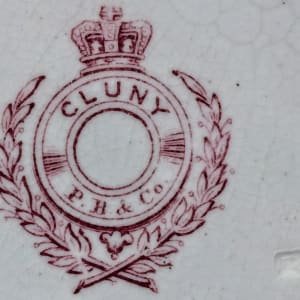
Footed platter, 8.75 x 6.4 inches. Red transfer. Printed maker's mark for Pinder, Bourne & Co. The impressed registry diamond is indecipherable. This pattern speaks to the Victorian fascination with medieval history and design. While the central oval consists of a simple stylized floral motif set within a checkered band, the border is much more complex. It features two alternating panels filled with pairs of mythical monsters and additional stylized floral motifs. Perhaps the pattern name here is a reference to the medieval Cluny abbey in France, which would have featured carved images of monsters and demons, like many other medieval European religious structures.
The partners were Thomas Shadford Pinder and Joseph Harvey Bourne. Thomas Pinder had previously operated from the Swan Bank Works from 1848 and the Fountain Place Works from c. 1852. In 1851 he was joined by two partners and they operated as Pinder, Bourne and Hope (Thomas Pinder, Joseph Harvey Bourne, and John Hope). In 1860 they moved to the already existing Nile Street Works. In 1862 Mr. Hope left the partnership and stayed at the Fountain Place Works - the Nile street works continued as Pinder, Bourne & Co. At some time, Joseph Bourne left the business. The '& Co.' were John Harris and Ernest Joban Berg. In 1877 notice for liquidation by arrangement was made by Thomas Shadford Pinder, John Harris, and Ernest Joban Berg, co-partners of Pinder, Bourne & Co. In 1877 Henry Doulton, of the Lambeth (London) pottery company Doulton & Co., was approached by Pinder, proposing he become a partner in the firm of Pinder, Bourne and Co. for an outlay of £12,000, but the money was unwisely spent and differences of opinion caused such a rift between the two concerns that only arbitration could resolve the matter. Pinder retired and Henry Doulton continued with the business. The name of Pinder, Bourne & Co. continued to be used until 1882 when it became Doulton & Co. Ltd.
- Subject Matter: Medieval Inspired
- Collections: Aesthetic Transferware, Pinder, Bourne & Co.